Pierce Gary L, Kalil Graziela Z, Ajibewa Tiwaloluwa, Holwerda Seth W, Persons Jane, Moser David J, Fiedorowicz Jess G
Department of Health and Human Physiology, College of Liberal Arts and Sciences, The University of Iowa, Iowa City, Iowa, USA.
Abboud Cardiovascular Research Center, The University of Iowa, Iowa City, Iowa, USA.
Obesity (Silver Spring). 2017 Feb;25(2):286-289. doi: 10.1002/oby.21698. Epub 2016 Dec 21.
Anxious and depressive states are associated with increased cardiovascular disease (CVD) risk and a proinflammatory phenotype, although the latter appears to be at least partially explained by adiposity. It was hypothesized that depression and anxiety would be associated with elevated inflammation independent of adiposity in persons with obesity at high risk of CVD.
This study explored the relation between baseline anxiety as measured by the Beck Anxiety Inventory and depression as measured by the Beck Depression Inventory-II and baseline serum c-reactive protein (CRP) in a cross-sectional sample of 100 participants [mean (SD) age 57.8 (7.7) years; 64% female] with obesity [mean (SD) body mass index, BMI 37.3 (5.5) kg/m ] enrolled in a clinical trial for pharmacological weight loss.
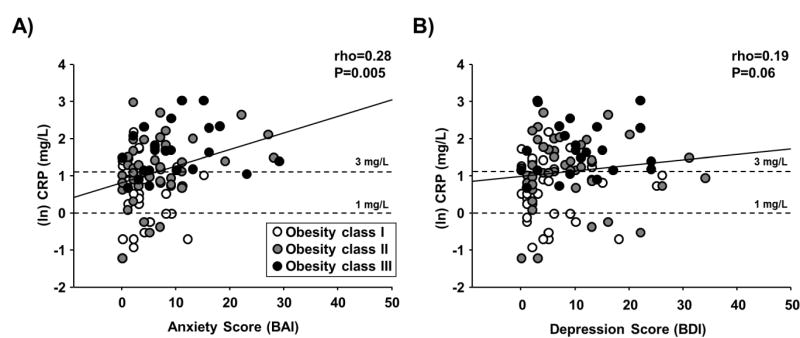
Beck Anxiety Inventory, but not Beck Depression Inventory-II, scores were significantly correlated with CRP (ρ = 0.28, P = 0.005). BMI was also highly correlated with CRP (ρ = 0.42, P < 0.0001). In multivariate models, the relation between anxiety and CRP remained significant (P = 0.038), independent of BMI, age, and sex.
Anxiety, but not depression, was associated with elevated inflammation in persons with obesity beyond that attributable to higher BMI. Further study is warranted to assess whether anxiety represents a potential therapeutic target to mitigate corresponding CVD risk associated with elevated inflammation in persons with obesity.
焦虑和抑郁状态与心血管疾病(CVD)风险增加及促炎表型相关,尽管后者似乎至少部分可由肥胖来解释。研究假设,在具有高CVD风险的肥胖人群中,抑郁和焦虑与独立于肥胖的炎症升高有关。
本研究在100名参与者的横断面样本中,探讨了用贝克焦虑量表测量的基线焦虑与用贝克抑郁量表第二版测量的抑郁之间的关系,以及基线血清C反应蛋白(CRP)水平。这些参与者[平均(标准差)年龄57.8(7.7)岁;64%为女性]患有肥胖症[平均(标准差)体重指数,BMI 37.3(5.5)kg/m²],均参加了一项药物减肥临床试验。
贝克焦虑量表得分与CRP显著相关(ρ = 0.28,P = 0.005),而贝克抑郁量表第二版得分与CRP无显著相关性。BMI也与CRP高度相关(ρ = 0.42,P < 0.0001)。在多变量模型中,焦虑与CRP之间的关系仍然显著(P = 0.038),独立于BMI、年龄和性别。
在肥胖人群中,焦虑而非抑郁与超出较高BMI所致的炎症升高有关。有必要进一步研究以评估焦虑是否代表一个潜在的治疗靶点,以减轻肥胖人群中与炎症升高相关联的相应CVD风险。