Tromer Eelco, Bade Debora, Snel Berend, Kops Geert J P L
Hubrecht Institute-KNAW (Royal Netherlands Academy of Arts and Sciences), Uppsalalaan 8, 3584 CT, Utrecht, The Netherlands.
Theoretical Biology and Bioinformatics, Department of Biology, Science Faculty, Utrecht University, 3584 CH, Utrecht, The Netherlands.
Open Biol. 2016 Dec;6(12). doi: 10.1098/rsob.160315.
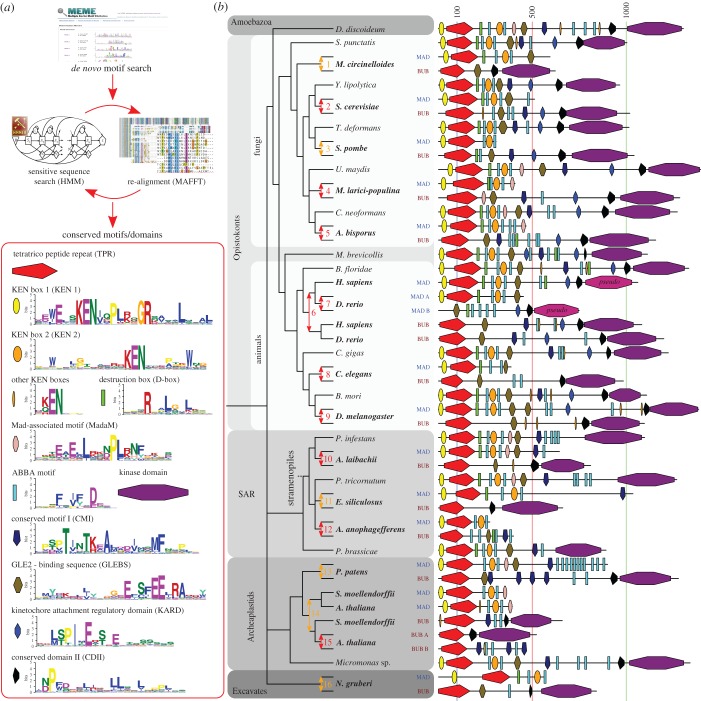
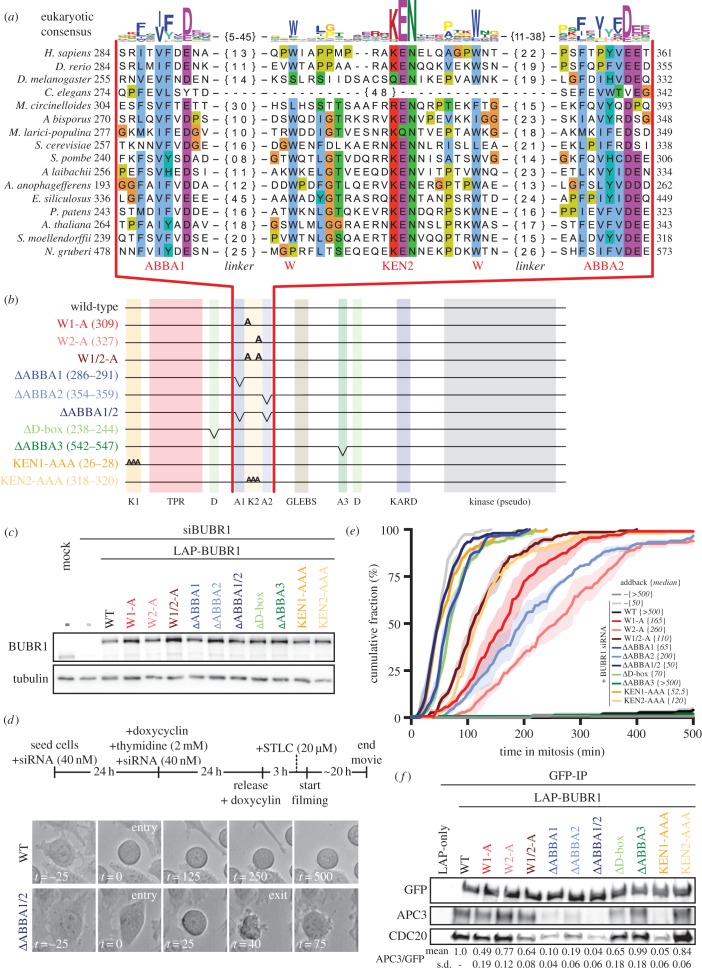
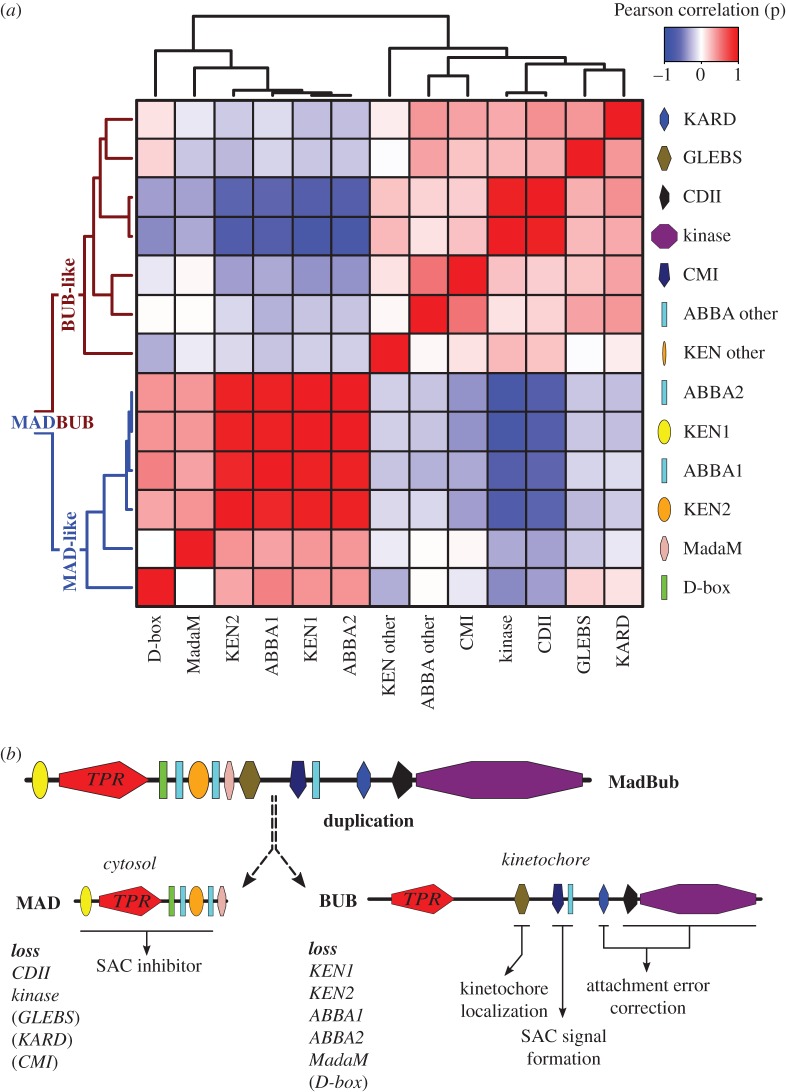
The spindle assembly checkpoint (SAC) maintains genomic integrity by preventing progression of mitotic cell division until all chromosomes are stably attached to spindle microtubules. The SAC critically relies on the paralogues Bub1 and BubR1/Mad3, which integrate kinetochore-spindle attachment status with generation of the anaphase inhibitory complex MCC. We previously reported on the widespread occurrences of independent gene duplications of an ancestral 'MadBub' gene in eukaryotic evolution and the striking parallel subfunctionalization that lead to loss of kinase function in BubR1/Mad3-like paralogues. Here, we present an elaborate subfunctionalization analysis of the Bub1/BubR1 gene family and perform de novo sequence discovery in a comparative phylogenomics framework to trace the distribution of ancestral sequence features to extant paralogues throughout the eukaryotic tree of life. We show that known ancestral sequence features are consistently retained in the same functional paralogue: GLEBS/CMI/CDII/kinase in the Bub1-like and KEN1/KEN2/D-Box in the BubR1/Mad3-like. The recently described ABBA motif can be found in either or both paralogues. We however discovered two additional ABBA motifs that flank KEN2. This cassette of ABBA1-KEN2-ABBA2 forms a strictly conserved module in all ancestral and BubR1/Mad3-like proteins, suggestive of a specific and crucial SAC function. Indeed, deletion of the ABBA motifs in human BUBR1 abrogates the SAC and affects APC/C-Cdc20 interactions. Our detailed comparative genomics analyses thus enabled discovery of a conserved cassette of motifs essential for the SAC and shows how this approach can be used to uncover hitherto unrecognized functional protein features.
纺锤体组装检验点(SAC)通过阻止有丝分裂细胞分裂的进程,直至所有染色体都稳定地附着于纺锤体微管,从而维持基因组的完整性。SAC关键依赖于旁系同源物Bub1和BubR1/Mad3,它们将动粒-纺锤体附着状态与后期抑制复合物MCC的产生整合在一起。我们之前报道了在真核生物进化过程中,一个祖先“MadBub”基因广泛发生独立基因复制,以及导致BubR1/Mad3样旁系同源物激酶功能丧失的显著平行亚功能化现象。在此,我们对Bub1/BubR1基因家族进行了详尽的亚功能化分析,并在比较系统基因组学框架下进行从头序列发现,以追踪祖先序列特征在整个真核生物生命树中现存旁系同源物中的分布。我们发现,已知的祖先序列特征始终保留在相同的功能旁系同源物中:Bub1样中的GLEBS/CMI/CDII/激酶结构域,以及BubR1/Mad3样中的KEN1/KEN2/D-Box结构域。最近描述的ABBA基序可在其中一个或两个旁系同源物中找到。然而,我们发现了另外两个位于KEN2两侧的ABBA基序。这个ABBA1-KEN2-ABBA2模块在所有祖先蛋白和BubR1/Mad3样蛋白中形成了一个严格保守的模块,提示其具有特定且关键的SAC功能。事实上,删除人类BUBR1中的ABBA基序会消除SAC并影响APC/C-Cdc20相互作用。因此,我们详细的比较基因组学分析能够发现对SAC至关重要的保守基序模块,并展示了这种方法如何用于揭示迄今未被认识的功能性蛋白质特征。