Tantry Thrivikrama Padur, Karanth Harish, Shenoy Sunil P, Ayya Shreekantha V, Shetty Pramal K, Adappa Karunakara K
Department of Anaesthesiology, A J Institute of Medical Sciences and Research Centre, Kuntikana, Mangalore, Karnataka, India.
Department of Urology, A J Institute of Medical Sciences and Research Centre, Kuntikana, Mangalore, Karnataka, India.
Indian J Anaesth. 2016 Dec;60(12):939-947. doi: 10.4103/0019-5049.195488.
Hypotensive anaesthesia reduces intra-articular bleed and promotes visualisation during arthroscopy. The haemodynamic effects of inhalational agents isoflurane and sevoflurane were studied extensively, and both were found to reduce mean arterial pressures (MBP) to an equivalent magnitude. We investigated the relative ability of isoflurane vis-a-vis sevoflurane to maintain the target systolic blood pressure (SBP) in patients undergoing shoulder arthroscopic procedures.
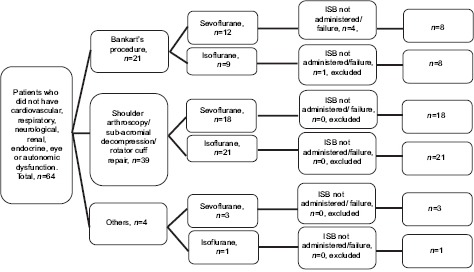
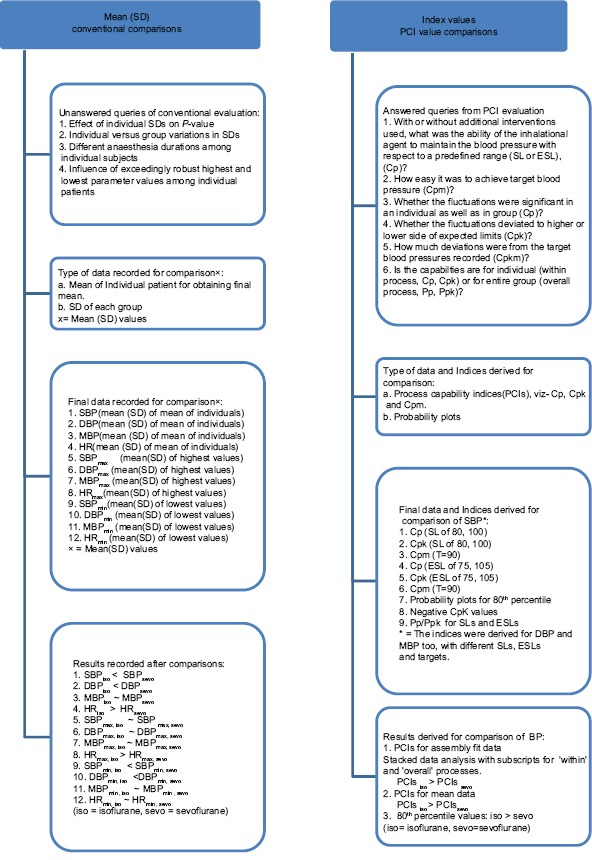
In a prospective randomised study, 59 patients in two groups of 30 and 29 patients each received concomitant general anaesthesia (1.2-1.5 MAC of isoflurane and sevoflurane) and interscalene brachial plexus block. Nitrous oxide was used in both groups. Intraoperatively, serial blood pressure recordings of SBP, diastolic blood pressure (DBP), MBP and heart rates were done at every 3 min intervals. The manipulations needed to achieve target SBP ( = 90 mmHg) for optimal arthroscopic visualisation and treat unacceptable hypotensive episodes were noted. Conventional statistical tests and process capability index (PCI) evaluation were both deployed for data analysis.
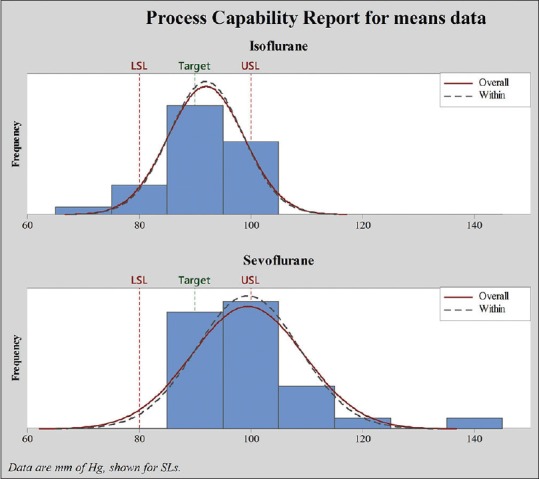
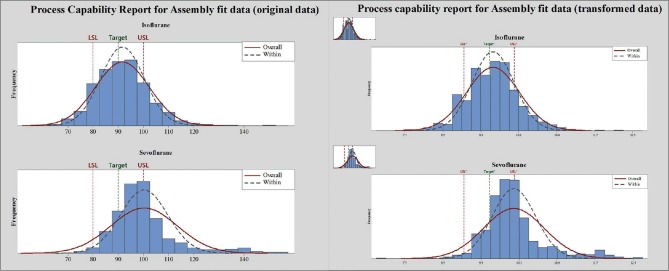
Lower mean SBP and DBPs were recorded for isoflurane patients as compared to sevoflurane ( < 0.05, for mean, maximum and minimum recordings). Higher mean heart rates were recorded for isoflurane ( < 0.05). PCIs indicated that isoflurane was superior to sevoflurane in the ease of achieving target SBP of 90 mmHg as well as maintaining blood pressures in the range of 80-100 mmHg.
Isoflurane provides better intraoperative haemodynamic status vis-a-vis sevoflurane in patients undergoing shoulder arthroscopic surgery with preliminary interscalene blockade. The PCI can be a useful additional medical data analysis tool.
低血压麻醉可减少关节内出血并有助于关节镜检查时的视野显示。吸入麻醉药异氟烷和七氟烷的血流动力学效应已得到广泛研究,发现二者均可使平均动脉压(MBP)降低至同等程度。我们研究了在接受肩关节镜手术的患者中,异氟烷相对于七氟烷维持目标收缩压(SBP)的相对能力。
在一项前瞻性随机研究中,两组患者分别为30例和29例,共59例,均接受全身麻醉(异氟烷和七氟烷1.2 - 1.5 MAC)联合肌间沟臂丛神经阻滞。两组均使用氧化亚氮。术中每隔3分钟记录一次SBP、舒张压(DBP)、MBP和心率的系列血压值。记录为实现最佳关节镜视野所需达到的目标SBP(= 90 mmHg)以及治疗不可接受的低血压发作所需的操作。采用传统统计检验和过程能力指数(PCI)评估进行数据分析。
与七氟烷组相比,异氟烷组患者的平均SBP和DBP更低(平均值、最大值和最小值记录均P < 0.05)。异氟烷组的平均心率更高(P < 0.05)。PCI表明,在达到90 mmHg的目标SBP以及将血压维持在80 - 100 mmHg范围内方面,异氟烷优于七氟烷。
在接受初步肌间沟阻滞的肩关节镜手术患者中,相对于七氟烷,异氟烷可提供更好的术中血流动力学状态。PCI可作为一种有用的额外医学数据分析工具。