Zemore Sarah E, Kaskutas Lee Ann, Mericle Amy, Hemberg Jordana
Alcohol Research Group, Emeryville, CA.
Alcohol Research Group, Emeryville, CA.
J Subst Abuse Treat. 2017 Feb;73:16-26. doi: 10.1016/j.jsat.2016.10.004. Epub 2016 Oct 6.
Many studies suggest that participation in 12-step groups contributes to better recovery outcomes, but people often object to such groups and most do not sustain regular involvement. Yet, research on alternatives to 12-step groups is very sparse. The present study aimed to extend the knowledge base on mutual help group alternatives for those with an alcohol use disorder (AUD), sampling from large, active, abstinence-focused groups including Women for Sobriety (WFS), LifeRing, and SMART Recovery (SMART). This paper presents a cross-sectional analysis of this longitudinal study, using baseline data to describe the profile and participation characteristics of attendees of these groups in comparison to 12-step members.
Data from participants 18 and over with a lifetime AUD (N=651) were collected using Web-based surveys. Members of alternative 12-step groups were recruited in collaboration with group directors, who helped publicize the study by emailing meeting conveners and attendees and posting announcements on social media. A comparison group of current (past-30-day) 12-step attendees was recruited from an online meeting hub for recovering persons. Interested parties were directed to a Webpage where they were screened, and eligible participants completed an online survey assessing demographic and clinical variables; in-person and online mutual help involvement; and group satisfaction and cohesion. Analyses involved comparing those identifying WFS, SMART, and LifeRing as their primary group to 12-step members on the above characteristics.
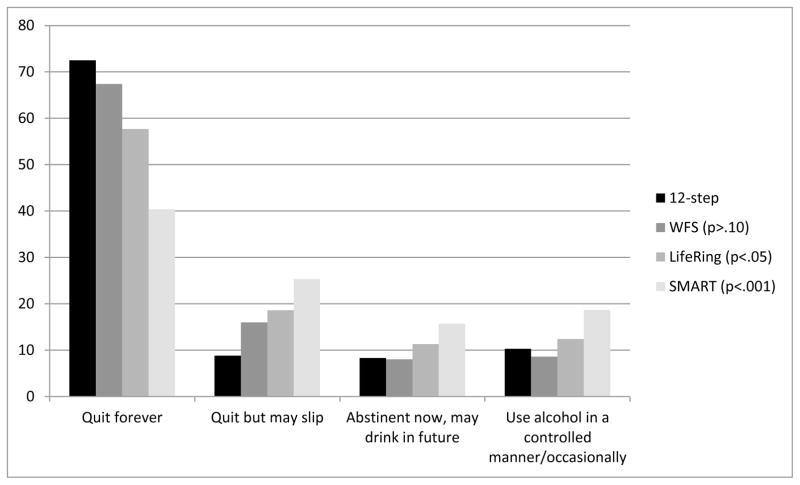
Compared to 12-step members, members of the mutual help alternatives were less religious and generally higher on education and income. WFS and LifeRing members were also older, more likely to be married, and lower on lifetime drug and psychiatric severity; meanwhile, LifeRing and SMART members were less likely to endorse the most stringent abstinence goal. Finally, despite lower levels of in-person meeting attendance, members of all the 12-step alternatives showed equivalent activity involvement and higher levels of satisfaction and cohesion, compared to 12-step members.
Results suggest differences across 12-step groups and their alternatives that may be relevant when advising clients on a choice of mutual help group. Meanwhile, findings for high levels of participation, satisfaction, and cohesion among members of the mutual help alternatives suggest promise for these groups in addressing addiction problems.
许多研究表明,参与12步团体有助于取得更好的康复效果,但人们常常对这类团体持反对态度,而且大多数人无法持续定期参与。然而,关于12步团体替代方案的研究非常稀少。本研究旨在扩充关于酒精使用障碍(AUD)患者互助团体替代方案的知识库,从大型、活跃、专注于戒酒的团体中抽样,包括清醒女性组织(WFS)、戒酒互诫会(LifeRing)和理性康复会(SMART Recovery,简称SMART)。本文呈现了这项纵向研究的横断面分析,使用基线数据来描述这些团体参与者的概况和参与特征,并与12步团体成员进行比较。
使用基于网络的调查收集了651名18岁及以上有终生酒精使用障碍的参与者的数据。与替代12步团体的负责人合作招募团体成员,他们通过给会议召集人和参与者发送电子邮件以及在社交媒体上发布公告来协助宣传这项研究。从一个面向康复者的在线会议中心招募了一个当前(过去30天内)参加12步团体的对照组。感兴趣的人被引导至一个网页进行筛选,符合条件的参与者完成一项在线调查,评估人口统计学和临床变量、面对面和在线互助参与情况以及团体满意度和凝聚力。分析包括在上述特征方面,将那些将WFS、SMART和LifeRing视为主要团体的人与12步团体成员进行比较。
与12步团体成员相比,互助替代团体的成员宗教信仰程度较低,教育程度和收入总体较高。WFS和LifeRing的成员年龄也更大,更有可能已婚,终生药物滥用和精神疾病严重程度较低;与此同时,LifeRing和SMART的成员不太可能认可最严格的戒酒目标。最后,尽管面对面会议的出席率较低,但与12步团体成员相比,所有12步替代团体的成员都表现出同等程度的活动参与以及更高的满意度和凝聚力。
结果表明12步团体及其替代方案存在差异,在为客户提供互助团体选择建议时这些差异可能具有相关性。同时,互助替代团体成员的高参与度、满意度和凝聚力的研究结果表明这些团体在解决成瘾问题方面具有潜力。