Zhao Ren, Cai Zhen, Li Sheng, Cheng Yong, Gao Hua, Liu Fang, Wu Shiyang, Liu Suyan, Dong Yan, Zheng Lei, Zhang Wenbin, Wu Xiaojun, Yao Xueqing
Department of General Surgery, Ruijin Hospital, Shanghai Jiaotong University School of Medicine, Shanghai, China.
Department of Laboratory Medicine, Sino-UK Circulating Biomarkers' Exploration and Detection Center, Nanfang Hospital, Southern Medical University, Guangzhou, China.
Oncotarget. 2017 Feb 7;8(6):9293-9302. doi: 10.18632/oncotarget.14065.
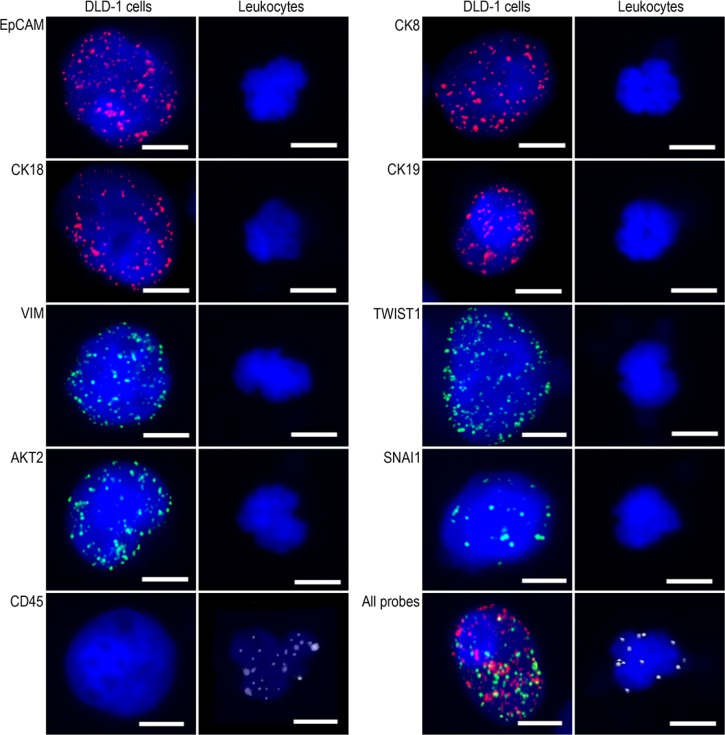
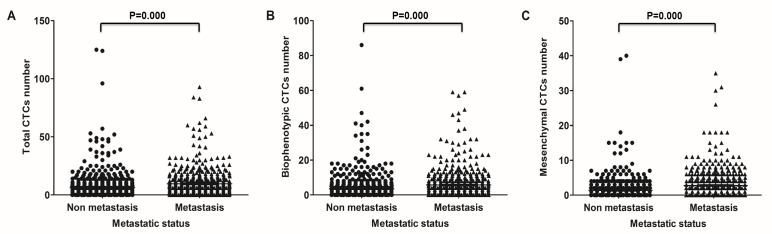
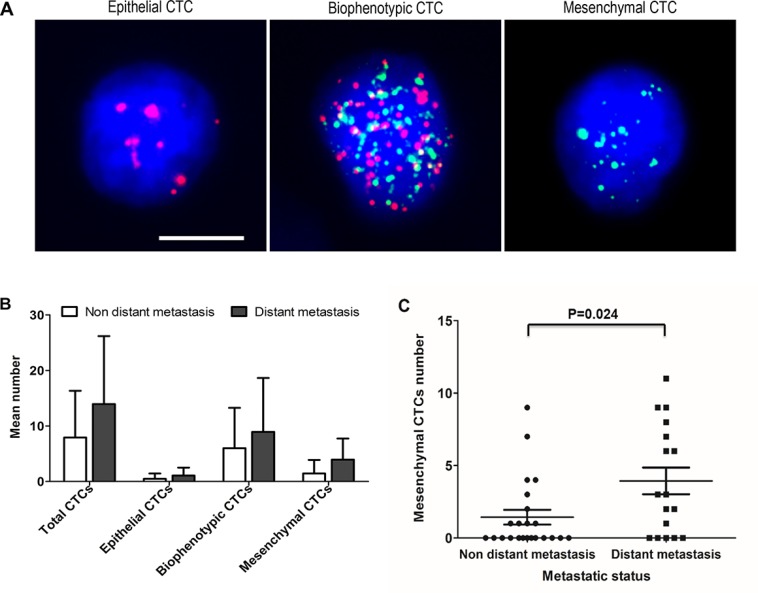
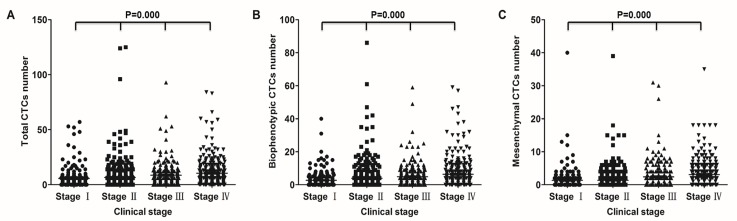
Circulating tumor cells (CTCs) with phenotypic hallmarks of epithelial-mesenchymal transition (EMT) reportedly contribute to tumor metastasis in different cancer types. We therefore evaluated the expression of EMT markers in CTCs obtained from a large cohort of Chinese patients with colorectal cancer (CRC) and investigated their clinical relevance. The CanPatrolTM CTC enrichment technique was used to isolate and classify CTCs. CTCs were detected in 1046 of 1203 patients (86.9%), and three phenotypes were identified based on the expression of epithelial and mesenchymal markers: epithelial CTCs, biophenotypic (epithelial/mesenchymal) CTCs, and mesenchymal CTCs. Total CTC numbers positively correlated with both clinical stage and lymph node metastasis and distant metastasis. Furthermore, both biophenotypic and mesenchymal, but not epithelial, CTCs, correlated with the above parameters, suggesting CTCs displaying a mesenchymal phenotype denote more aggressive disease and metastatic potential. This is the first study to demonstrate a significant correlation between CTCs displaying a mesenchymal phenotype and both clinical stage and metastasis in a large cohort of patients with CRC. Our findings suggest that assessment of not only epithelial, but also mesenchymal markers in CTC analyses may offer valuable assistance for tumor staging and metastasis evaluation in patients with CRC.
据报道,具有上皮-间质转化(EMT)表型特征的循环肿瘤细胞(CTC)在不同类型癌症中促进肿瘤转移。因此,我们评估了从一大群中国结直肠癌(CRC)患者中获取的CTC中EMT标志物的表达,并研究了它们的临床相关性。采用CanPatrolTM CTC富集技术分离和分类CTC。在1203例患者中的1046例(86.9%)检测到CTC,并根据上皮和间质标志物的表达确定了三种表型:上皮性CTC、双表型(上皮/间质)CTC和间质性CTC。总CTC数量与临床分期、淋巴结转移和远处转移均呈正相关。此外,双表型和间质性CTC(而非上皮性CTC)与上述参数相关,提示表现为间质性表型的CTC预示疾病更具侵袭性和转移潜能。这是第一项在一大群CRC患者中证明表现为间质性表型的CTC与临床分期和转移之间存在显著相关性的研究。我们的研究结果表明,在CTC分析中不仅评估上皮标志物,而且评估间质标志物可能为CRC患者的肿瘤分期和转移评估提供有价值的帮助。