Lee Mi Ji, Chung Jong-Won, Ahn Myung-Ju, Kim Seonwoo, Seok Jin Myoung, Jang Hye Min, Kim Gyeong-Moon, Chung Chin-Sang, Lee Kwang Ho, Bang Oh Young
Department of Neurology, Samsung Medical Center, Sungkyunkwan University School of Medicine, Seoul, Korea.
Department of Medicine, Samsung Medical Center, Sungkyunkwan University School of Medicine, Seoul, Korea.
J Stroke. 2017 Jan;19(1):77-87. doi: 10.5853/jos.2016.00570. Epub 2016 Dec 12.
Patients with active cancer are at an increased risk for stroke. Hypercoagulability plays an important role in cancer-related stroke. We aimed to test whether 1) hypercoagulability is a predictor of survival, and 2) correction of the hypercoagulable state leads to better survival in patients with stroke and active cancer.
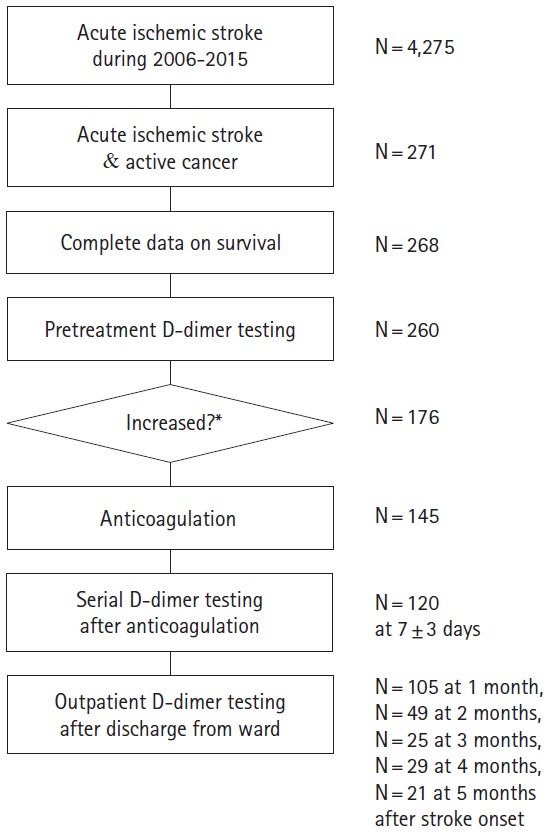
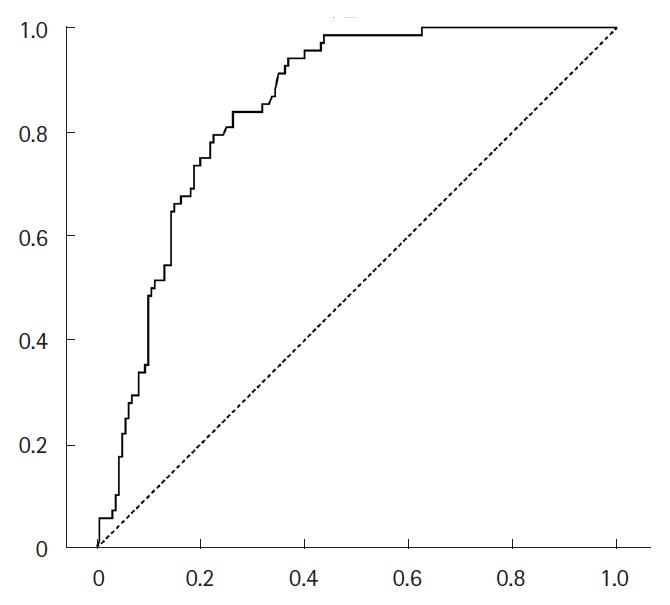
We recruited consecutive patients with acute ischemic stroke and active systemic cancer between January 2006 and July 2015. Hypercoagulability was assessed using plasma D-dimer levels before and after 7 days of anticoagulation treatment. The study outcomes included overall and 1-year survival. Plasma D-dimer levels before and after treatment were tested in univariate and multivariate Cox regression models. We controlled for systemic metastasis, stroke mechanism, age, stroke severity, primary cancer type, histology, and atrial fibrillation using the forward stepwise method.
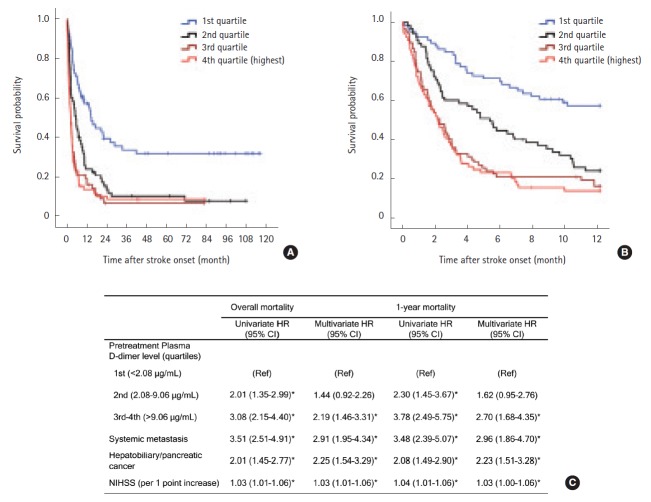
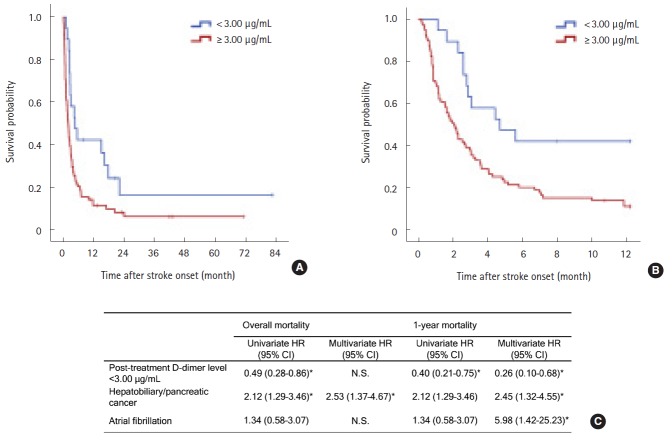
A total of 268 patients were included in the analysis. Patients with high (3rd-4th quartiles) pre-treatment plasma D-dimer levels showed decreased overall and 1-year survival (adjusted HR, 2.19 [95% CI, 1.46-3.31] and 2.70 [1.68-4.35], respectively). After anticoagulation treatment, post-treatment D-dimer level was significantly reduced and independently associated with poor 1-year survival (adjusted HR, 1.03 [95% CI, 1.01-1.05] per 1 μg/mL increase, =0.015). The successful correction of hypercoagulability was a protective factor for 1-year survival (adjusted HR 0.26 [CI 0.10-0.68], =0.006).
Hypercoagulability is associated with poor survival after stroke in patients with active cancer. Effective correction of hypercoagulability may play a protective role for survival in these patients.
活动性癌症患者发生卒中的风险增加。高凝状态在癌症相关性卒中中起重要作用。我们旨在检验:1)高凝状态是否为生存的预测因素;2)纠正高凝状态是否能使卒中合并活动性癌症患者获得更好的生存。
我们纳入了2006年1月至2015年7月期间连续的急性缺血性卒中和活动性全身癌症患者。在抗凝治疗7天前后,使用血浆D - 二聚体水平评估高凝状态。研究结局包括总体生存和1年生存。在单变量和多变量Cox回归模型中对治疗前后的血浆D - 二聚体水平进行检验。我们采用向前逐步法对全身转移、卒中机制、年龄、卒中严重程度、原发性癌症类型、组织学和心房颤动进行了控制。
共有268例患者纳入分析。治疗前血浆D - 二聚体水平处于高值(第3 - 4四分位数)的患者总体生存和1年生存均降低(校正风险比分别为2.19 [95%可信区间,1.46 - 3.31]和2.70 [1.68 - 4.35])。抗凝治疗后,治疗后D - 二聚体水平显著降低,且与1年生存率低独立相关(每增加1μg/mL校正风险比为1.03 [95%可信区间,1.01 - 1.05],P = 0.015)。成功纠正高凝状态是1年生存的保护因素(校正风险比0.26 [可信区间0.10 - 0.68],P = 0.006)。
高凝状态与活动性癌症患者卒中后的不良生存相关。有效纠正高凝状态可能对这些患者的生存起到保护作用。