Adam Abdulfatah, Jensen Jørgen D
Department of Food and Resource Economics, University of Copenhagen, Rolighedsvej 25, DK-1958, Frederiksberg, Denmark.
BMC Public Health. 2016 Dec 28;16(1):1247. doi: 10.1186/s12889-016-3985-x.
The Prevalence of obesity and overweight has been increasing in many countries. Many factors have been identified as contributing to obesity including the food environment, especially the access, availability and affordability of healthy foods in grocery stores and supermarkets. Several interventions have been carried out in retail grocery/supermarket settings as part of an effort to understand and influence consumption of healthful foods. The review's key outcome variable is sale/purchase of healthy foods as a result of the interventions. This systematic review sheds light on the effectiveness of food store interventions intended to promote the consumption of healthy foods and the methodological quality of studies reporting them.
Systematic literature search spanning from 2003 to 2015 (inclusive both years), and confined to papers in the English language was conducted. Studies fulfilling search criteria were identified and critically appraised. Studies included in this review report health interventions at physical food stores including supermarkets and corner stores, and with outcome variable of adopting healthier food purchasing/consumption behavior. The methodological quality of all included articles has been determined using a validated 16-item quality assessment tool (QATSDD).
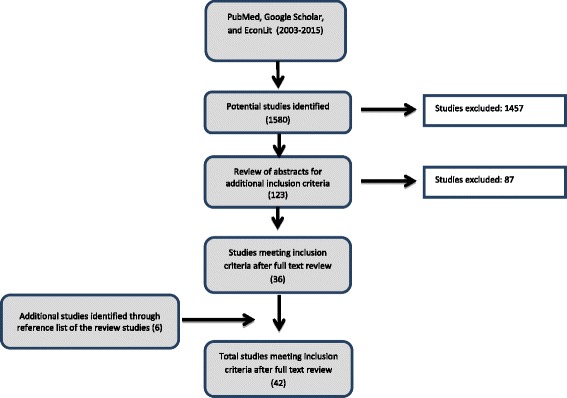
The literature search identified 1580 publications, of which 42 met the inclusion criteria. Most interventions used a combination of information (e.g. awareness raising through food labeling, promotions, campaigns, etc.) and increasing availability of healthy foods such as fruits and vegetables. Few used price interventions. The average quality score for all papers is 65.0%, or an overall medium methodological quality. Apart from few studies, most studies reported that store interventions were effective in promoting purchase of healthy foods.
Given the diverse study settings and despite the challenges of methodological quality for some papers, we find efficacy of in-store healthy food interventions in terms of increased purchase of healthy foods. Researchers need to take risk of bias and methodological quality into account when designing future studies that should guide policy makers. Interventions which combine price, information and easy access to and availability of healthy foods with interactive and engaging nutrition information, if carefully designed can help customers of food stores to buy and consume more healthy foods.
许多国家肥胖和超重的患病率一直在上升。已确定许多因素会导致肥胖,包括食物环境,尤其是杂货店和超市中健康食品的可及性、可得性和可承受性。作为了解和影响健康食品消费努力的一部分,已在零售杂货店/超市环境中开展了多项干预措施。该综述的关键结果变量是干预措施导致的健康食品销售/购买情况。本系统综述揭示了旨在促进健康食品消费的食品店干预措施的有效性以及报告这些措施的研究的方法学质量。
进行了从2003年至2015年(包括这两年)的系统文献检索,且仅限于英文论文。确定并严格评估符合检索标准的研究。本综述纳入的研究报告了在实体食品店(包括超市和街角商店)进行的健康干预措施,其结果变量为采用更健康的食品购买/消费行为。已使用经过验证的16项质量评估工具(QATSDD)确定了所有纳入文章的方法学质量。
文献检索共识别出1580篇出版物,其中42篇符合纳入标准。大多数干预措施采用了信息(例如通过食品标签、促销活动、宣传运动等提高认识)和增加水果和蔬菜等健康食品的可得性相结合的方式。很少使用价格干预措施。所有论文的平均质量得分是65.0%,即总体方法学质量为中等。除了少数研究外,大多数研究报告称商店干预措施在促进健康食品购买方面是有效的。
鉴于研究环境多样,尽管部分论文存在方法学质量方面的挑战,但我们发现店内健康食品干预措施在增加健康食品购买方面是有效的。研究人员在设计未来研究时需要考虑偏倚风险和方法学质量,这些研究应能为政策制定者提供指导。如果精心设计,将价格、信息以及健康食品的便捷获取和可得性与互动且引人入胜的营养信息相结合的干预措施,有助于食品店顾客购买和消费更多健康食品。