Department of Anatomy & Neurobiology, University of Kentucky, Lexington, Kentucky, USA.
Sanders Brown Center on Aging, University of Kentucky, Lexington, Kentucky, USA.
J Neurointerv Surg. 2018 Jan;10(1):29-33. doi: 10.1136/neurintsurg-2016-012793. Epub 2016 Dec 28.
Nitroglycerin (also known as glyceryl trinitrate (GTN)), a vasodilator best known for treatment of ischemic heart disease, has also been investigated for its potential therapeutic benefit in ischemic stroke. The completed Efficacy of Nitric Oxide in Stroke trial suggested that GTN has therapeutic benefit with acute (within 6 hours) transdermal systemic sustained release therapy.
To examine an alternative use of GTN as an acute therapy for ischemic stroke following successful recanalization.
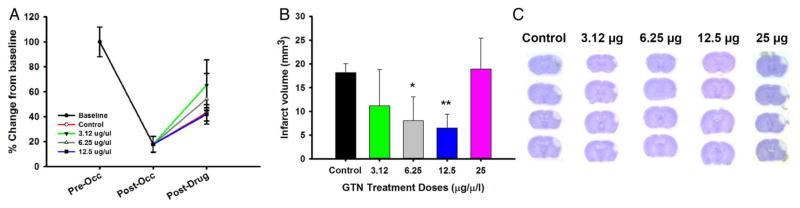
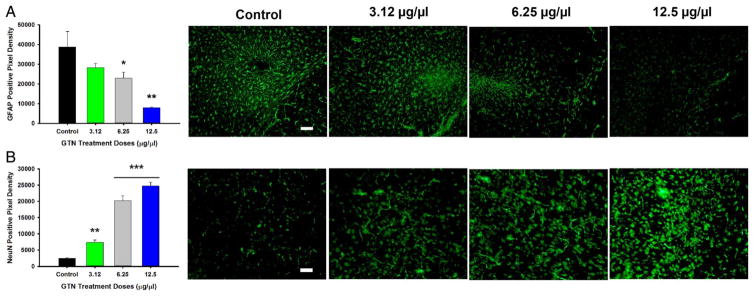
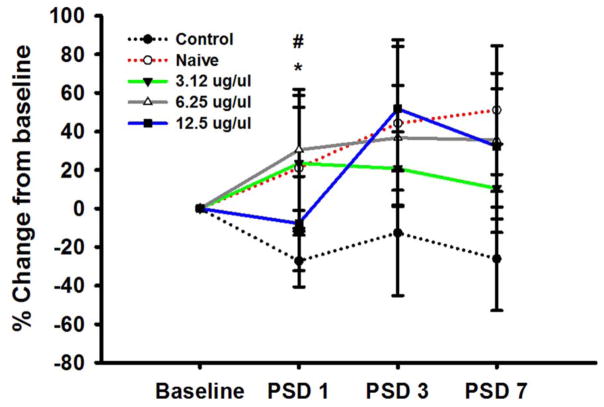
We administered GTN IA following transient middle cerebral artery occlusion in mice. Because no standard dose of GTN is available following emergent large vessel occlusion, we performed a dose-response (3.12, 6.25, 12.5, and 25 µg/µL) analysis. Next, we looked at blood perfusion (flow) through the middle cerebral artery using laser Doppler flowmetry. Functional outcomes, including forced motor movement rotor rod, were assessed in the 3.12, 6.25, and 12.5 µg/µL groups. Histological analysis was performed using cresyl violet for infarct volume, and glial fibrillary activating protein (GFAP) and NeuN immunohistochemistry for astrocyte activation and mature neuron survival, respectively.
Overall, we found that acute post-stroke IA GTN had little effect on vessel dilatation after 15 min. Functional analysis showed a significant difference between GTN (3.12 and 6.25 µg/µL) and control at post-stroke day 1. Histological measures showed a significant reduction in infarct volume and GFAP immunoreactivity and a significant increase in NeuN.
These results demonstrate that acute IA GTN is neuroprotective in experimental ischemic stroke and warrants further study as a potentially new stroke therapy.
硝酸甘油(也称为三硝酸甘油酯(GTN))是一种血管扩张剂,主要用于治疗缺血性心脏病,也因其在缺血性中风中的潜在治疗益处而受到研究。已完成的一氧化氮在中风中的疗效试验表明,GTN 具有治疗作用,其急性(6 小时内)经皮全身持续释放治疗效果最佳。
研究 GTN 作为急性治疗缺血性中风的新方法,即针对成功再通的缺血性中风患者。
我们在小鼠短暂性大脑中动脉闭塞后进行 GTN 鞘内给药。由于没有针对大血管闭塞的 GTN 标准剂量,因此我们进行了剂量反应(3.12、6.25、12.5 和 25μg/μL)分析。接下来,我们使用激光多普勒血流仪评估大脑中动脉的血流灌注(流量)。在 3.12、6.25 和 12.5μg/μL 组中评估了强制运动旋转杆等功能结果。使用 cresyl violet 进行组织学分析,评估梗死体积,并用胶质纤维酸性蛋白(GFAP)和神经元特异性核蛋白(NeuN)免疫组织化学分别评估星形胶质细胞激活和成熟神经元存活情况。
总的来说,我们发现急性中风后鞘内 GTN 在 15 分钟后对血管扩张作用不大。功能分析显示 GTN(3.12 和 6.25μg/μL)与对照组在中风后第 1 天有显著差异。组织学测量显示梗死体积和 GFAP 免疫反应显著减少,NeuN 显著增加。
这些结果表明,急性 IA GTN 在实验性缺血性中风中具有神经保护作用,值得进一步研究作为一种潜在的新的中风治疗方法。