Gendle Mathew H
PhD., Department of Psychology, Elon University, Elon, NC, USA.
Mens Sana Monogr. 2016 Jan-Dec;14(1):141-151. doi: 10.4103/0973-1229.193074.
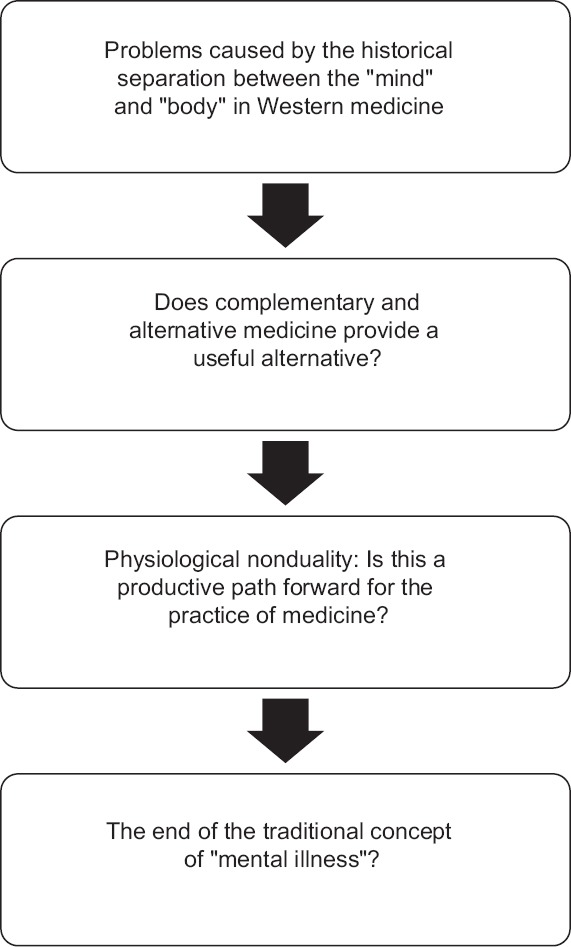
Dualism is historically important in that it allowed the medical practice to be divorced from church oversight. The reductionist approaches of modern Western medicine facilitate a dispassionate and mechanistic approach to patient care, and dualist views promoted by complementary and alternative medicine are also problematic. Behavioural disorders are multifactorally realizable and emerge apparently chaotically from interactions between internal physiological systems and the patient's environment and experiential history. Conceptualizations of behavioural disorders that are based on dualism deny the primacy of individual physiology in the generation of pathology and distract from therapies that are most likely to produce positive outcomes. Behavioural health professionals should adopt holistic models of patient care, but these models must be based on methodologies that emphasize radical emergence over the artificial separation of the "physical" and "mental." This will allow for the humanistic practice of medicine while simultaneously maximizing the likelihood of treatment success.
二元论在历史上具有重要意义,因为它使医学实践摆脱了教会的监督。现代西方医学的还原论方法有助于以冷静和机械的方式进行患者护理,而补充和替代医学所倡导的二元论观点也存在问题。行为障碍是多因素可实现的,并且明显地从内部生理系统与患者的环境和经验历史之间的相互作用中混乱地出现。基于二元论的行为障碍概念否认个体生理在病理产生中的首要地位,并分散了对最有可能产生积极结果的治疗方法的注意力。行为健康专业人员应采用整体的患者护理模式,但这些模式必须基于强调根本涌现而非“身体”与“精神”人为分离的方法。这将允许医学的人文实践,同时最大限度地提高治疗成功的可能性。