Hambäck Peter A, Weingartner Elisabeth, Dalén Love, Wirta Helena, Roslin Tomas
Department of Ecology, Environment and Plants Sciences Stockholm University Stockholm Sweden.
Department of Bioinformatics and Genetics Swedish Museum of Natural History Stockholm Sweden.
Ecol Evol. 2016 Oct 26;6(23):8431-8439. doi: 10.1002/ece3.2536. eCollection 2016 Dec.
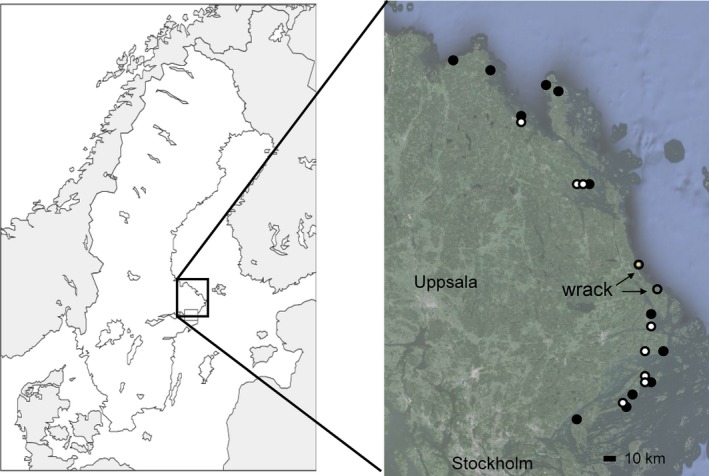
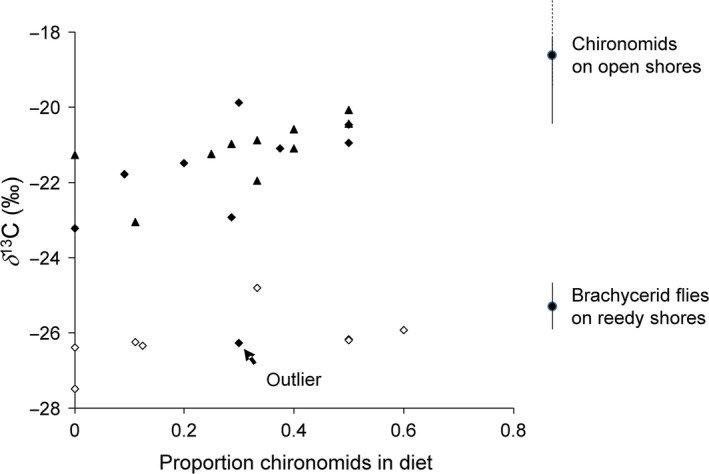
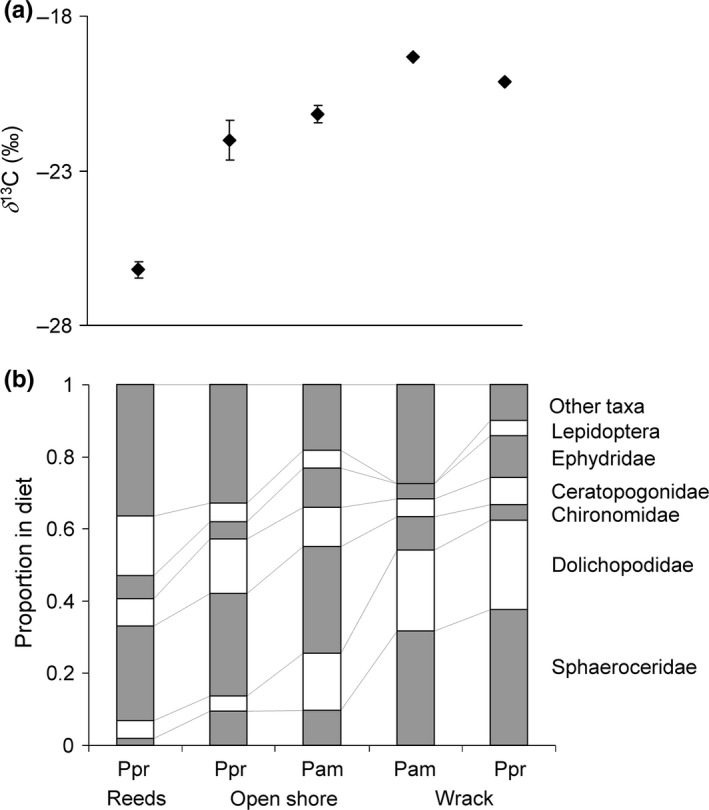
Inflow of matter and organisms may strongly affect the local density and diversity of organisms. This effect is particularly evident on shores where organisms with aquatic larval stages enter the terrestrial food web. The identities of such trophic links are not easily estimated as spiders, a dominant group of shoreline predator, have external digestion. We compared trophic links and the prey diversity of spiders on different shore types along the Baltic Sea: on open shores and on shores with a reed belt bordering the water. A priori, we hypothesized that the physical structure of the shoreline reduces the flow between ecosystem and the subsidies across the sea-land interface. To circumvent the lack of morphologically detectable remains of spider prey, we used a combination of stable isotope and molecular gut content analyses. The two tools used for diet analysis revealed complementary information on spider diets. The stable isotope analysis indicated that spiders on open shores had a marine signal of carbon isotopes, while spiders on reedy shores had a terrestrial signal. The molecular analysis revealed a diverse array of dipteran and lepidopteran prey, where spiders on open and reedy shores shared a similar diet with a comparable proportion of chironomids, the larvae of which live in the marine system. Comparing the methods suggests that differences in isotope composition of the two spider groups occurred because of differences in the chironomid diets: as larvae, chironomids of reedy shores likely fed on terrestrial detritus and acquired a terrestrial isotope signature, while chironomids of open shores utilized an algal diet and acquired a marine isotope signature. Our results illustrate how different methods of diet reconstruction may shed light on complementary aspects of nutrient transfer. Overall, they reveal that reed belts can reduce connectivity between habitats, but also function as a source of food for predators.
物质和生物的流入可能会强烈影响生物的局部密度和多样性。这种影响在海岸线上尤为明显,在那里具有水生幼虫阶段的生物进入陆地食物网。由于蜘蛛是海岸线上占主导地位的捕食者群体,具有体外消化的特性,因此这类营养联系的身份并不容易估计。我们比较了波罗的海不同海岸类型上蜘蛛的营养联系和猎物多样性:开阔海岸和有芦苇带与水接壤的海岸。我们预先假设海岸线的物理结构会减少生态系统之间的流动以及海陆界面间的补贴。为了规避蜘蛛猎物形态上可检测的残骸缺失的问题,我们结合了稳定同位素分析和分子肠道内容物分析。用于饮食分析的这两种工具揭示了关于蜘蛛饮食的互补信息。稳定同位素分析表明,开阔海岸上的蜘蛛具有碳同位素的海洋信号,而芦苇海岸上的蜘蛛具有陆地信号。分子分析揭示了各种各样的双翅目和鳞翅目猎物,开阔海岸和芦苇海岸上的蜘蛛有着相似的饮食,摇蚊的比例相当,摇蚊幼虫生活在海洋系统中。对这些方法的比较表明,两组蜘蛛同位素组成的差异是由于摇蚊饮食的差异造成的:作为幼虫,芦苇海岸的摇蚊可能以陆地碎屑为食并获得陆地同位素特征,而开阔海岸的摇蚊以藻类为食并获得海洋同位素特征。我们的结果说明了不同的饮食重建方法如何能够揭示营养物质转移的互补方面。总体而言,它们表明芦苇带可以减少栖息地之间的连通性,但同时也作为捕食者的食物来源。