Yang Su, Li Xiao-Jiang, Li Shihua
Department of Human Genetics, Emory University School of Medicine , Atlanta, GA, USA.
Department of Human Genetics, Emory University School of Medicine, Atlanta, GA, USA; State Key Laboratory of Molecular Developmental Biology, Institute of Genetics and Developmental Biology, Chinese Academy of Sciences, Beijing, China.
Rare Dis. 2016 Aug 12;4(1):e1223580. doi: 10.1080/21675511.2016.1223580. eCollection 2016.
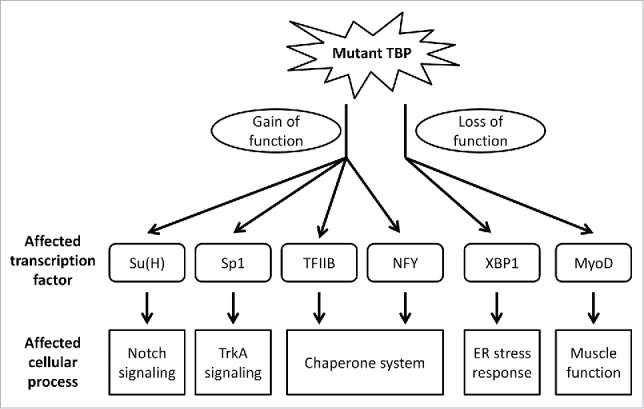
Spinocerebellar ataxia 17 (SCA17) belongs to the family of 9 genetically inherited, late-onset neurodegenerative diseases, which are caused by polyglutamine (polyQ) expansion in different proteins. In SCA17, the polyQ expansion occurs in the TATA box binding protein (TBP), which functions as a general transcription factor. Patients with SCA17 suffer from a broad array of motor and non-motor defects, and their life expectancy is normally within 20 y after the initial appearance of symptoms. Currently there is no effective treatment, but remarkable efforts have been devoted to tackle this devastating disorder. In this review, we will summarize our current knowledge about the molecular mechanisms underlying the pathogenesis of SCA17, with a primary focus on transcriptional dysregulations. We believe that impaired transcriptional activities caused by mutant TBP with polyQ expansion is a major form of toxicity contributing to SCA17 pathogenesis, and rectifying the altered level of downstream transcripts represents a promising therapeutic approach for the treatment of SCA17.
脊髓小脑共济失调17型(SCA17)属于9种基因遗传性迟发性神经退行性疾病家族,这些疾病由不同蛋白质中的多聚谷氨酰胺(polyQ)扩增引起。在SCA17中,多聚谷氨酰胺扩增发生在作为一般转录因子发挥作用的TATA框结合蛋白(TBP)中。SCA17患者存在广泛的运动和非运动缺陷,其预期寿命通常在症状首次出现后的20年内。目前尚无有效治疗方法,但已投入大量努力来应对这种毁灭性疾病。在本综述中,我们将总结目前关于SCA17发病机制的分子机制的认识,主要关注转录失调。我们认为,由具有多聚谷氨酰胺扩增的突变TBP引起的转录活性受损是导致SCA17发病机制的主要毒性形式,纠正下游转录本水平的改变是治疗SCA17的一种有前景的治疗方法。