Geerling Joel C, Yokota Shigefumi, Rukhadze Irma, Roe Dan, Chamberlin Nancy L
Department of Neurology, Beth Israel Deaconess Medical Center and Harvard Medical School, Boston, Massachusetts.
Division of Sleep Medicine, Beth Israel Deaconess Medical Center and Harvard Medical School, Boston, Massachusetts.
J Comp Neurol. 2017 Jun 1;525(8):1844-1860. doi: 10.1002/cne.24164. Epub 2017 Mar 14.
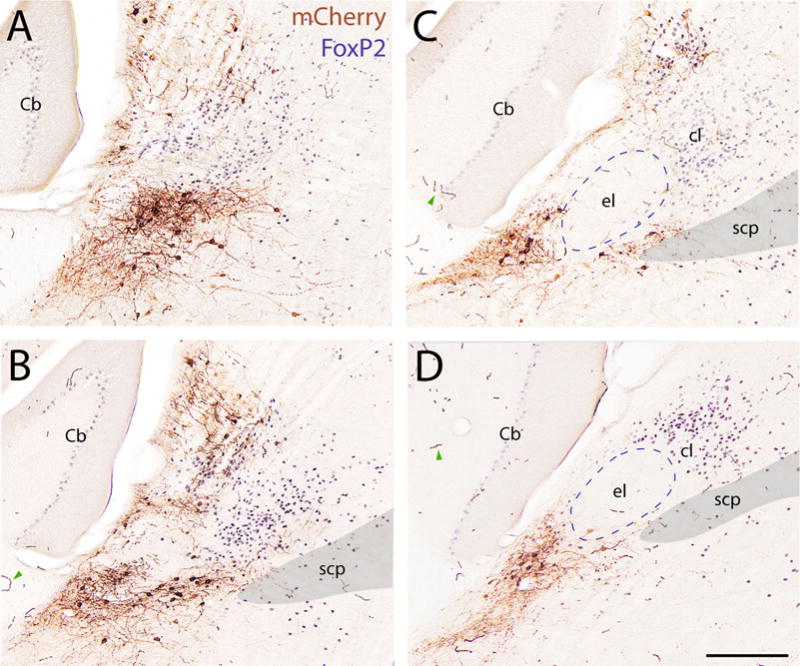
The Kölliker-Fuse nucleus (KF) is known primarily for its respiratory function as the "pneumotaxic center" or "pontine respiratory group." Considered part of the parabrachial (PB) complex, KF contains glutamatergic neurons that project to respiratory-related targets in the medulla and spinal cord (Yokota, Oka, Tsumori, Nakamura, & Yasui, 2007). Here we describe an unexpected population of neurons in the caudal KF and adjacent lateral crescent subnucleus (PBlc), which are γ-aminobutyric acid (GABA)ergic and have an entirely different pattern of projections than glutamatergic KF neurons. First, immunofluorescence, in situ hybridization, and Cre-reporter labeling revealed that many of these GABAergic neurons express FoxP2 in both rats and mice. Next, using Cre-dependent axonal tracing in Vgat-IRES-Cre and Vglut2-IRES-Cre mice, we identified different projection patterns from GABAergic and glutamatergic neurons in this region. GABAergic neurons in KF and PBlc project heavily and almost exclusively to trigeminal sensory nuclei, with minimal projections to cardiorespiratory nuclei in the brainstem, and none to the spinal cord. In contrast, glutamatergic KF neurons project heavily to the autonomic, respiratory, and motor regions of the medulla and spinal cord previously identified as efferent targets mediating KF cardiorespiratory effects. These findings identify a novel, GABAergic subpopulation of KF/PB neurons with a distinct efferent projection pattern targeting the brainstem trigeminal sensory system. Rather than regulating breathing, we propose that these neurons influence vibrissal sensorimotor function.
柯利克-富泽核(KF)主要因其作为“呼吸调整中枢”或“脑桥呼吸组”的呼吸功能而闻名。KF被认为是臂旁(PB)复合体的一部分,包含向延髓和脊髓中与呼吸相关的靶点投射的谷氨酸能神经元(横田、冈、津守、中村和安井,2007年)。在此,我们描述了在尾侧KF和相邻的外侧新月形亚核(PBlc)中意外发现的一群神经元,它们是γ-氨基丁酸(GABA)能神经元,其投射模式与谷氨酸能KF神经元完全不同。首先,免疫荧光、原位杂交和Cre报告基因标记显示,在大鼠和小鼠中,许多这些GABA能神经元都表达FoxP2。接下来,我们在Vgat-IRES-Cre和Vglut2-IRES-Cre小鼠中使用Cre依赖的轴突追踪技术,确定了该区域GABA能神经元和谷氨酸能神经元的不同投射模式。KF和PBlc中的GABA能神经元大量且几乎专门投射到三叉神经感觉核,向脑干中的心肺核的投射极少,且不投射到脊髓。相比之下,谷氨酸能KF神经元大量投射到延髓和脊髓的自主、呼吸和运动区域,这些区域先前被确定为介导KF心肺效应的传出靶点。这些发现确定了KF/PB神经元中一个新的GABA能亚群,其具有针对脑干三叉神经感觉系统的独特传出投射模式。我们提出,这些神经元不是调节呼吸,而是影响触须感觉运动功能。