Kim Hyojin, Yang Jeong Mi, Jin Yan, Jheon Sanghoon, Kim Kwhanmien, Lee Choon Taek, Chung Jin-Haeng, Paik Jin Ho
Department of Pathology, Seoul National University Bundang Hospital, Seongnam, Korea.
Department of Thoracic and Cardiovascular Surgery, Seoul National University Bundang Hospital, Seongnam, Korea.
Oncotarget. 2017 Jan 31;8(5):8484-8498. doi: 10.18632/oncotarget.14298.
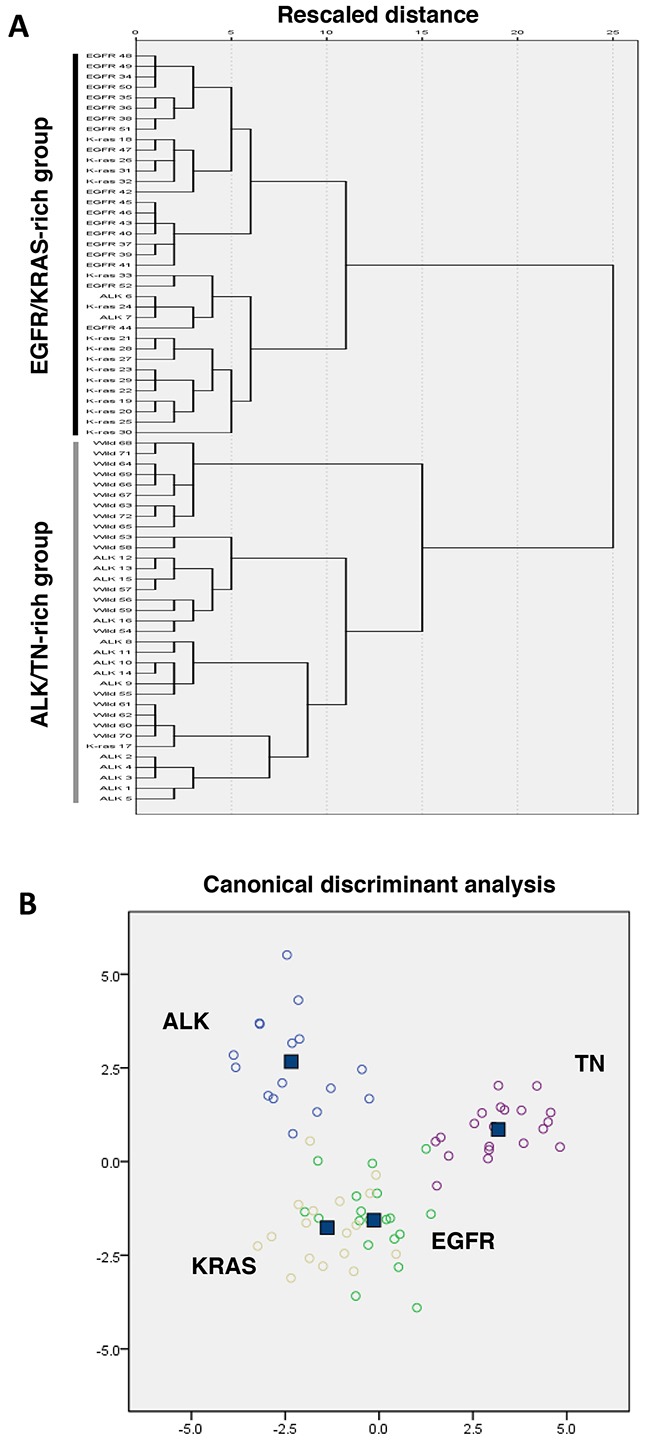
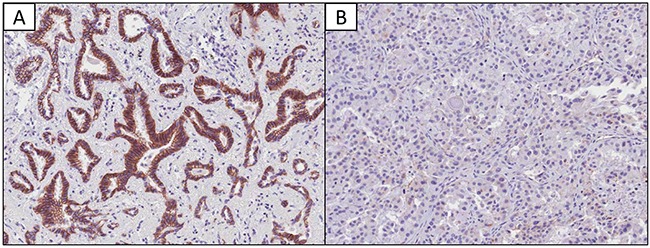
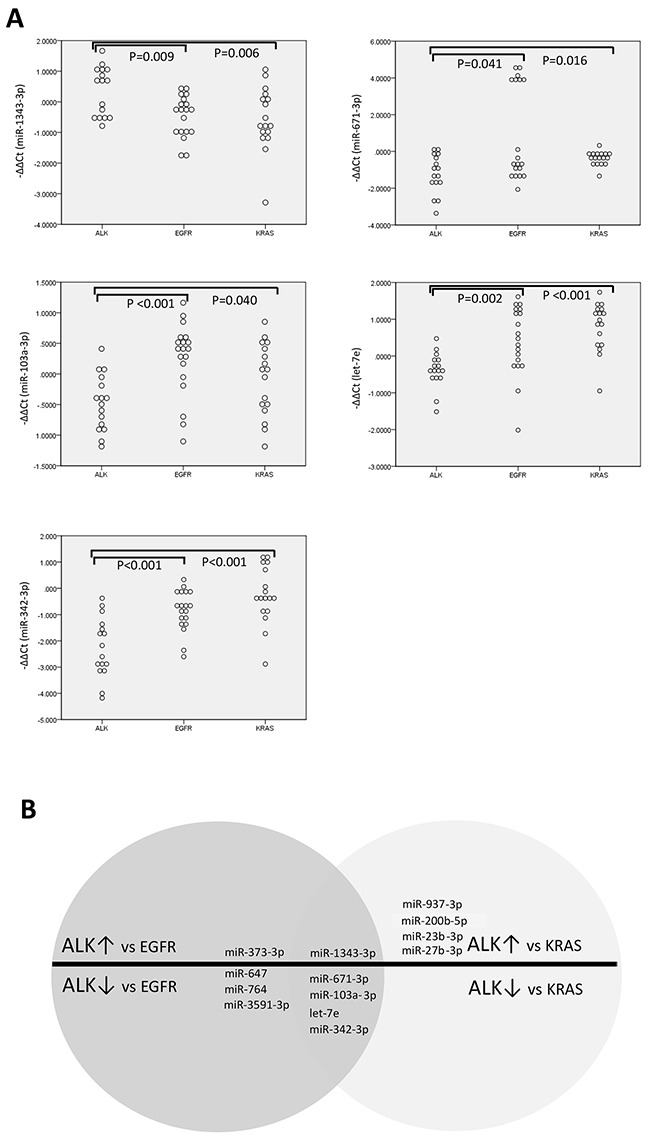
Lung adenocarcinoma has distinctive clinicopathological features that are related to specific genetic alterations, including EGFR and KRAS mutations and ALK rearrangement. MicroRNAs are small non-coding RNAs that post-transcriptionally regulate many important biological processes and influence cancer phenotypes. This study retrospectively investigated microRNA expression profiles, and their clinicopathological implications, in lung adenocarcinoma according to genetic status (EGFR, KRAS, ALK, and triple negative). A total of 72 surgically resected lung adenocarcinoma specimens (19 EGFR-mutated, 17 KRAS-mutated, 16 ALK-rearranged, and 20 triple negative cancers) were screened for 23 microRNAs using quantitative real-time reverse transcriptase polymerase chain reaction. We then evaluated the associations between the microRNA expressions and the cancers' genetic and clinicopathological features. Eight microRNAs were associated with clinicopathological features, such as male sex and ever-smoker status (high miR-373-3p, miR-1343-3p, miR-138-1-3p, and miR-764; low miR-27b-3p) and vascular invasion (high miR-27b-3p; low miR-1343-3p and miR-764). Clustering and discriminant analyses revealed that the microRNA expression patterns in the ALK group were different from those in the EGFR and KRAS groups. Five microRNAs (high miR-1343-3p; low miR-671-3p, miR-103a-3p, let-7e, and miR-342-3p) were especially distinctive in the ALK group, compared to the EGFR and KRAS groups. Moreover, a significant association was observed between ALK-rearrangement, decreased miR-342-3p expression, and immunohistochemical loss of E-cadherin. Therefore, microRNA expression profiles appear to have distinctive clinicopathological implications in ALK-rearranged lung adenocarcinoma. Furthermore, the association of ALK rearrangement, decreased miR-342-3p expression, and E-cadherin loss might indicate that miR-342-3p is involved in the ALK-associated phenotypes and epithelial-mesenchymal transition.
肺腺癌具有与特定基因改变相关的独特临床病理特征,包括表皮生长因子受体(EGFR)和 Kirsten 大鼠肉瘤病毒癌基因(KRAS)突变以及间变性淋巴瘤激酶(ALK)重排。微小RNA是小的非编码RNA,可在转录后调节许多重要的生物学过程并影响癌症表型。本研究根据基因状态(EGFR、KRAS、ALK和三阴性)回顾性调查了肺腺癌中微小RNA的表达谱及其临床病理意义。使用定量实时逆转录聚合酶链反应对72例手术切除的肺腺癌标本(19例EGFR突变、17例KRAS突变、16例ALK重排和20例三阴性癌)进行了23种微小RNA的筛查。然后,我们评估了微小RNA表达与癌症的基因及临床病理特征之间的关联。8种微小RNA与临床病理特征相关,如男性性别和曾经吸烟状态(高表达的miR-373-3p、miR-1343-3p、miR-138-1-3p和miR-764;低表达的miR-27b-3p)以及血管侵犯(高表达的miR-27b-3p;低表达的miR-1343-3p和miR-764)。聚类和判别分析显示,ALK组的微小RNA表达模式与EGFR组和KRAS组不同。与EGFR组和KRAS组相比,5种微小RNA(高表达的miR-1343-3p;低表达的miR-67%-3p、miR-103a-3p、let-7e和miR-342-3p)在ALK组中尤为独特。此外,观察到ALK重排、miR-342-3p表达降低与E钙黏蛋白免疫组化缺失之间存在显著关联。因此,微小RNA表达谱在ALK重排的肺腺癌中似乎具有独特的临床病理意义。此外,ALK重排、miR-342-3p表达降低与E钙黏蛋白缺失之间的关联可能表明miR-342-3p参与了ALK相关表型和上皮-间质转化。