Lee Ga Hye, Lee Won-Woo
Department of Biomedical Sciences, Seoul National University College of Medicine and BK21Plus Biomedical Science Project, Seoul National University College of Medicine, Seoul 03080, Korea.
Department of Biomedical Sciences, Seoul National University College of Medicine and BK21Plus Biomedical Science Project, Seoul National University College of Medicine, Seoul 03080, Korea.; Department of Microbiology and Immunology, Seoul National University College of Medicine; Ischemic/Hypoxic Disease Institute and Institute of Infectious Diseases, Seoul National University College of Medicine; Seoul National University Hospital Biomedical Research Institute, Seoul 03080, Korea.
Immune Netw. 2016 Dec;16(6):322-329. doi: 10.4110/in.2016.16.6.322. Epub 2016 Dec 22.
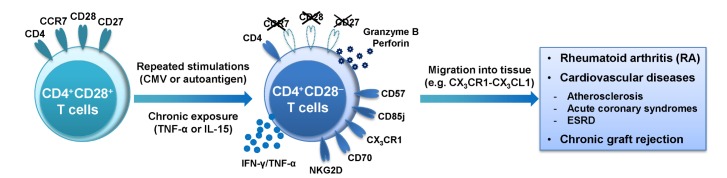
CD28 is a primary co-stimulatory receptor that is essential for successful T cell activation, proliferation, and survival. While ubiquitously expressed on naive T cells, the level of CD28 expression on memory T cells is largely dependent on the T-cell differentiation stage in humans. Expansion of circulating T cells lacking CD28 was originally considered a hallmark of age-associated immunological changes in humans, with a progressive loss of CD28 following replicative senescence with advancing age. However, an increasing body of evidence has revealed that there is a significant age-inappropriate expansion of CD4CD28 T cells in patients with a variety of chronic inflammatory diseases, suggesting that these cells play a role in their pathogenesis. In fact, expanded CD4CD28 T cells can produce large amounts of proinflammatory cytokines such as IFN-γ and TNF-α and also have cytotoxic potential, which may cause tissue damage and development of pathogenesis in many inflammatory disorders. Here we review the characteristics of CD4CD28 T cells as well as the recent advances highlighting the contribution of these cells to several disease conditions.
CD28是一种主要的共刺激受体,对T细胞的成功激活、增殖和存活至关重要。虽然在初始T细胞上普遍表达,但记忆T细胞上CD28的表达水平在很大程度上取决于人类T细胞的分化阶段。最初认为缺乏CD28的循环T细胞扩增是人类年龄相关免疫变化的一个标志,随着年龄的增长,复制性衰老后CD28会逐渐丧失。然而,越来越多的证据表明,在患有各种慢性炎症性疾病的患者中,CD4CD28 T细胞存在明显的与年龄不符的扩增,这表明这些细胞在其发病机制中起作用。事实上,扩增的CD4CD28 T细胞可产生大量促炎细胞因子,如IFN-γ和TNF-α,并且还具有细胞毒性潜能,这可能在许多炎症性疾病中导致组织损伤和发病机制的发展。在这里,我们综述了CD4CD28 T细胞的特征以及突出这些细胞对几种疾病状态贡献的最新进展。