Procter Duncan S, Cottrell Joan E, Watts Kevin, A'Hara Stuart W, Hofreiter Michael, Robinson Elva J H
York Centre for Complex Systems Analysis & Department of Biology University of York York UK; Centre for Exercise, Nutrition and Health Sciences School for Policy Studies University of Bristol Bristol UK.
Forest Research Roslin Midlothian UK.
Ecol Evol. 2016 Nov 21;6(24):8846-8856. doi: 10.1002/ece3.2590. eCollection 2016 Dec.
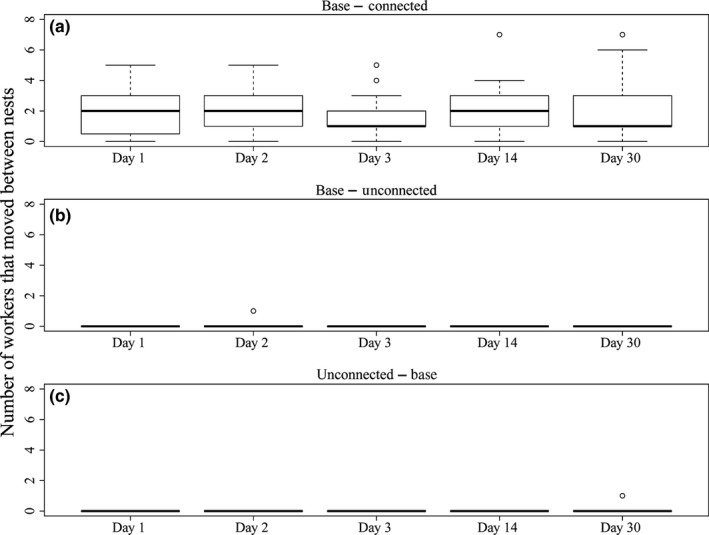
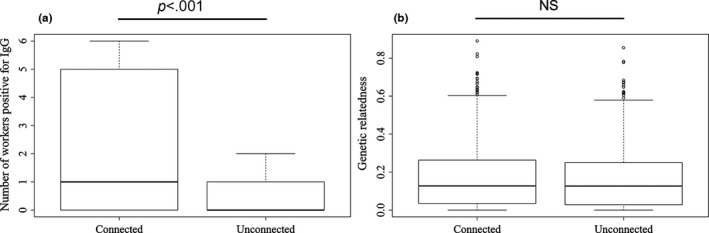
Eusociality is one of the most complex forms of social organization, characterized by cooperative and reproductive units termed colonies. Altruistic behavior of workers within colonies is explained by inclusive fitness, with indirect fitness benefits accrued by helping kin. Members of a social insect colony are expected to be more closely related to one another than they are to other conspecifics. In many social insects, the colony can extend to multiple socially connected but spatially separate nests (polydomy). Social connections, such as trails between nests, promote cooperation and resource exchange, and we predict that workers from socially connected nests will have higher internest relatedness than those from socially unconnected, and noncooperating, nests. We measure social connections, resource exchange, and internest genetic relatedness in the polydomous wood ant to test whether (1) socially connected but spatially separate nests cooperate, and (2) high internest relatedness is the underlying driver of this cooperation. Our results show that socially connected nests exhibit movement of workers and resources, which suggests they do cooperate, whereas unconnected nests do not. However, we find no difference in internest genetic relatedness between socially connected and unconnected nest pairs, both show high kinship. Our results suggest that neighboring pairs of connected nests show a social and cooperative distinction, but no genetic distinction. We hypothesize that the loss of a social connection may initiate ecological divergence within colonies. Genetic divergence between neighboring nests may build up only later, as a consequence rather than a cause of colony separation.
真社会性是最复杂的社会组织形式之一,其特征是存在被称为群体的合作与繁殖单位。群体内工蚁的利他行为通过广义适合度来解释,即通过帮助亲属获得间接的适合度收益。社会昆虫群体的成员之间预计比它们与其他同种个体的关系更为密切。在许多社会昆虫中,群体可以扩展到多个在社会上相互联系但空间上分离的巢穴(多巢型)。巢穴之间的社会联系,如路径,促进了合作和资源交换,我们预测来自社会联系紧密的巢穴的工蚁比来自社会无联系且不合作的巢穴的工蚁具有更高的巢间亲缘关系。我们测量了多巢型木蚁的社会联系、资源交换和巢间遗传亲缘关系,以检验:(1)社会联系紧密但空间分离的巢穴是否合作;(2)高巢间亲缘关系是否是这种合作的潜在驱动因素。我们的结果表明,社会联系紧密的巢穴表现出工蚁和资源的流动,这表明它们确实在合作,而无联系的巢穴则不然。然而,我们发现社会联系紧密和无联系的巢对之间在巢间遗传亲缘关系上没有差异,两者都显示出高亲缘关系。我们的结果表明,相邻的联系紧密巢穴对表现出社会和合作上的差异,但没有遗传差异。我们推测,社会联系的丧失可能会引发群体内部的生态分化。相邻巢穴之间的遗传分化可能只会在以后才出现,是群体分离的结果而非原因。