Lu Shun, Ye Ming, Ding Lieming, Tan Fenlai, Fu Jie, Wu Bin
Department of Medical Oncology, Shanghai Chest Hospital, Shanghai Jiaotong University, Shanghai, China.
Department of Radiotherapy, Renji Hospital, School of Medicine, Shanghai Jiaotong University, Shanghai, China.
Oncotarget. 2017 Feb 7;8(6):9996-10006. doi: 10.18632/oncotarget.14310.
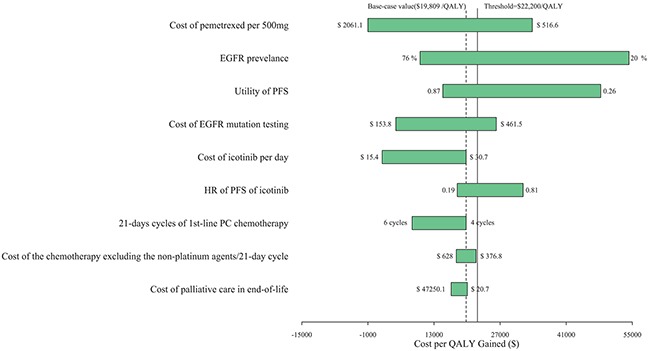
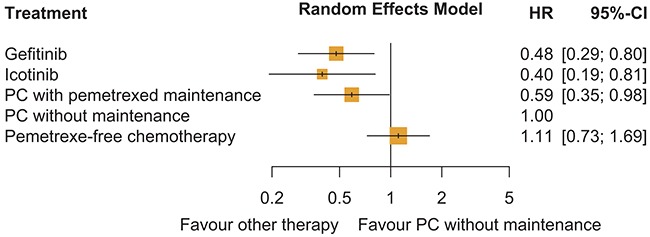
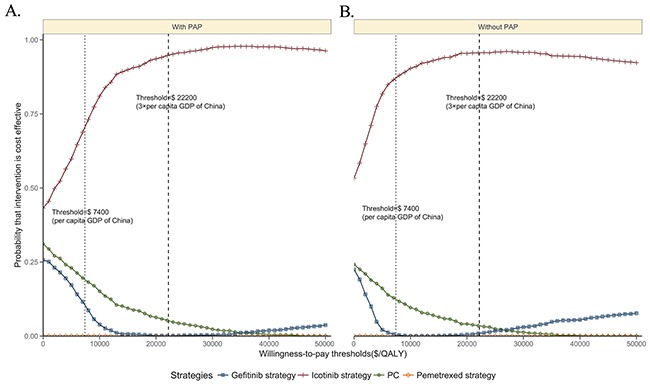
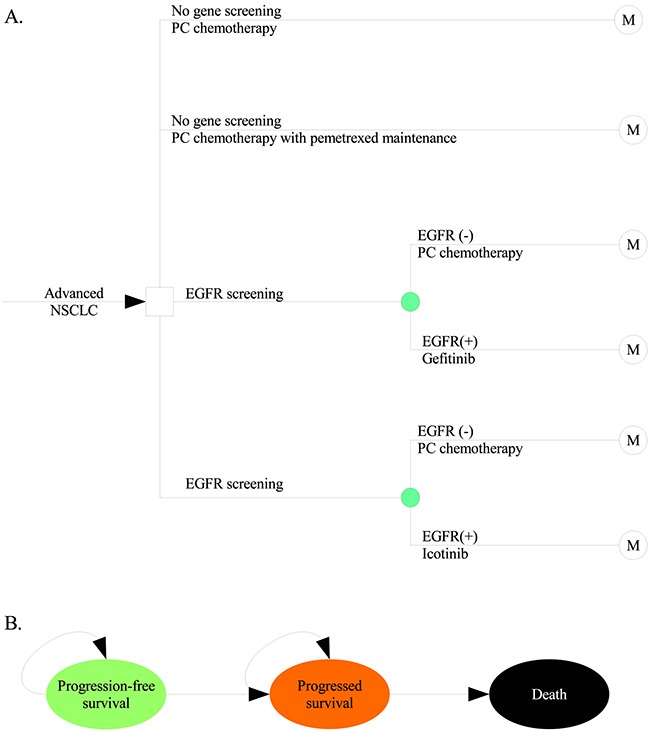
Tyrosine kinase inhibitors of the epidermal growth factor receptor (EGFR) are becoming the standard treatment option for patients with advanced non-small cell lung cancer (NSCLC) harboring an EGFR mutation, but the economic impact of this practice is unclear, especially in a health resource-limited setting. A decision-analytic model was developed to simulate 21-day patient transitions in a 10-year time horizon. The health and economic outcomes of four first-line strategies (pemetrexed plus cisplatin [PC] alone, PC followed by maintenance with pemetrexed, or initial treatment with gefitinib or icotinib) among patients harboring EGFR mutations were estimated and assessed via indirect comparisons. Costs in the Chinese setting were estimated. The primary outcome was the incremental cost-effectiveness ratio (ICER). Sensitivity analyses were performed. The icotinib strategy resulted in greater health benefits than the other three strategies in NSCLC patients harboring EGFR mutations. Relative to PC alone, PC followed by pemetrexed maintenance, gefitinib and icotinib resulted in ICERs of $104,657, $28,485 and $19,809 per quality-adjusted life-year gained, respectively. The cost of pemetrexed, the EGFR mutation prevalence and the utility of progression-free survival were factors that had a considerable impact on the model outcomes. When the icotinib Patient Assistance Program was available, the economic outcome of icotinib was more favorable. These results indicate that gene-guided therapy with icotinib might be a more cost-effective treatment option than traditional chemotherapy.
表皮生长因子受体(EGFR)酪氨酸激酶抑制剂正成为携带EGFR突变的晚期非小细胞肺癌(NSCLC)患者的标准治疗选择,但这种治疗方式的经济影响尚不清楚,尤其是在卫生资源有限的环境中。我们开发了一个决策分析模型,以模拟10年时间范围内21天的患者转变情况。通过间接比较,估计并评估了携带EGFR突变患者的四种一线治疗策略(单纯培美曲塞加顺铂[PC]、PC后用培美曲塞维持治疗,或初始用吉非替尼或埃克替尼治疗)的健康和经济结果。估算了中国环境下的成本。主要结果是增量成本效益比(ICER)。进行了敏感性分析。在携带EGFR突变的NSCLC患者中,埃克替尼策略比其他三种策略带来更大的健康益处。相对于单纯PC、PC后用培美曲塞维持治疗、吉非替尼和埃克替尼,每获得一个质量调整生命年的ICER分别为104,657美元、28,485美元和19,809美元。培美曲塞的成本、EGFR突变患病率和无进展生存的效用是对模型结果有相当大影响的因素。当有埃克替尼患者援助计划时,埃克替尼的经济结果更有利。这些结果表明,与传统化疗相比,埃克替尼基因导向治疗可能是一种更具成本效益的治疗选择。