Maas Brian M, Francis Owen, Mollan Katie R, Lee Cynthia, Cottrell Mackenzie L, Prince Heather M A, Sykes Craig, Trezza Christine, Torrice Chad, White Nicole, Malone Stephanie, Hudgens Michael G, Sharpless Norman E, Dumond Julie B
UNC Eshelman School of Pharmacy, University of North Carolina at Chapel Hill, Chapel Hill, NC, United States of America.
Gillings School of Global Public Health, University of North Carolina at Chapel Hill, Chapel Hill, NC, United States of America.
PLoS One. 2016 Dec 30;11(12):e0168709. doi: 10.1371/journal.pone.0168709. eCollection 2016.
As the HIV-infected population ages, the role of cellular senescence and inflammation on co-morbid conditions and pharmacotherapy is increasingly of interest. p16INK4a expression, a marker for aging and senescence in T-cells, is associated with lower intracellular concentrations of endogenous nucleotides (EN) and nucleos(t)ide reverse transcriptase inhibitors (NRTIs). This study expands on these findings by determining whether inflammation is contributing to the association of p16INK4a expression with intracellular metabolite (IM) exposure and endogenous nucleotide concentrations.
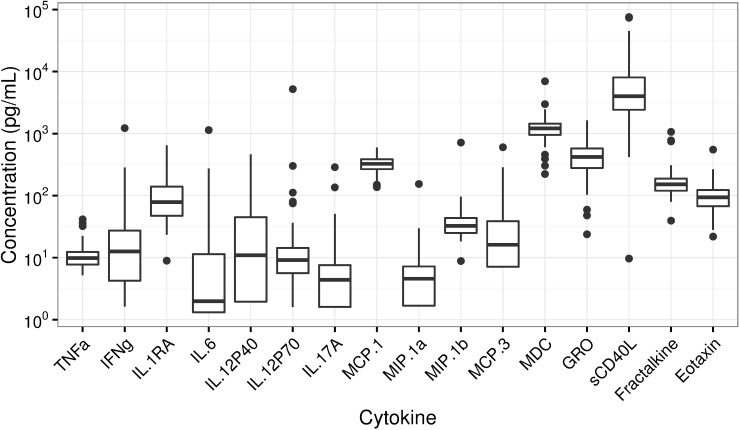
Samples from 73 HIV-infected adults receiving daily tenofovir/emtricitabine (TFV/FTC) with either efavirenz (EFV) or atazanavir/ritonavir (ATV/r) were tested for p16INK4a expression, and plasma cytokine and intracellular drug concentrations. Associations between p16INK4a expression and cytokine concentrations were assessed using maximum likelihood methods, and elastic net regression was applied to assess whether cytokines were predictive of intracellular metabolite/endogenous nucleotide exposures.
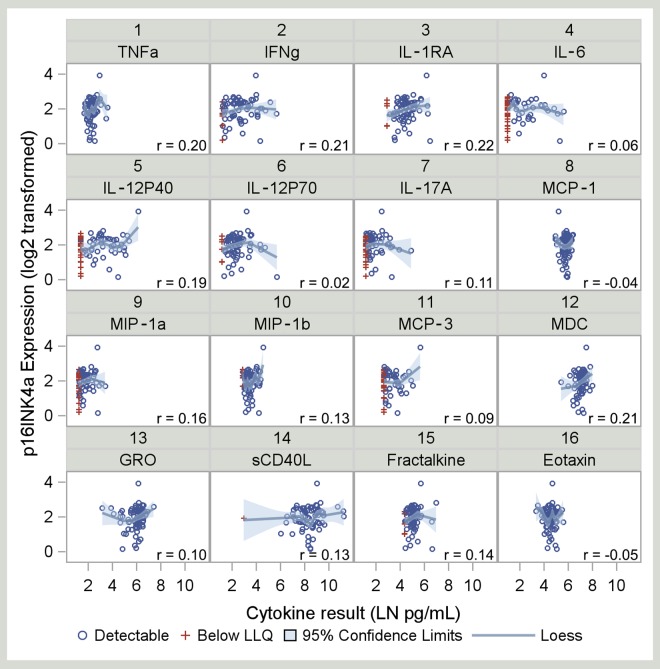
Enrolled participants had a median age of 48 years (range 23-73). There were no significant associations between p16INK4a expression and cytokines. Results of the elastic net regression showed weak relationships between IL-1Ra and FTC-triphosphate and deoxyadenosine triphosphate exposures, and MIP-1β, age and TFV-diphosphate exposures.
In this clinical evaluation, we found no relationships between p16INK4a expression and cytokines, or cytokines and intracellular nucleotide concentrations. While inflammation is known to play a role in this population, it is not a major contributor to the p16INK4a association with decreased IM/EN exposures in these HIV-infected participants.
随着感染艾滋病毒的人群老龄化,细胞衰老和炎症在合并症及药物治疗中的作用越来越受到关注。p16INK4a表达是T细胞衰老的标志物,与内源性核苷酸(EN)和核苷(酸)逆转录酶抑制剂(NRTIs)的细胞内浓度较低有关。本研究通过确定炎症是否导致p16INK4a表达与细胞内代谢物(IM)暴露及内源性核苷酸浓度之间的关联,对这些发现进行了拓展。
对73名接受每日替诺福韦/恩曲他滨(TFV/FTC)联合依非韦伦(EFV)或阿扎那韦/利托那韦(ATV/r)治疗的成年艾滋病毒感染者的样本进行p16INK4a表达、血浆细胞因子和细胞内药物浓度检测。使用最大似然法评估p16INK4a表达与细胞因子浓度之间的关联,并应用弹性网络回归评估细胞因子是否可预测细胞内代谢物/内源性核苷酸暴露。
入组参与者的中位年龄为48岁(范围23 - 73岁)。p16INK4a表达与细胞因子之间无显著关联。弹性网络回归结果显示,白细胞介素-1受体拮抗剂(IL-1Ra)与三磷酸FTC及脱氧三磷酸腺苷暴露之间、巨噬细胞炎性蛋白-1β(MIP-1β)、年龄与二磷酸TFV暴露之间存在弱关联。
在本临床评估中,我们发现p16INK4a表达与细胞因子之间、细胞因子与细胞内核苷酸浓度之间均无关联。虽然已知炎症在该人群中起作用,但在这些感染艾滋病毒的参与者中,炎症并非p16INK4a与IM/EN暴露减少之间关联的主要促成因素。