Wang Haiyong, Zhang Chenyue, Zhang Jingze, Kong Li, Zhu Hui, Yu Jinming
Department of Radiation Oncology, Shandong Cancer Hospital Affiliated to Shandong University, Shandong Academy of Medical Sciences, Shandong 250117, China.
Department of Integrative Oncology, Fudan University Shanghai Cancer Center, Shanghai 200032, China.
Oncotarget. 2017 Apr 18;8(16):26368-26379. doi: 10.18632/oncotarget.14300.
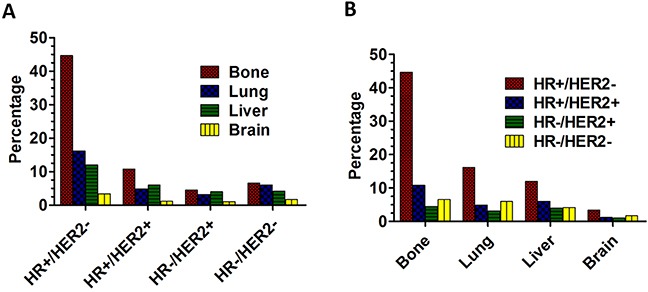
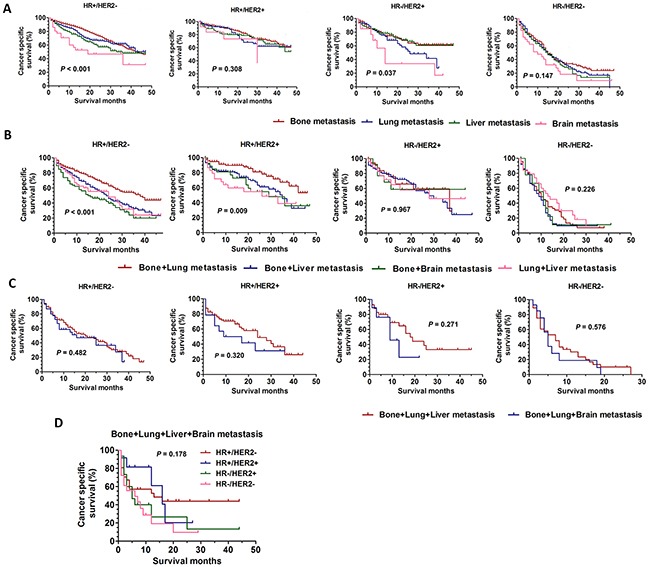
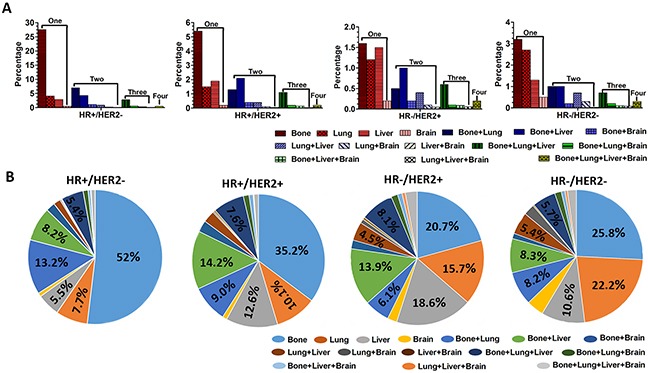
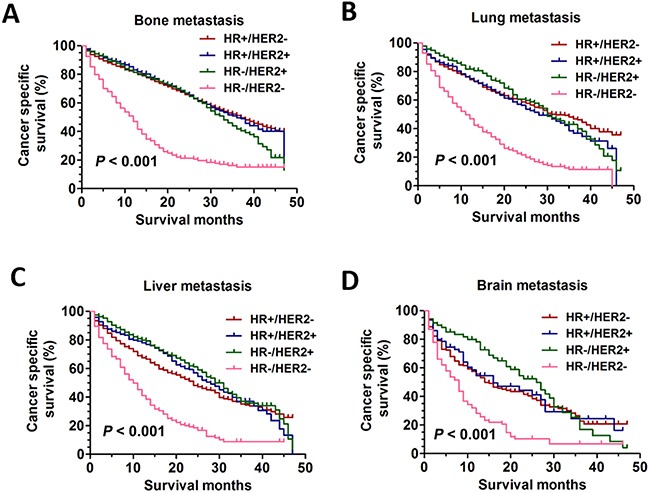
Studies on prognosis of different metastasis patterns in patients with different breast cancer subtypes (BCS) are limited. Therefore, we identified 7862 breast cancer patients with distant metastasis from 2010 to 2013 using Surveillance, Epidemiology, wand End Results (SEER) population-based data. The results showed that bone was the most common metastatic site and brain was the least common metastatic site, and the patients with HR+/HER2- occupied the highest metastasis proportion, the lowest metastasis proportion were found in HR-/HER2+ patients. Univariate and multivariate logistic regression analysis were used to analyze the association, and it was found that there were significant differences of distant metastasis patterns in patients with different BCS(different P value). Importantly, univariate and multivariate Cox regression analysis were used to analyze the prognosis. It was proven that only bone metastasis was not a prognostic factor in the HR+/HER2-, HR+/HER2+ and HR-/HER2+ subgroup (all, P > 0.05), and patients with brain metastasis had the worst cancer specific survival (CSS) in all the subgroups of BCS (all, P<0.01). Interestingly, for patients with two metastatic sites, those with bone and lung metastasis had best CSS in the HR+/HER2- (P<0.001) and HR+/HER2+ subgroups (P=0.009) However, for patients with three and four metastatic sites, there was no statistical difference in their CSS (all, P>0.05).
关于不同乳腺癌亚型(BCS)患者不同转移模式预后的研究有限。因此,我们利用监测、流行病学和最终结果(SEER)基于人群的数据,确定了2010年至2013年期间7862例发生远处转移的乳腺癌患者。结果显示,骨是最常见的转移部位,脑是最不常见的转移部位,HR+/HER2-患者的转移比例最高,HR-/HER2+患者的转移比例最低。采用单因素和多因素逻辑回归分析来分析这种关联,发现不同BCS患者的远处转移模式存在显著差异(不同的P值)。重要的是,采用单因素和多因素Cox回归分析来分析预后。结果证明,在HR+/HER2-、HR+/HER2+和HR-/HER2+亚组中,只有骨转移不是预后因素(所有P>0.05),并且在所有BCS亚组中,脑转移患者的癌症特异性生存率(CSS)最差(所有P<0.01)。有趣的是,对于有两个转移部位的患者,骨和肺转移患者在HR+/HER2-(P<0.001)和HR+/HER2+亚组(P=0.009)中的CSS最佳。然而,对于有三个和四个转移部位的患者,他们的CSS没有统计学差异(所有P>0.05)。