Department of Public Health, Shiga University of Medical Science, Shiga, Japan.
Research and Development Department, OMRON HEALTHCARE Co., Ltd, Kyoto, Japan.
Int J Epidemiol. 2017 Oct 1;46(5):1564-1572. doi: 10.1093/ije/dyw287.
Association between casual and 24-h urinary sodium-to-potassium (Na/K) ratio is well recognized, although it has not been validated in diverse demographic groups. Our aim was to assess utility across and within populations of casual urine to estimate 24-h urinary Na/K ratio using data from the INTERSALT Study.
The INTERSALT Study collected cross-sectional standardized data on casual urinary sodium and potassium and also on timed 24-h urinary sodium and potassium for 10 065 individuals from 52 population samples in 32 countries (1985-87). Pearson correlation coefficients and agreement were computed for Na/K ratio of casual urine against 24-h urinary Na/K ratio both at population and individual levels.
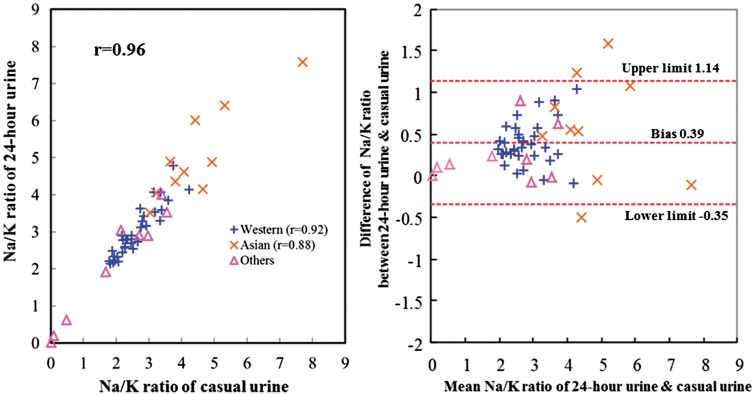
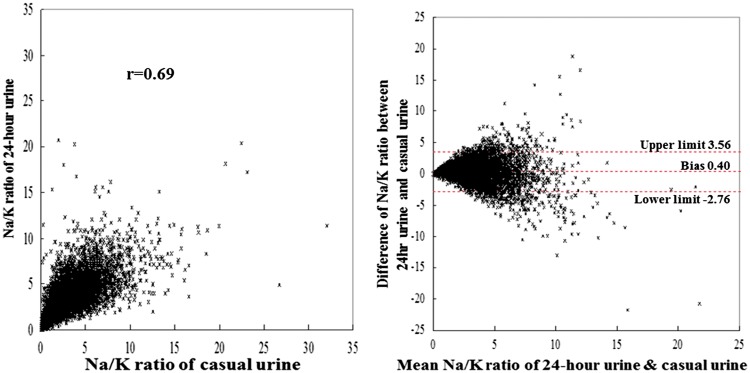
Pearson correlation coefficients relating means of 24-h urine and casual urine Na/K ratio were r = 0.96 and r = 0.69 in analyses across populations and individuals, respectively. Correlations of casual urine Na/creatinine and K/creatinine ratios with 24-h urinary Na and K excretion, respectively, were lower than correlation of casual and 24-h urinary Na/K ratio in analyses across populations and individuals. The bias estimate with the Bland-Altman method, defined as the difference between Na/K ratio of 24-h urine and casual urine, was approximately 0.4 across both populations and individuals. Spread around, the mean bias was higher for individuals than populations.
With appropriate bias correction, casual urine Na/K ratio may be a useful, low-burden alternative method to 24-h urine for estimation of population urinary Na/K ratio. It may also be applicable for assessment of the urinary Na/K ratio of individuals, with use of repeated measurements to reduce measurement error and increase precision.
虽然在不同的人群中尚未验证,但人们已经认识到偶然尿与 24 小时尿钠钾(Na/K)比值之间的关联。我们的目的是评估使用 INTERSALT 研究数据从人群之间和人群内部使用随机尿来估计 24 小时尿 Na/K 比值的效用。
INTERSALT 研究收集了来自 32 个国家的 52 个人群样本中的 10065 个人的随机尿钠和钾以及 24 小时尿钠和钾的时间分布数据(1985-87 年)。在人群和个体水平上,计算了随机尿和 24 小时尿 Na/K 比值的 Pearson 相关系数和一致性。
在人群和个体分析中,24 小时尿和随机尿 Na/K 比值的平均值之间的 Pearson 相关系数分别为 r = 0.96 和 r = 0.69。在人群和个体分析中,随机尿 Na/肌酐和 K/肌酐比值与 24 小时尿 Na 和 K 排泄的相关性均低于随机尿和 24 小时尿 Na/K 比值的相关性。Bland-Altman 方法定义的偏差估计值,即 24 小时尿和随机尿 Na/K 比值之间的差异,在人群和个体中均约为 0.4。从分布上看,个体的平均偏差高于人群。
通过适当的偏差校正,随机尿 Na/K 比值可能是一种有用的、低负担的替代方法,可以替代 24 小时尿来估计人群尿 Na/K 比值。它也可能适用于个体尿 Na/K 比值的评估,通过使用重复测量来减少测量误差并提高精度。