Yang Tengyu, Fang Fang, Chen Yawen, Ma Jing, Xiao Zhaowen, Zou Songfeng, Zheng Na, Yan Dewen, Liao Songyan, Chen Shaoyuan, Fang Hongchen, Yu Chekmen, Liu Jie, Dong Ming
Division of Pathophysiology, Medical College, Shenzhen University, Shenzhen, Guangdong, China.
Division of cardiology, Department of Medicine and Therapeutics, Prince of Wales Hospital, Li Ka Shing Institute of Health and Sciences, Institute of Vascular Medicine, The Chinese University of Hong Kong, Hong Kong, China.
Oncotarget. 2017 Feb 7;8(6):9686-9695. doi: 10.18632/oncotarget.14195.
The plasma level of interleukin-37 is elevated in patients with acute coronary syndrome, however, its function during the onset and progress of the disease remains unclear. This study aimed to investigate the clinical significance of IL-37 in acute coronary syndrome and its underlying mechanism.
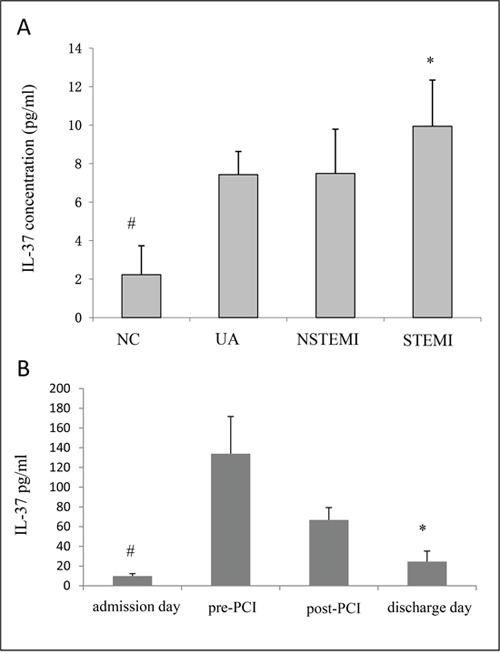
124 patients with acute coronary syndrome and 40 healthy controls were recruited in this study. Plasma interleukin-37 levels were measured in 41 patients with ST elevation myocardial infarction (STEMI), 41 patients with non-STEMI, 42 patients with unstable angina, and 40 controls. Mortality was defined as an event.
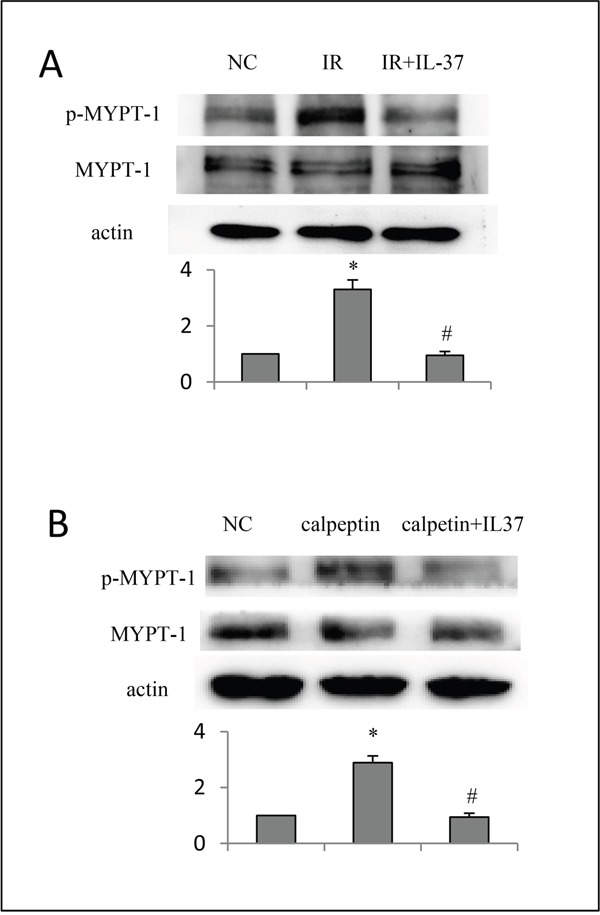
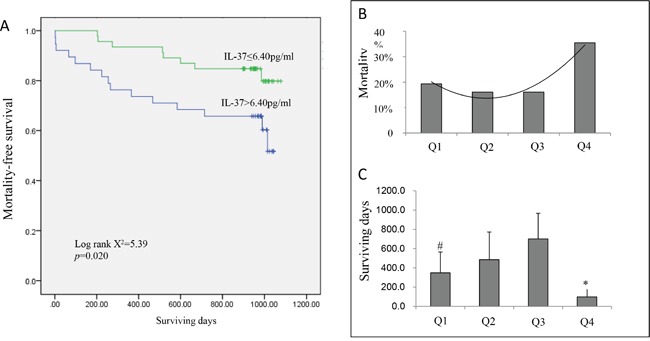
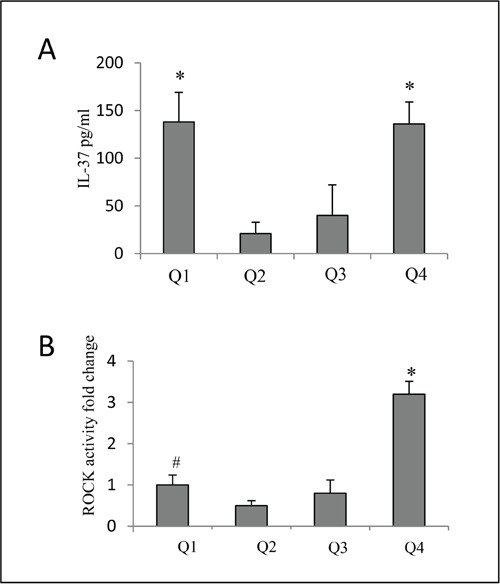
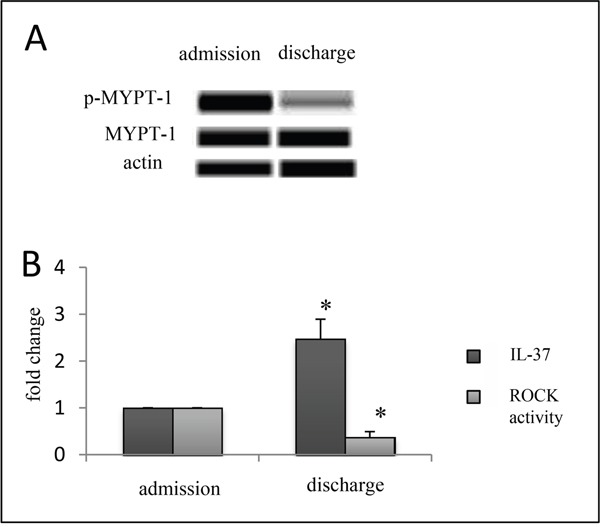
In this study, the mean follow-up period was 824±306 days (2-1077 days). 22% (n=27) of patients died. The mortality rate was significantly lower in patients with interleukin-37 serum levels below the median (6.4 pg/mL) than those with interleukin-37 serum levels above 6.4 pg/mL at 36-month follow-up (16% vs. 24%, p=0.02, log rank X2=5.39). Highly concentration of the anti-inflammatory interleukin-37 exerted a protective effect by suppressing the activated Rho Kinase (ROCK) activity in the peripheral blood mononuclear cells in vivo and in vitro after ischemia/reperfusion injury and stimulation of the Rho activator, calpeptin.
The interleukin-37 level is significantly increased in acute coronary syndrome. Elevated baseline interleukin-37 levels in patients on admission are associated with poor outcomes. Thus, we propose that interleukin-37 could be a biomarker predictive of mortality in acute coronary syndrome. Moreover, this study reveals that the protective effect of interleukin-37 against atherosclerosis may involve the inhibition of ROCK activity.
急性冠状动脉综合征患者血浆白细胞介素-37水平升高,但其在疾病发生和发展过程中的作用仍不清楚。本研究旨在探讨白细胞介素-37在急性冠状动脉综合征中的临床意义及其潜在机制。
本研究招募了124例急性冠状动脉综合征患者和40例健康对照。测定了41例ST段抬高型心肌梗死(STEMI)患者、41例非STEMI患者、42例不稳定型心绞痛患者和40例对照的血浆白细胞介素-37水平。将死亡定义为一个事件。
在本研究中,平均随访期为824±306天(2 - 1077天)。22%(n = 27)的患者死亡。在36个月的随访中,白细胞介素-37血清水平低于中位数(6.4 pg/mL)的患者死亡率显著低于白细胞介素-37血清水平高于6.4 pg/mL的患者(16%对24%,p = 0.02,对数秩X2 = 5.39)。在体内和体外缺血/再灌注损伤以及Rho激活剂钙肽素刺激后,高浓度的抗炎性白细胞介素-37通过抑制外周血单个核细胞中活化的Rho激酶(ROCK)活性发挥保护作用。
急性冠状动脉综合征患者白细胞介素-37水平显著升高。入院时患者基线白细胞介素-37水平升高与不良预后相关。因此,我们认为白细胞介素-37可能是急性冠状动脉综合征死亡率的预测生物标志物。此外,本研究揭示白细胞介素-37对动脉粥样硬化的保护作用可能涉及对ROCK活性的抑制。