Friedman Danielle Novetsky, Hilden Patrick, Moskowitz Chaya S, Suzuki Maya, Boulad Farid, Kernan Nancy A, Wolden Suzanne L, Oeffinger Kevin C, Sklar Charles A
Department of Pediatrics, Memorial Sloan Kettering Cancer Center, New York, New York.
Department of Epidemiology-Biostatistics, Memorial Sloan Kettering Cancer Center, New York, New York.
Biol Blood Marrow Transplant. 2017 Mar;23(3):475-482. doi: 10.1016/j.bbmt.2016.12.623. Epub 2016 Dec 28.
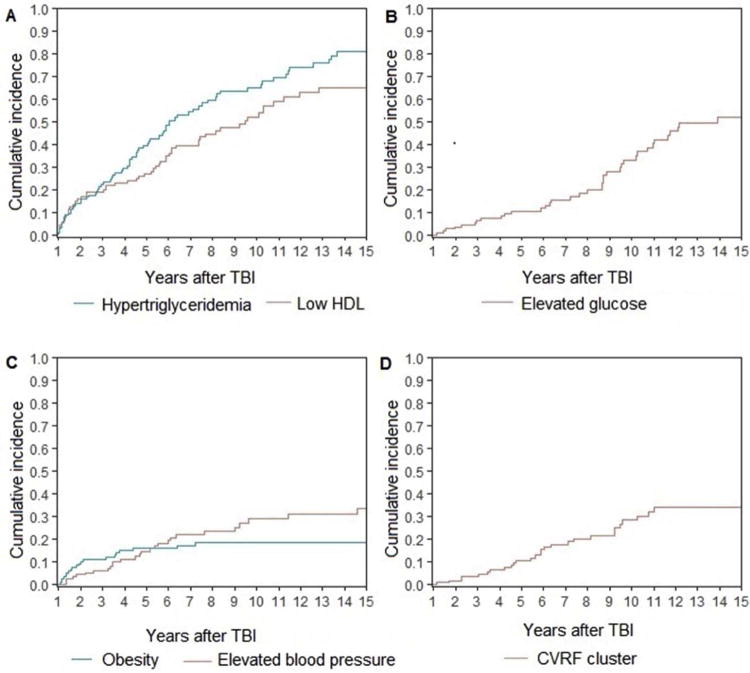
Hematopoietic cell transplantation (HCT) survivors treated with total body irradiation (TBI) are known to be at increased risk for the development of cardiovascular risk factors (CVRFs). We sought to characterize the incidence of CVRFs in a TBI-exposed survivor cohort and to describe prognostic indicators of their development through a retrospective analysis of CVRFs in 1-year survivors of leukemia or lymphoma treated with TBI at Memorial Sloan Kettering between April 1987 and May 2011. Eligible participants were age ≤21 years at the time of TBI and were not receiving glucocorticoid therapy at the time of entry to long-term follow-up. Survivors were assessed for obesity (body mass index ≥95th percentile for age ≤ 20 years and ≥30 kg/m for age >20 years), elevated blood pressure, dyslipidemia (elevated triglycerides [TG], low high-density lipoprotein [HDL]), and glucose intolerance (fasting glucose ≥100 mg/dL); those with ≥3 risk factors were deemed to have a CVRF cluster, a surrogate for metabolic syndrome. Cox regression models were used to estimate hazard ratios (HRs) for factors associated with each CVRF. To compare the prevalence of CVRFs in HCT survivors and the general population, survivors were compared with age-, sex-, and race-matched controls from the National Health and Nutrition Examination Survey. A total of 123 survivors were evaluated (62.6% males). The median age at TBI was 11.8 years (range, 1.6 to 21.9 years). The median duration of follow-up was 8.0 years (range, 1.01 to 24.6 years), and the median age at last follow-up was 20.1 years (range, 4.0 to 41.3 years). The 5-year cumulative incidence was 14.7% for elevated blood pressure, 10.5% for elevated glucose, 26.8% for low HDL, 39.2% for hypertriglyceridemia, and 16.0% for obesity, and corresponding 10-year cumulative incidences of 28.8%, 33.1%, 52.0%, 65.0%, and 18.6%. The median cumulative incidence of a CVRF cluster rose from 10.6% (range, 5.6% to 17.5%) at 5 years to 28.4% (range, 18.8% to 38.7%) at 10 years. In multivariate analysis, growth hormone (GH) deficiency (hazard ratio [HR], 8.6; 95% confidence interval [CI], 2.1 to 34.4; P = .002), history of cranial radiation (HR, 4.0; 95% CI, 1.7 to 9.6; P = .002), and grade II-IV acute graft-versus-host disease GVHD (HR, 4.2; 95% CI, 1.5 to 12.2; P = .008) were associated with the risk of developing a CVRF cluster. Compared with a random sample of matched population controls, HCT survivors had an increased prevalence of hypertriglyceridemia and low HDL, but not of glucose intolerance, elevated blood pressure, or CVRF cluster. Given the young age of this HCT survivor cohort, these data highlight the importance of routine screening for CVRF starting in childhood in individuals exposed to TBI.
已知接受全身照射(TBI)治疗的造血细胞移植(HCT)幸存者发生心血管危险因素(CVRF)的风险增加。我们试图通过对1987年4月至2011年5月在纪念斯隆凯特琳癌症中心接受TBI治疗的白血病或淋巴瘤1年幸存者的CVRF进行回顾性分析,来描述TBI暴露幸存者队列中CVRF的发生率,并描述其发生的预后指标。符合条件的参与者在接受TBI时年龄≤21岁,进入长期随访时未接受糖皮质激素治疗。对幸存者进行肥胖(年龄≤20岁时体重指数≥第95百分位数,年龄>20岁时≥30kg/m²)、血压升高、血脂异常(甘油三酯[TG]升高、高密度脂蛋白[HDL]降低)和葡萄糖耐量异常(空腹血糖≥100mg/dL)的评估;有≥3种危险因素的患者被认为患有CVRF簇,这是代谢综合征的替代指标。使用Cox回归模型估计与每种CVRF相关因素的风险比(HR)。为了比较HCT幸存者和一般人群中CVRF的患病率,将幸存者与来自国家健康和营养检查调查的年龄、性别和种族匹配的对照组进行比较。共评估了123名幸存者(62.6%为男性)。TBI时的中位年龄为11.8岁(范围1.6至21.9岁)。中位随访时间为8.0年(范围1.01至24.6年),最后一次随访时的中位年龄为20.1岁(范围4.0至41.3岁)。血压升高的5年累积发病率为14.7%,血糖升高为10.5%,HDL降低为26.8%,高甘油三酯血症为39.2%,肥胖为16.0%,相应的10年累积发病率分别为28.8%、33.1%、52.0%、65.0%和18.6%。CVRF簇的中位累积发病率从5年时的10.6%(范围5.6%至17.5%)升至10年时的28.4%(范围18.8%至38.7%)。在多变量分析中,生长激素(GH)缺乏(风险比[HR],8.6;95%置信区间[CI],2.1至34.4;P = 0.002)、颅脑放疗史(HR,4.0;95%CI,1.7至9.6;P = 0.002)以及II-IV级急性移植物抗宿主病(GVHD)(HR,4.2;95%CI,1.5至12.2;P = 0.008)与发生CVRF簇的风险相关。与匹配的人群对照随机样本相比,HCT幸存者高甘油三酯血症和HDL降低的患病率增加,但葡萄糖耐量异常、血压升高或CVRF簇的患病率未增加。鉴于该HCT幸存者队列年龄较小,这些数据凸显了对暴露于TBI的个体从儿童期开始进行CVRF常规筛查的重要性。