Song Kang-Ho, Fan Alexander C, Hinkle Joshua J, Newman Joshua, Borden Mark A, Harvey Brandon K
Department of Mechanical Engineering, University of Colorado, Boulder, CO 80309.; Intramural Research Program, National Institute on Drug Abuse, Baltimore, Maryland, 21224.
Intramural Research Program, National Institute on Drug Abuse, Baltimore, Maryland, 21224.
Theranostics. 2017 Jan 1;7(1):144-152. doi: 10.7150/thno.15987. eCollection 2017.
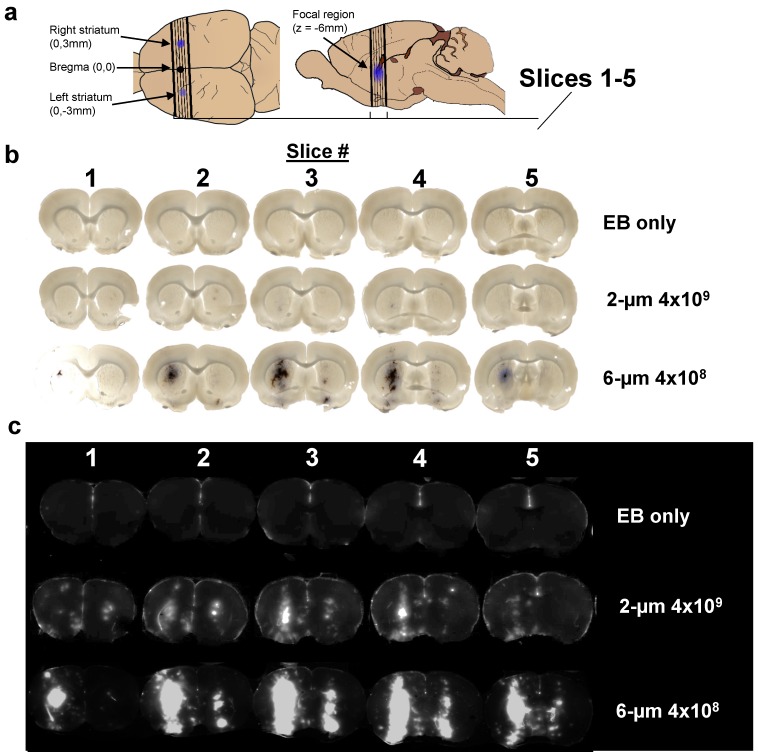
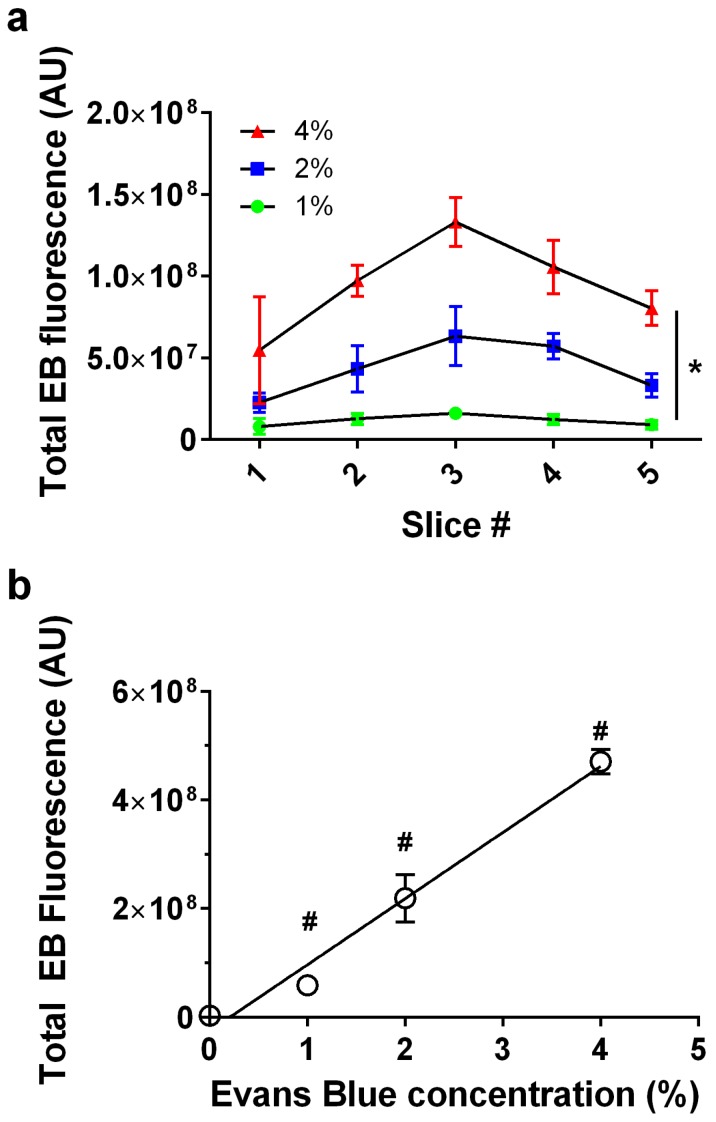
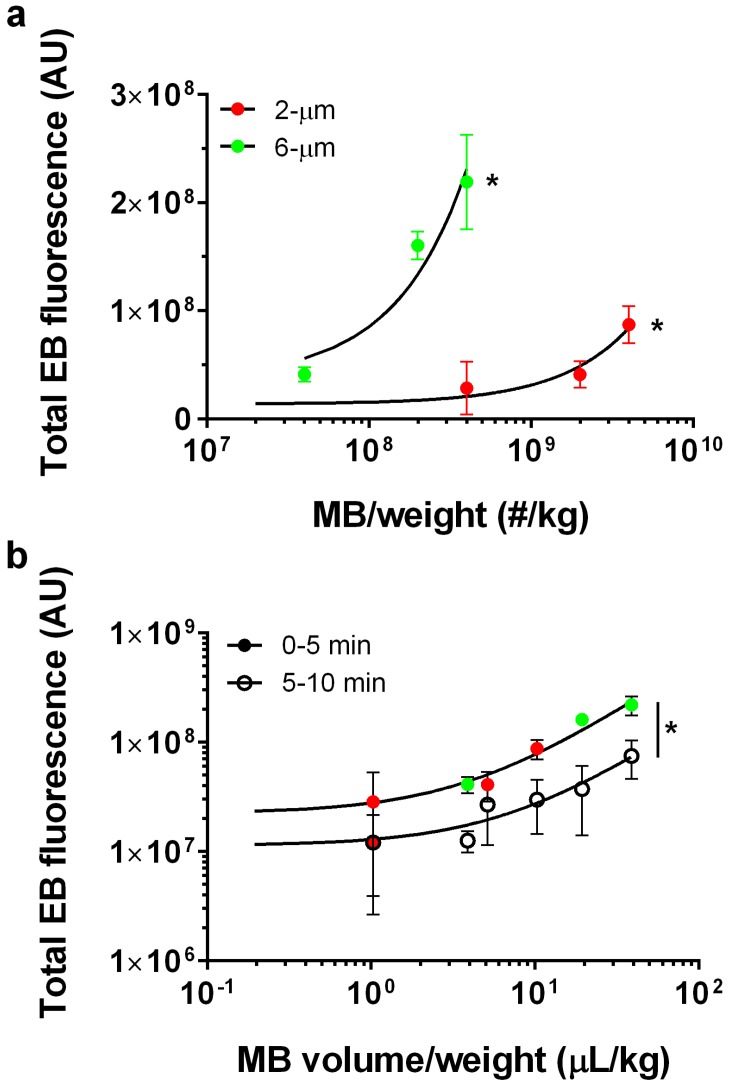
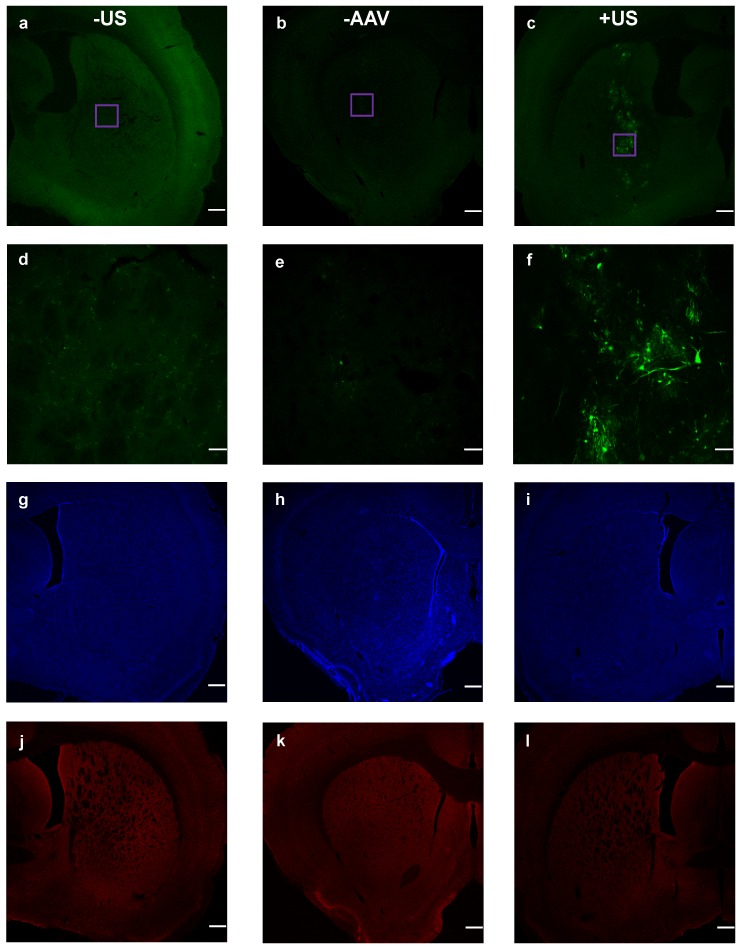
Focused ultrasound with microbubbles is being developed to transiently, locally and noninvasively open the blood-brain barrier (BBB) for improved pharmaceutical delivery. Prior work has demonstrated that, for a given concentration dose, microbubble size affects both the intravascular circulation persistence and extent of BBB opening. When matched to gas volume dose, however, the circulation half-life was found to be independent of microbubble size. In order to determine whether this holds true for BBB opening as well, we independently measured the effects of microbubble size (2 vs. 6 µm diameter) and concentration, covering a range of overlapping gas volume doses (1-40 µL/kg). We first demonstrated precise targeting and a linear dose-response of Evans Blue dye extravasation to the rat striatum for a set of constant microbubble and ultrasound parameters. We found that dye extravasation increased linearly with gas volume dose, with data points from both microbubble sizes collapsing to a single line. A linear trend was observed for both the initial sonication (R=0.90) and a second sonication on the contralateral side (R=0.68). Based on these results, we conclude that microbubble gas volume dose, not size, determines the extent of BBB opening by focused ultrasound (1 MHz, ~0.5 MPa at the focus). This result may simplify planning for focused ultrasound treatments by constraining the protocol to a single microbubble parameter - gas volume dose - which gives equivalent results for varying size distributions. Finally, using optimal parameters determined for Evan Blue, we demonstrated gene delivery and expression using a viral vector, dsAAV1-CMV-EGFP, one week after BBB disruption, which allowed us to qualitatively evaluate neuronal health.
聚焦超声联合微泡技术正在被研发,用于短暂、局部且无创地打开血脑屏障(BBB),以改善药物递送。先前的研究表明,对于给定的浓度剂量,微泡大小会影响血管内循环持续时间和血脑屏障开放程度。然而,当与气体体积剂量匹配时,发现循环半衰期与微泡大小无关。为了确定这是否也适用于血脑屏障开放,我们独立测量了微泡大小(直径2与6 µm)和浓度的影响,涵盖了一系列重叠的气体体积剂量(1 - 40 µL/kg)。我们首先展示了对于一组恒定的微泡和超声参数,伊文思蓝染料向大鼠纹状体的精确靶向和线性剂量反应。我们发现染料外渗随气体体积剂量呈线性增加,来自两种微泡大小的数据点汇聚成一条单一曲线。在初始超声处理(R = 0.90)和对侧第二次超声处理(R = 0.68)中均观察到线性趋势。基于这些结果,我们得出结论,微泡气体体积剂量而非大小决定了聚焦超声(1 MHz,焦点处约0.5 MPa)打开血脑屏障的程度。这一结果可能会简化聚焦超声治疗的规划,将方案限制为单一的微泡参数——气体体积剂量——对于不同的大小分布能给出等效结果。最后,使用为伊文思蓝确定的最佳参数,我们在血脑屏障破坏一周后,使用病毒载体dsAAV1 - CMV - EGFP展示了基因递送和表达,这使我们能够定性评估神经元健康状况。