Chengat Prakashbabu B, Thenmozhi V, Limon G, Kundu K, Kumar S, Garg R, Clark E L, Srinivasa Rao A S R, Raj D G, Raman M, Banerjee P S, Tomley F M, Guitian J, Blake D P
Department of Production and Population Health, Royal Veterinary College, North Mymms, Hertfordshire, UK.
Department of Veterinary Parasitology, Madras Veterinary College, Tamil Nadu Veterinary and Animal Sciences University, Chennai, India.
Vet Parasitol. 2017 Jan 15;233:62-72. doi: 10.1016/j.vetpar.2016.12.003. Epub 2016 Dec 6.
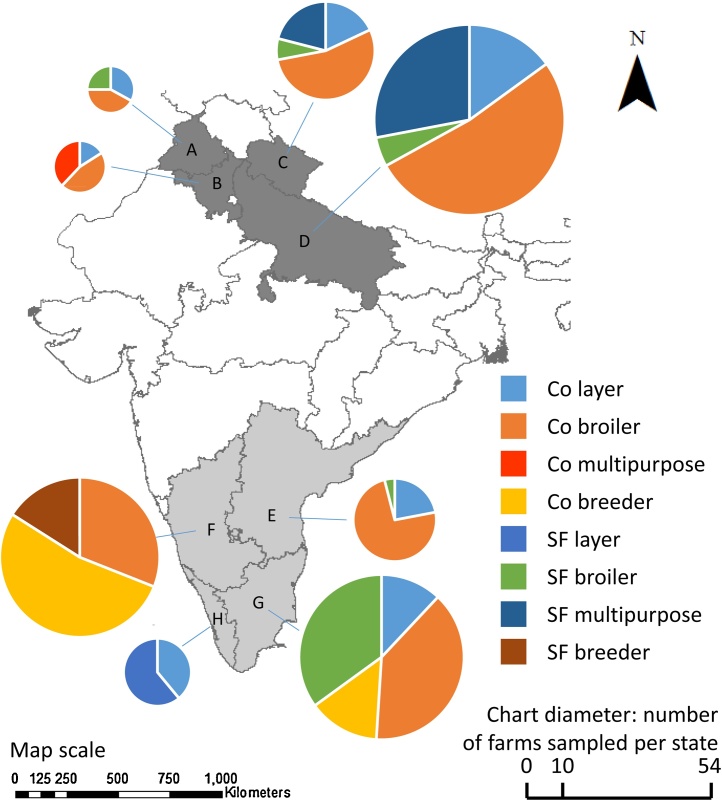
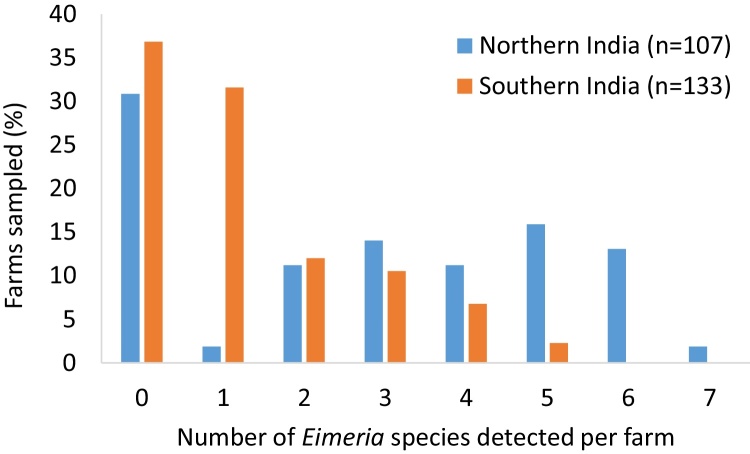
Coccidiosis is one of the biggest challenges faced by the global poultry industry. Recent studies have highlighted the ubiquitous distribution of all Eimeria species which can cause this disease in chickens, but intriguingly revealed a regional divide in genetic diversity and population structure for at least one species, Eimeria tenella. The drivers associated with such distinct geographic variation are unclear, but may impact on the occurrence and extent of resistance to anticoccidial drugs and future subunit vaccines. India is one of the largest poultry producers in the world and includes a transition between E. tenella populations defined by high and low genetic diversity. The aim of this study was to identify risk factors associated with the prevalence of Eimeria species defined by high and low pathogenicity in northern and southern states of India, and seek to understand factors which vary between the regions as possible drivers for differential genetic variation. Faecal samples and data relating to farm characteristics and management were collected from 107 farms from northern India and 133 farms from southern India. Faecal samples were analysed using microscopy and PCR to identify Eimeria occurrence. Multiple correspondence analysis was applied to transform correlated putative risk factors into a smaller number of synthetic uncorrelated factors. Hierarchical cluster analysis was used to identify poultry farm typologies, revealing three distinct clusters in the studied regions. The association between clusters and presence of Eimeria species was assessed by logistic regression. The study found that large-scale broiler farms in the north were at greatest risk of harbouring any Eimeria species and a larger proportion of such farms were positive for E. necatrix, the most pathogenic species. Comparison revealed a more even distribution for E. tenella across production systems in south India, but with a lower overall occurrence. Such a polarised region- and system-specific distribution may contribute to the different levels of genetic diversity observed previously in India and may influence parasite population structure across much of Asia and Africa. The findings of the study can be used to prioritise target farms to launch and optimise appropriate anticoccidial strategies for long-term control.
球虫病是全球家禽业面临的最大挑战之一。最近的研究强调了所有艾美耳属物种在全球的广泛分布,这些物种均可导致鸡感染此病,但有趣的是,研究揭示了至少一种球虫——柔嫩艾美耳球虫在遗传多样性和种群结构上存在区域差异。造成这种明显地理差异的驱动因素尚不清楚,但可能会影响抗球虫药物和未来亚单位疫苗的耐药性出现情况及程度。印度是世界上最大的家禽生产国之一,其国内由高遗传多样性和低遗传多样性定义的柔嫩艾美耳球虫种群之间存在过渡区域。本研究的目的是确定印度北部和南部各州高致病性和低致病性艾美耳属物种流行率的相关风险因素,并试图了解各地区之间存在差异的因素,这些因素可能是造成遗传差异的驱动因素。研究人员从印度北部的107个养殖场和南部的133个养殖场收集了粪便样本以及与养殖场特征和管理相关的数据。通过显微镜检查和聚合酶链反应(PCR)分析粪便样本,以确定艾美耳球虫的感染情况。运用多重对应分析将相关的假定风险因素转化为数量更少的综合不相关因素。采用层次聚类分析来确定家禽养殖场类型,结果在研究区域内发现了三个不同的类别。通过逻辑回归评估类别与艾美耳属物种存在之间的关联。研究发现,印度北部的大型肉鸡养殖场感染任何艾美耳属物种的风险最高,且此类养殖场中有较大比例对致病力最强的毒害艾美耳球虫呈阳性。比较结果显示,柔嫩艾美耳球虫在印度南部各生产系统中的分布更为均匀,但总体感染率较低。这种两极分化的区域和系统特异性分布可能导致了此前在印度观察到的不同水平的遗传多样性,并可能影响亚洲和非洲大部分地区的寄生虫种群结构。该研究结果可用于确定目标养殖场的优先级,以便推出并优化适当的抗球虫策略,实现长期防控。