Singhania Akul, Rupani Hitasha, Jayasekera Nivenka, Lumb Simon, Hales Paul, Gozzard Neil, Davies Donna E, Woelk Christopher H, Howarth Peter H
Clinical and Experimental Sciences, Faculty of Medicine, University of Southampton, Southampton, United Kingdom.
UCB Celltech, Slough, United Kingdom.
PLoS One. 2017 Jan 3;12(1):e0168680. doi: 10.1371/journal.pone.0168680. eCollection 2017.
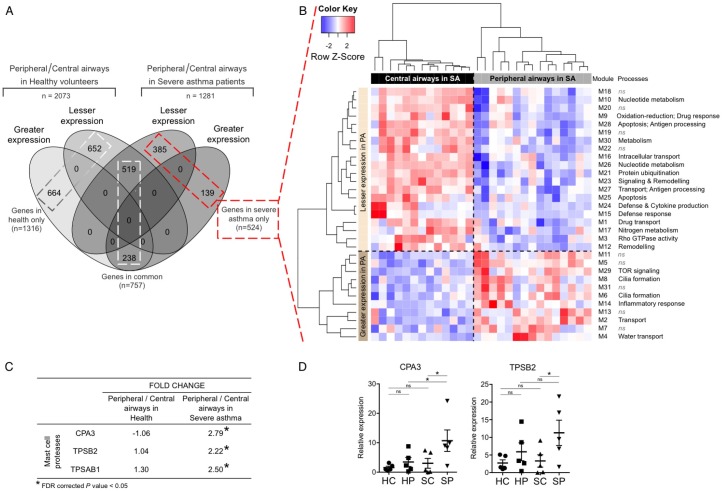
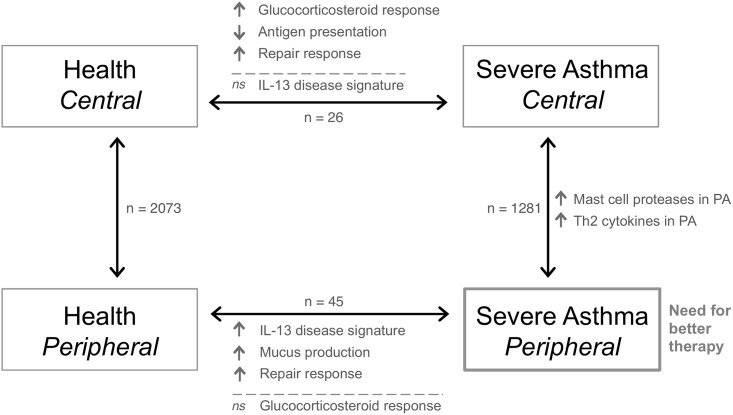
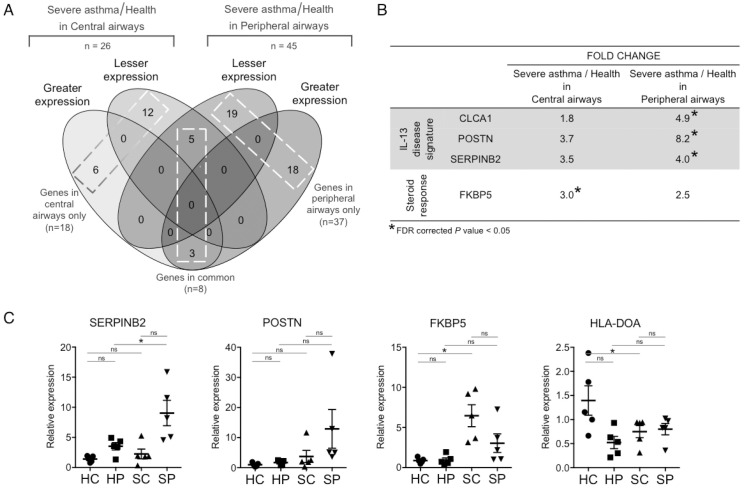
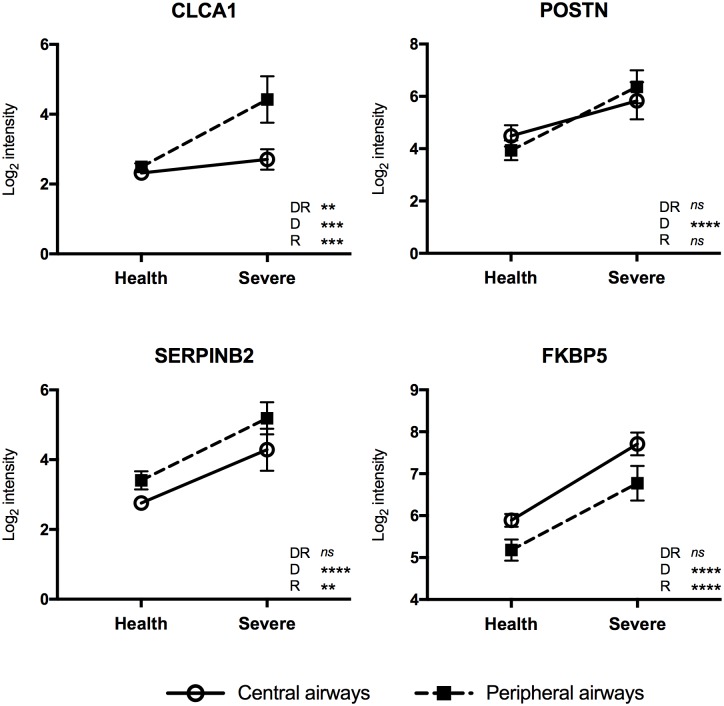
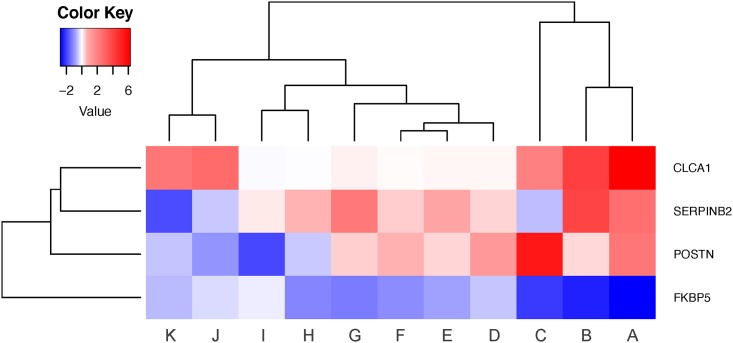
Management of severe asthma remains a challenge despite treatment with glucocorticosteroid therapy. The majority of studies investigating disease mechanisms in treatment-resistant severe asthma have previously focused on the large central airways, with very few utilizing transcriptomic approaches. The small peripheral airways, which comprise the majority of the airway surface area, remain an unexplored area in severe asthma and were targeted for global epithelial gene expression profiling in this study. Differences between central and peripheral airways were evaluated using transcriptomic analysis (Affymetrix HG U133 plus 2.0 GeneChips) of epithelial brushings obtained from severe asthma patients (N = 17) and healthy volunteers (N = 23). Results were validated in an independent cohort (N = 10) by real-time quantitative PCR. The IL-13 disease signature that is associated with an asthmatic phenotype was upregulated in severe asthmatics compared to healthy controls but was predominantly evident within the peripheral airways, as were genes related to mast cell presence. The gene expression response associated with glucocorticosteroid therapy (i.e. FKBP5) was also upregulated in severe asthmatics compared to healthy controls but, in contrast, was more pronounced in central airways. Moreover, an altered epithelial repair response (e.g. FGFBP1) was evident across both airway sites reflecting a significant aspect of disease in severe asthma unadressed by current therapies. A transcriptomic approach to understand epithelial activation in severe asthma has thus highlighted the need for better-targeted therapy to the peripheral airways in severe asthma, where the IL-13 disease signature persists despite treatment with currently available therapy.
尽管使用糖皮质激素疗法进行治疗,但重度哮喘的管理仍然是一项挑战。以前,大多数研究治疗抵抗性重度哮喘疾病机制的研究都集中在大气道,很少使用转录组学方法。构成气道表面积大部分的小外周气道在重度哮喘中仍是未被探索的领域,本研究将其作为全球上皮基因表达谱分析的目标。使用转录组分析(Affymetrix HG U133 plus 2.0基因芯片)对从重度哮喘患者(N = 17)和健康志愿者(N = 23)获得的上皮刷检样本进行分析,以评估中央气道和外周气道之间的差异。通过实时定量PCR在一个独立队列(N = 10)中对结果进行了验证。与哮喘表型相关的IL-13疾病特征在重度哮喘患者中相对于健康对照上调,但主要在外周气道中明显,与肥大细胞存在相关的基因也是如此。与糖皮质激素疗法相关的基因表达反应(即FKBP5)在重度哮喘患者中相对于健康对照也上调,但相比之下,在中央气道中更明显。此外,在两个气道部位均明显存在上皮修复反应改变(例如FGFBP1),这反映了重度哮喘疾病中当前疗法未解决的一个重要方面。因此,一种用于了解重度哮喘上皮激活的转录组学方法突出了对重度哮喘外周气道进行更有针对性治疗的必要性,在重度哮喘中,尽管使用了现有疗法进行治疗,但IL-13疾病特征仍然存在。