Chen Qing, Weng Ziyi, Lu Yunshu, Jia Yijun, Ding Longlong, Bai Fang, Ge Meixin, Lin Qing, Wu Kejin
Department of General Surgery, XinHua Hospital, Shanghai Jiao Tong University School of Medicine, Shanghai, China.
Department of General Surgery, Shanghai International Medical Center, Shanghai, China.
PLoS One. 2017 Jan 3;12(1):e0168960. doi: 10.1371/journal.pone.0168960. eCollection 2017.
To investigate the effects of trastuzumab (herceptin) and fulvestrant (falsodex) either in combination or alone, on downstream cell signaling pathways in lab-cultured human HR+/HER2+ breast cancer cell lines ZR-75-1 and BT-474, as well as on protein expression levels in mouse xenograft tissue.
Cells were cultivated in the presence of trastuzumab or fulvestrant or both. Molecular events that resulted in an inhibition of cell proliferation and cell cycle progression or in an increased rate of apoptosis were studied. The distribution and abundance of the proteins p-Akt and p-Erk expressed in these cells in response to single agents or combinatorial treatment were also investigated. In addition, the effects of trastuzumab and fulvestrant, either as single agents or in combination on tumor growth as well as on expression of the protein p-MED1 expressed in in vivo mouse xenograft models was also examined.
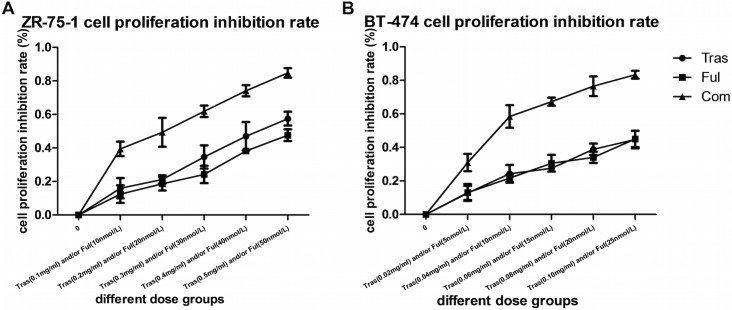
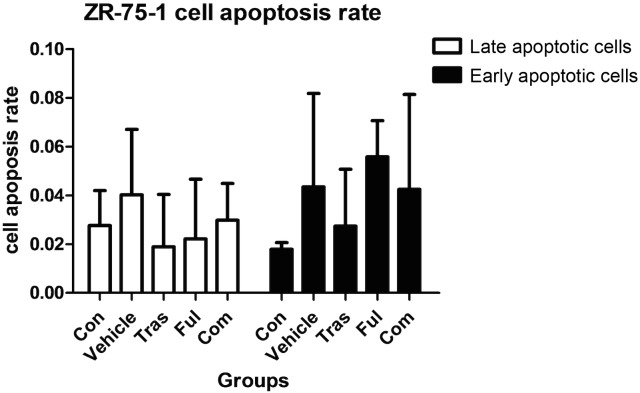
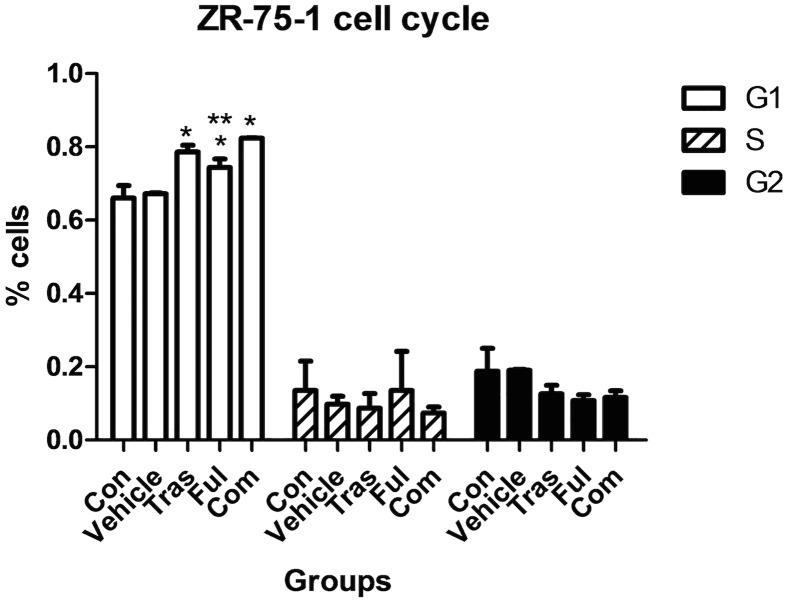
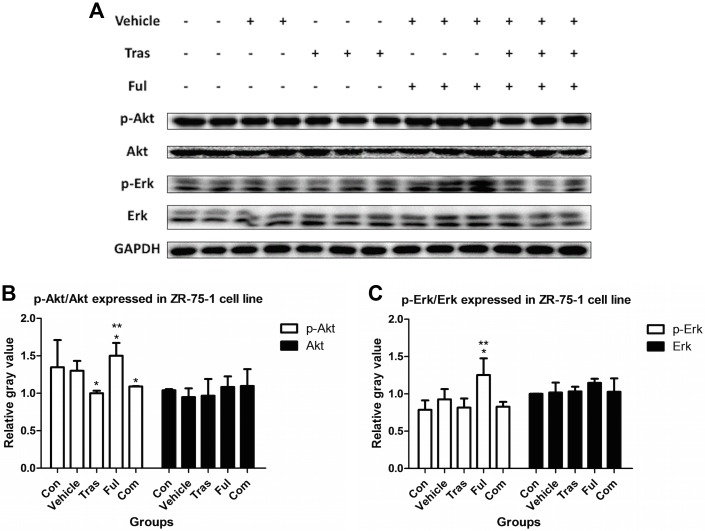
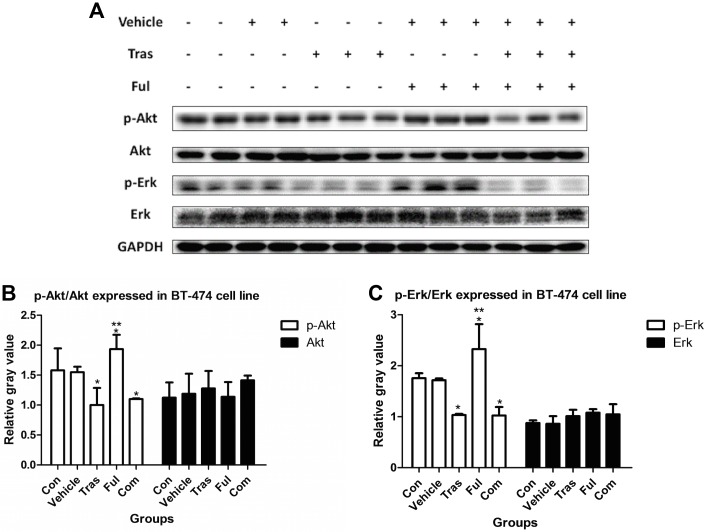
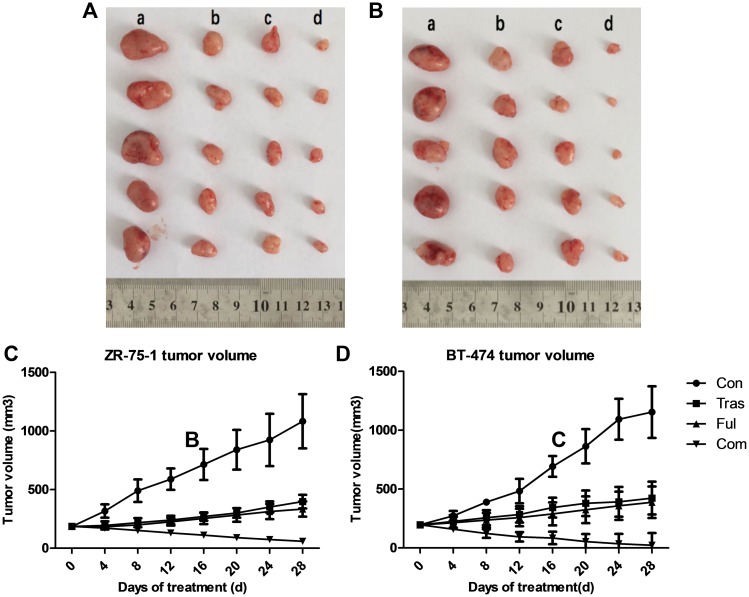
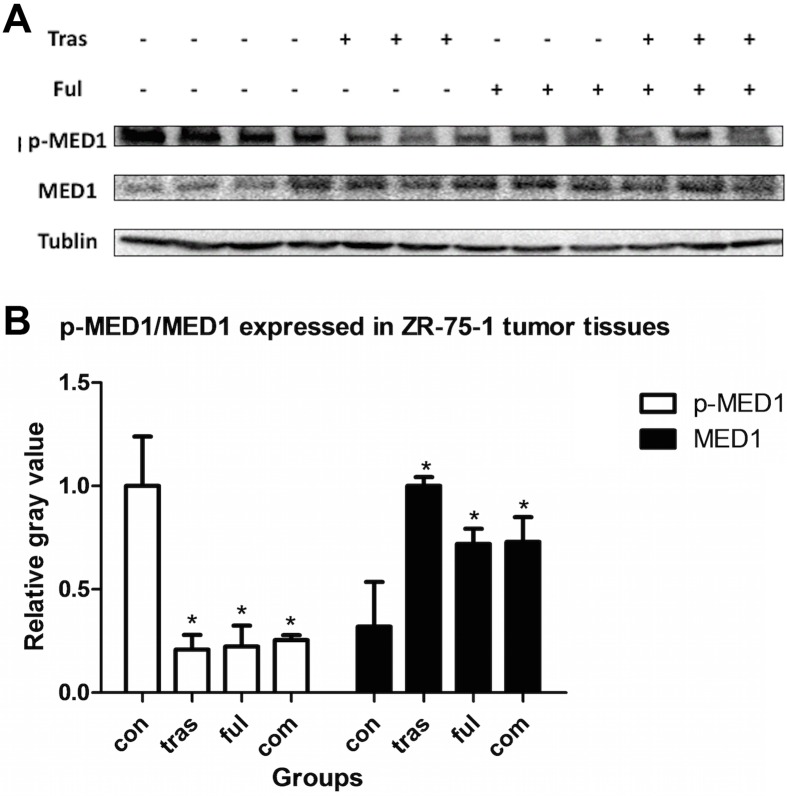
Cell proliferation was increasingly inhibited by trastuzumab or fulvestrant or both, with a CI<1 and DRI>1 in both human cell lines. The rate of apoptosis increased only in the BT-474 cell line and not in the ZR-75-1 cell line upon treatment with fulvestrant and not trastuzumab as a single agent (P<0.05). Interestingly, fulvestrant, in combination with trastuzumab, did not significantly alter the rate of apoptosis (in comparison with fulvestrant alone), in the BT-474 cell line (P>0.05). Cell accumulation in the G1 phase of cell cycle was investigated in all treatment groups (P<0.05), and the combination of trastuzumab and fulvestrant reversed the effects of fulvestrant alone on p-Akt and p-Erk protein expression levels. Using ZR-75-1 or BT-474 to generate in vivo tumor xenografts in BALB/c athymic mouse models, we showed that a combination of both drugs resulted in a stronger inhibition of tumor growth (P<0.05) and a greater decrease in the levels of activated MED1 (p-MED1) expressed in tumor issues compared with the use of either drug as a single agent.
We demonstrate that the administration of trastuzumab and fulvestrant in combination results in positive synergistic effects on both, ZR-75-1 and BT-474 cell lines. This combinatorial approach is likely to reduce physiological side effects of both drugs, thus providing a theoretical basis for the use of such combination treatment in order to resolve HR+/HER2+ triple positive breast cancer that has previously been shown to be resistant to endocrine treatment alone.
研究曲妥珠单抗(赫赛汀)和氟维司群(芙仕得)单独或联合使用对实验室培养的人HR+/HER2+乳腺癌细胞系ZR-75-1和BT-474下游细胞信号通路以及小鼠异种移植组织中蛋白质表达水平的影响。
在曲妥珠单抗或氟维司群或两者存在的情况下培养细胞。研究导致细胞增殖抑制、细胞周期进程受阻或凋亡率增加的分子事件。还研究了这些细胞中响应单一药物或联合治疗而表达的p-Akt和p-Erk蛋白的分布和丰度。此外,还检测了曲妥珠单抗和氟维司群单独或联合使用对体内小鼠异种移植模型中肿瘤生长以及p-MED1蛋白表达的影响。
曲妥珠单抗或氟维司群或两者联合使用对细胞增殖的抑制作用越来越强,在两种人细胞系中CI<1且DRI>1。单独使用氟维司群而非曲妥珠单抗处理后,仅BT-474细胞系的凋亡率增加,而ZR-75-1细胞系未增加(P<0.05)。有趣的是,在BT-474细胞系中,氟维司群与曲妥珠单抗联合使用并未显著改变凋亡率(与单独使用氟维司群相比)(P>0.05)。在所有治疗组中研究了细胞周期G1期的细胞积累情况(P<0.05),曲妥珠单抗和氟维司群联合使用逆转了氟维司群单独对p-Akt和p-Erk蛋白表达水平的影响。使用ZR-75-1或BT-474在BALB/c无胸腺小鼠模型中生成体内肿瘤异种移植,我们发现与单独使用任何一种药物相比,两种药物联合使用对肿瘤生长的抑制作用更强(P<0.05),并且肿瘤组织中表达的活化MED1(p-MED1)水平下降幅度更大。
我们证明曲妥珠单抗和氟维司群联合给药对ZR-75-1和BT-474细胞系均产生积极的协同作用。这种联合方法可能会降低两种药物的生理副作用,从而为使用这种联合治疗以解决先前已证明对单独内分泌治疗耐药的HR+/HER