Freidoony Leila, Kim Chun Bae, Haghani Hamid, Park Myung Bae, Chang Sei Jin, Kim Sang Ha, Koh Sang Baek
Department of Preventive Medicine, Yonsei University Wonju College of Medicine, Wonju, Korea.
Institute for Poverty Alleviation and International Development, Yonsei University, Wonju, Korea.
J Korean Med Sci. 2017 Feb;32(2):278-286. doi: 10.3346/jkms.2017.32.2.278.
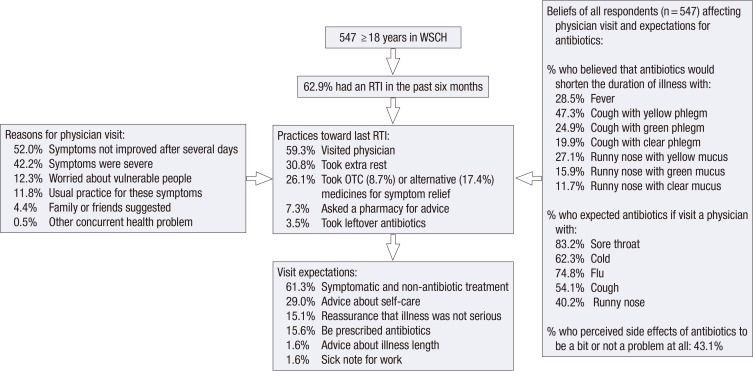
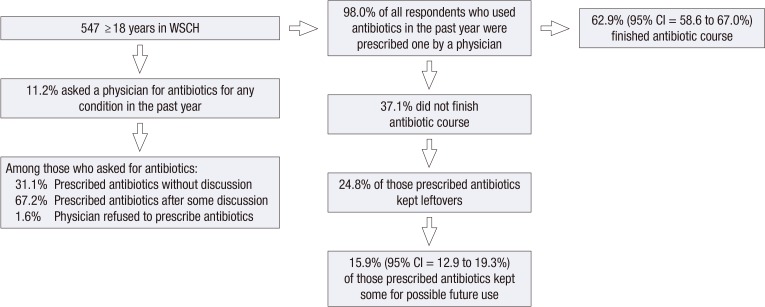
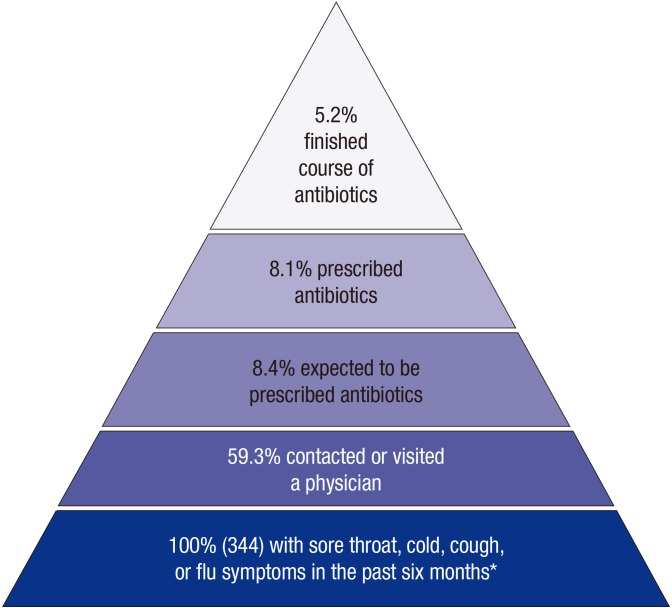
Antibiotic resistance is steadily rising worldwide. Respiratory tract infections (RTIs) are common indications, mostly imprudent, for antibiotic prescriptions in outpatient setting. In Korea, antibiotic prescription rate for RTIs is still high. As physician visit and antibiotic prescribing are influenced by patient's perceptions and beliefs, we aimed to explore the general public's perspectives and practices toward RTIs and to develop the 'RTI clinical iceberg.' A cross-sectional survey was conducted in Wonju Severance Christian Hospital (WSCH) among 550 adults attending outpatient departments during January 2016. Differences in distributions between groups were examined using two-tailed Pearson χ² test. Using the Andersen's behavioral model as a conceptual framework, we constructed logistic regression models to assess factors associated with physician visit. Of 547 participants with complete questionnaires, 62.9% reported having experienced an RTI in the previous six months; 59.3% visited a physician for the illness, most commonly because the symptoms were severe or prolonged, and approximately 16% of them expected an antibiotic prescription from the visit. Perceptions of symptoms severity, the need factor, most strongly influenced physician visit. Predisposing and enabling factors such as inappropriate expectations for antibiotic for a sore throat or having national health insurance also influenced physician visit. Almost all participants who reported asking for an antibiotic were prescribed one, with a 37.1% non-adherence rate. Conclusively, public education on self-care for RTI symptoms that addresses their main concerns may reduce physician visits. Improving physician-patient relationship and informing patients about the lack of antibiotic benefit for most RTIs may also reduce antibiotic prescriptions.
抗生素耐药性在全球范围内正稳步上升。呼吸道感染(RTIs)是门诊环境中抗生素处方的常见指征,且大多使用不当。在韩国,RTIs的抗生素处方率仍然很高。由于患者的认知和信念会影响就医及抗生素处方行为,我们旨在探究公众对RTIs的看法和做法,并构建“RTI临床冰山模型”。2016年1月,我们在原州圣母医院(WSCH)对550名门诊成年患者进行了横断面调查。采用双侧Pearson χ²检验分析组间分布差异。以安德森行为模型为概念框架,构建逻辑回归模型以评估与就医相关的因素。在547名完成问卷的参与者中,62.9%报告在过去六个月内经历过RTIs;59.3%因该病就医,最常见的原因是症状严重或持续时间长,其中约16%期望就医时能开具抗生素处方。对症状严重程度的认知,即需求因素,对就医的影响最为强烈。诸如对喉咙痛使用抗生素的不恰当期望或拥有国民健康保险等前置因素和促成因素也会影响就医。几乎所有报告要求开具抗生素的参与者都得到了处方,其中有37.1%的不依从率。总之,针对公众主要担忧的RTIs症状自我护理进行公众教育可能会减少就医次数。改善医患关系并告知患者大多数RTIs使用抗生素并无益处,也可能会减少抗生素处方。