Polat Bülent, Kaiser Philipp, Wohlleben Gisela, Gehrke Thomas, Scherzad Agmal, Scheich Matthias, Malzahn Uwe, Fischer Thomas, Vordermark Dirk, Flentje Michael
Department of Radiation Oncology, University of Würzburg, Josef-Schneider-Straße 11, 97080, Würzburg, Germany.
Department of Oto-Rhino-Laryngology, Plastic, Aesthetic and Reconstructive Head and Neck Surgery, University of Würzburg, Würzburg, Germany.
BMC Cancer. 2017 Jan 3;17(1):6. doi: 10.1186/s12885-016-3024-4.
In head and neck cancer little is known about the kinetics of osteopontin (OPN) expression after tumor resection. In this study we evaluated the time course of OPN plasma levels before and after surgery.
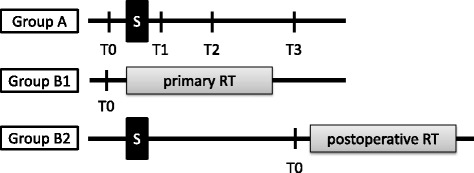
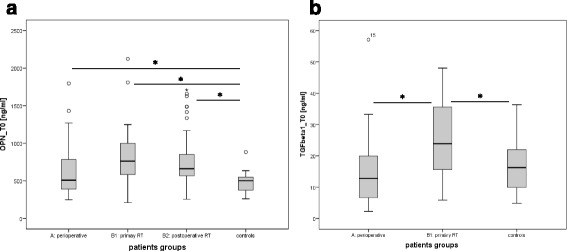
Between 2011 and 2013 41 consecutive head and neck cancer patients were enrolled in a prospective study (group A). At different time points plasma samples were collected: T0) before, T1) 1 day, T2) 1 week and T3) 4 weeks after surgery. Osteopontin and TGFβ1 plasma concentrations were measured with a commercial ELISA system. Data were compared to 131 head and neck cancer patients treated with primary (n = 42) or postoperative radiotherapy (n = 89; group B1 and B2).
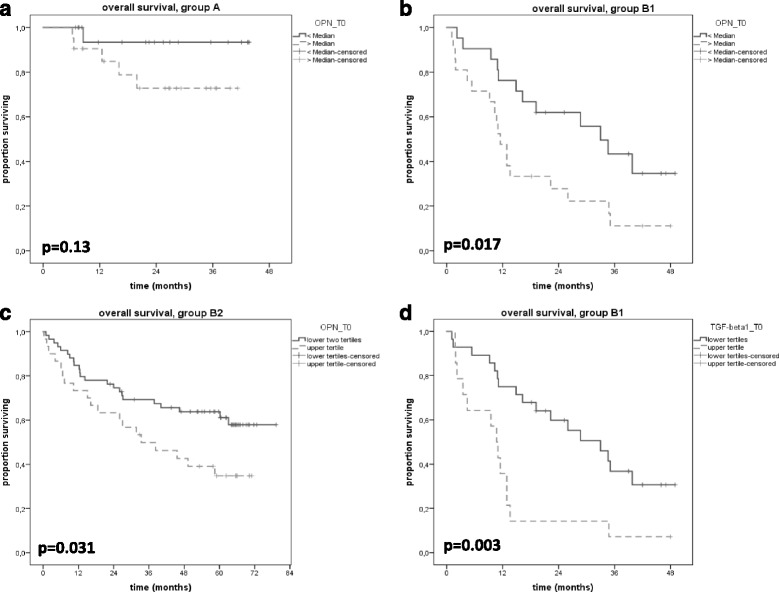
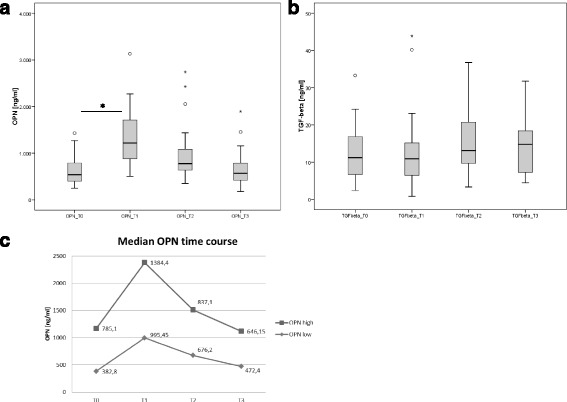
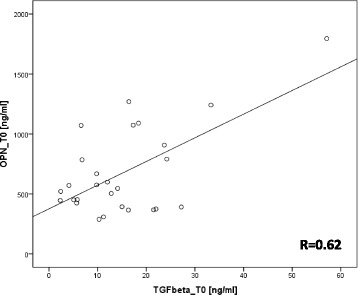
A significant OPN increase was seen as early as 1 day after surgery (T0 to T1, p < 0.01). OPN levels decreased to base line 3-4 weeks after surgery. OPN values were correlated with postoperative TGFβ1 expression suggesting a relation to wound healing. Survival analysis showed a significant benefit for patients with lower OPN levels both in the primary and postoperative radiotherapy group (B1: 33 vs 11.5 months, p = 0.017, B2: median not reached vs 33.4, p = 0.031). TGFβ1 was also of prognostic significance in group B1 (33.0 vs 10.7 months, p = 0.003).
Patients with head and neck cancer showed an increase in osteopontin plasma levels directly after surgery. Four weeks later OPN concentration decreased to pre-surgery levels. This long lasting increase was presumably associated to wound healing. Both pretherapeutic osteopontin and TGFβ1 had prognostic impact.
在头颈癌中,关于肿瘤切除后骨桥蛋白(OPN)表达的动力学知之甚少。在本研究中,我们评估了手术前后OPN血浆水平的时间进程。
2011年至2013年期间,41例连续的头颈癌患者被纳入一项前瞻性研究(A组)。在不同时间点采集血浆样本:T0)术前,T1)术后1天,T2)术后1周,T3)术后4周。使用商业ELISA系统测量骨桥蛋白和TGFβ1血浆浓度。将数据与131例接受原发(n = 42)或术后放疗(n = 89;B1组和B2组)的头颈癌患者进行比较。
术后1天(T0至T1)就观察到OPN显著升高(p < 0.01)。术后3 - 4周OPN水平降至基线。OPN值与术后TGFβ1表达相关,提示与伤口愈合有关。生存分析显示,在原发和术后放疗组中,OPN水平较低的患者有显著获益(B1组:33个月对11.5个月,p = 0.017;B2组:未达到中位数对33.4个月,p = 0.031)。TGFβ1在B1组中也具有预后意义(33.0个月对10.7个月,p = 0.003)。
头颈癌患者术后血浆骨桥蛋白水平直接升高。四周后OPN浓度降至术前水平。这种持续时间较长的升高可能与伤口愈合有关。治疗前的骨桥蛋白和TGFβ1均具有预后影响。