Vivanti Giacomo, Hocking Darren R, Fanning Peter, Dissanayake Cheryl
A.J. Drexel Autism Institute, Drexel University, 3020 Market Street, Suite 560, Philadelphia, PA 19104-3734 USA ; Olga Tennison Autism Research Centre, School of Psychology and Public Health, La Trobe University, Melbourne, Australia.
Developmental Neuromotor and Cognition Lab, School of Psychology and Public Health, La Trobe University, Melbourne, Australia.
J Neurodev Disord. 2016 Dec 30;8:46. doi: 10.1186/s11689-016-9180-7. eCollection 2016.
Early research has documented that young children show an increased interest toward objects that are verbally labeled by an adult, compared to objects that are presented without a label. It is unclear whether the same phenomenon occurs in neurodevelopmental disorders affecting social development, such as autism spectrum disorder (ASD) and Williams syndrome (WS).
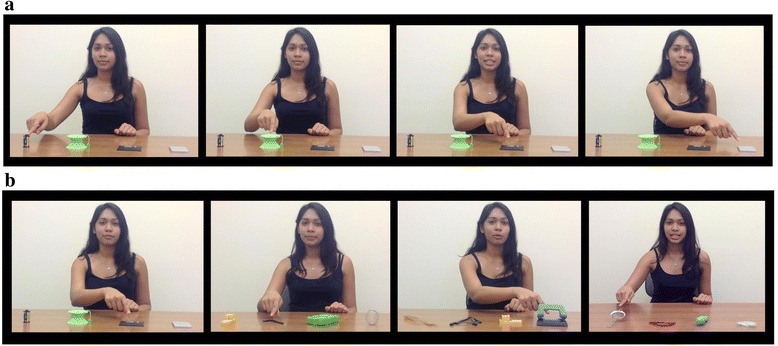
The present study used a novel eye-tracking paradigm to determine whether hearing a verbal label increases the salience of novel objects in 35 preschoolers with ASD, 18 preschoolers with WS, and 20 typically developing peers.
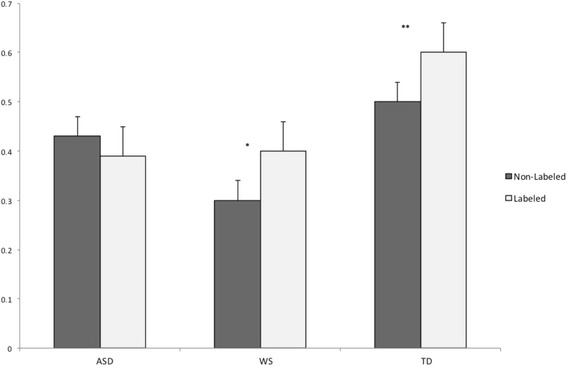
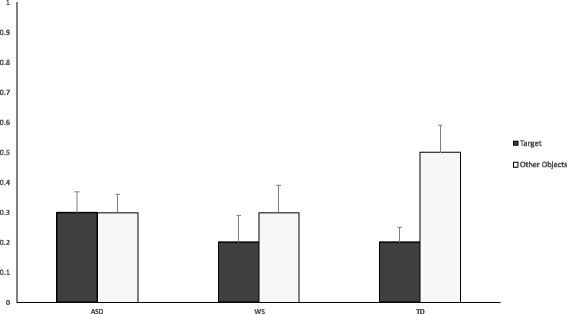
We found that typically developing children and those with WS, but not those with ASD, spent significantly more time looking at objects that are verbally labeled by an adult, compared to objects that are presented without a label.
In children without ASD, information accompanied by the speaker's verbal label is accorded a "special status," and it is more likely to be attended to. In contrast, children with ASD do not appear to attribute a special salience to labeled objects compared to non-labeled objects. This result is consistent with the notion that reduced responsivity to pedagogical cues hinders social learning in young children with ASD.
早期研究表明,与未加标签呈现的物体相比,幼儿对成人用语言标注的物体表现出更高的兴趣。目前尚不清楚在影响社会发展的神经发育障碍中,如自闭症谱系障碍(ASD)和威廉姆斯综合征(WS),是否会出现同样的现象。
本研究采用一种新颖的眼动追踪范式,以确定听到语言标签是否会增加35名患有ASD的学龄前儿童、18名患有WS的学龄前儿童和20名发育正常的同龄人对新物体的关注度。
我们发现,发育正常的儿童和患有WS的儿童,但不包括患有ASD的儿童,与未加标签呈现的物体相比,他们花在看成人用语言标注的物体上的时间明显更多。
在没有ASD的儿童中,伴随着说话者语言标签的信息被赋予了“特殊地位”,并且更有可能被关注。相比之下,与未加标签的物体相比,患有ASD的儿童似乎没有赋予加标签的物体特殊的显著性。这一结果与以下观点一致,即对教学线索反应性降低会阻碍患有ASD的幼儿的社会学习。