Chen Jin, Chen Qian, Hu Bo, Wang Yunji, Song Jinlin
Chongqing Key Laboratory for Oral Diseases and Biomedical Sciences, Chongqing Municipal Key Laboratory of Oral Biomedical Engineering of Higher Education, Chongqing Medical University College of Stomatology, Chongqing, China .
J Periodontal Implant Sci. 2016 Dec;46(6):382-395. doi: 10.5051/jpis.2016.46.6.382. Epub 2016 Dec 26.
Alendronate has been proposed as a local and systemic drug treatment used as an adjunct to scaling and root planing (SRP) for the treatment of periodontitis. However, its effectiveness has yet to be conclusively established. The purpose of the present meta-analysis was to assess the effectiveness of SRP with alendronate on periodontitis compared to SRP alone.
Five electronic databases were used by 2 independent reviewers to identify relevant articles from the earliest records up to September 2016. Randomized controlled trials (RCTs) comparing SRP with alendronate to SRP with placebo in the treatment of periodontitis were included. The outcome measures were changes in bone defect fill, probing depth (PD), and clinical attachment level (CAL) from baseline to 6 months. A fixed-effect or random-effect model was used to pool the extracted data, as appropriate. Mean differences (MDs) with 95% confidence intervals (CIs) were calculated. Heterogeneity was assessed using the Cochrane χ and I tests.
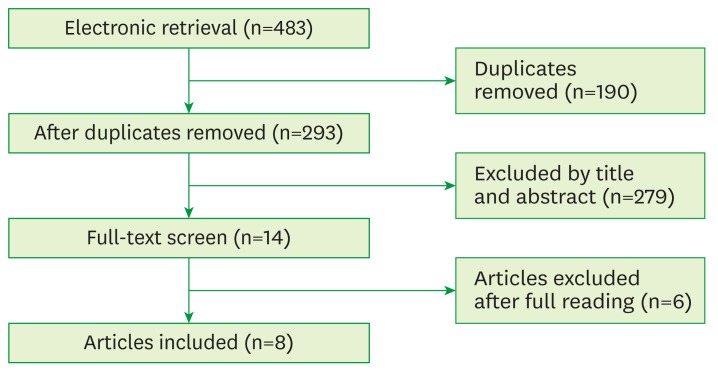
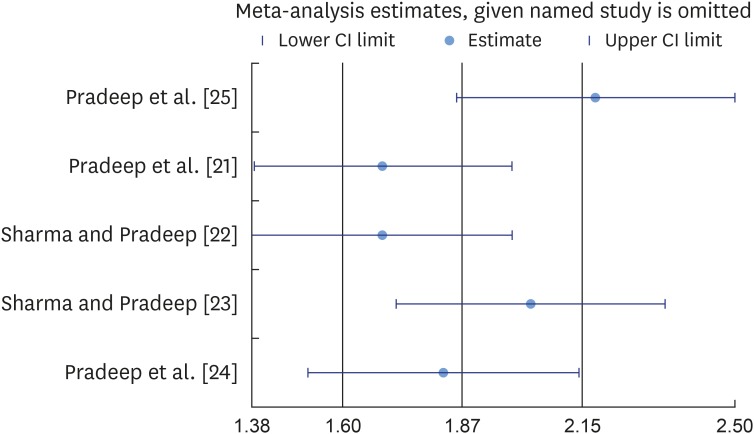
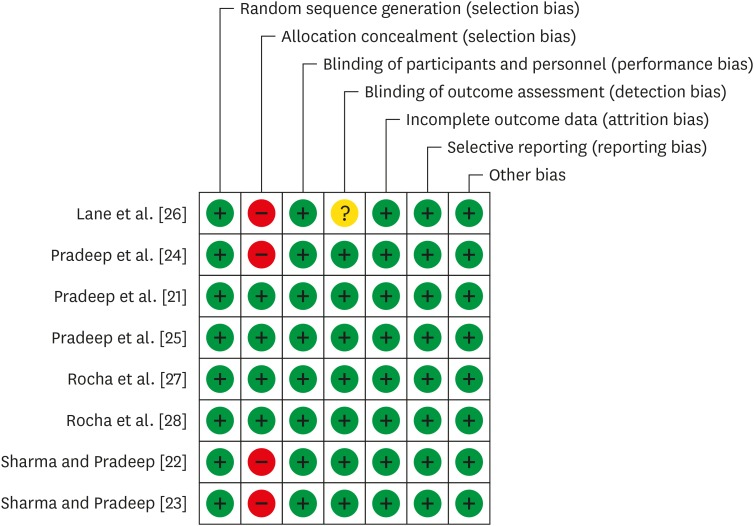
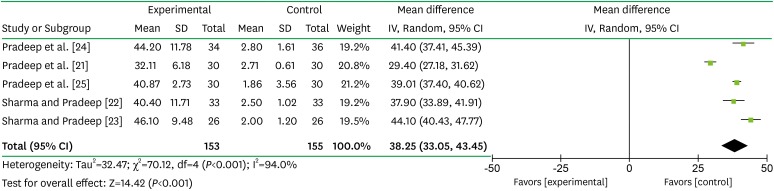
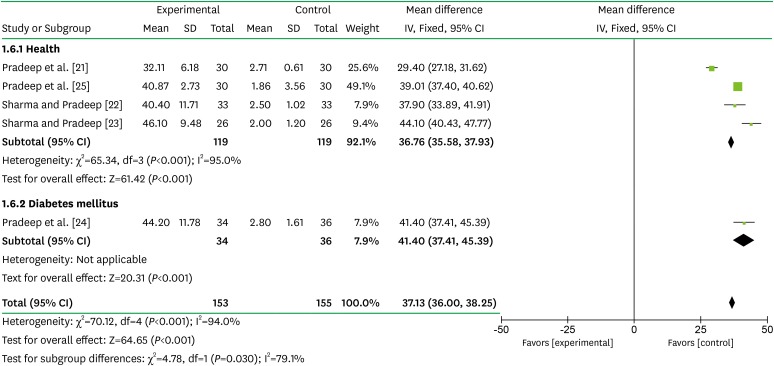
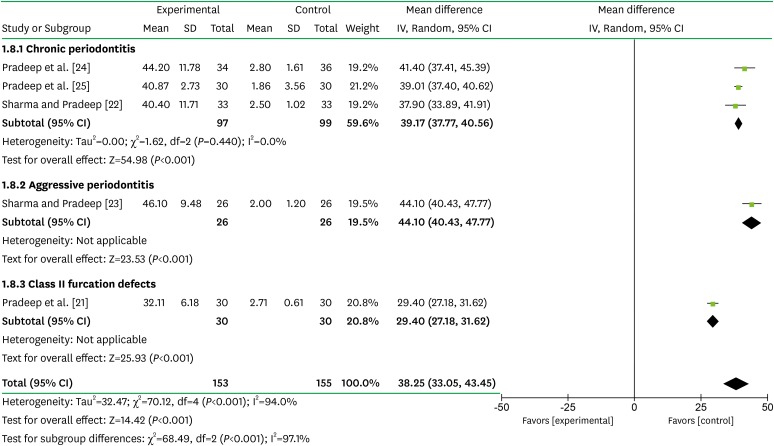
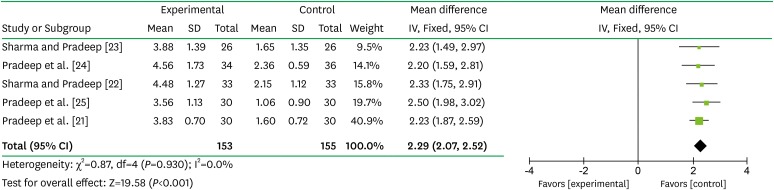
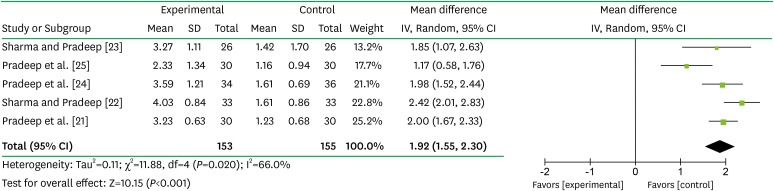
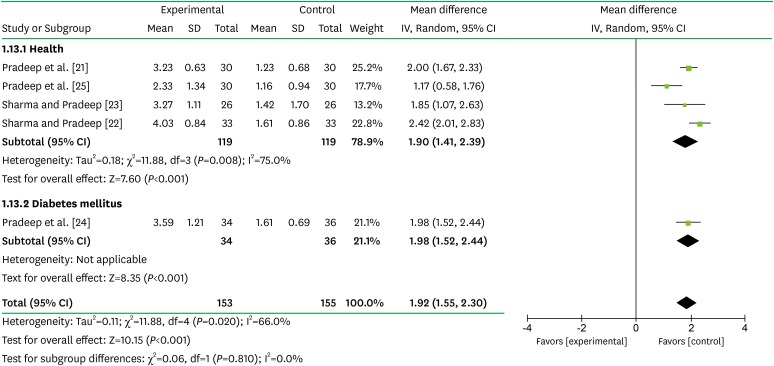
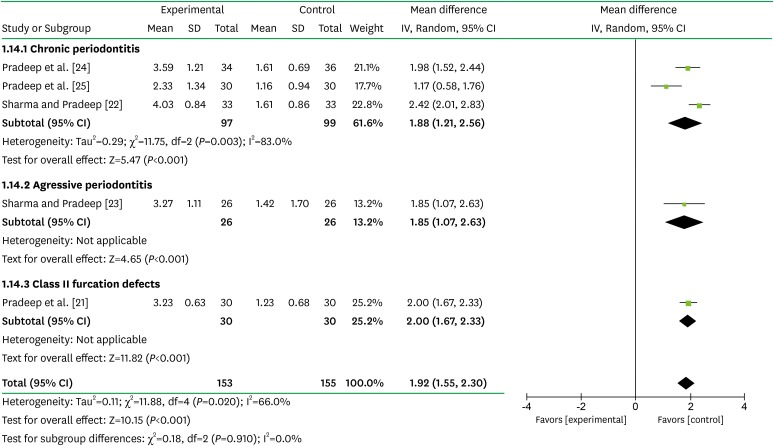
After the selection process, 8 articles were included in the meta-analysis. Compared with SRP alone, the adjunctive mean benefits of locally delivered alendronate were 38.25% for bone defect fill increase (95% CI=33.05-43.45; <0.001; I=94.0%), 2.29 mm for PD reduction (95% CI=2.07-2.52 mm; <0.001; I=0.0%) and 1.92 mm for CAL gain (95% CI=1.55-2.30 mm; <0.001; I=66.0%). In addition, systemically administered alendronate with SRP significantly reduced PD by 0.36 mm (95% CI=0.18-0.55 mm; <0.001; I=0.0%) and increased CAL by 0.39 mm (95% CI=0.11-0.68 mm; =0.006; I=6.0%).
The collective evidence regarding the adjunctive use of alendronate locally and systemically with SRP indicates that the combined treatment can improve the efficacy of non-surgical periodontal therapy on increasing CAL and bone defect fill and reducing PD. However, precautions must be exercised in interpreting these results, and multicenter studies evaluating this specific application should be carried out.
阿仑膦酸钠已被提议作为一种局部和全身用药,辅助龈下刮治术和根面平整术(SRP)用于治疗牙周炎。然而,其有效性尚未得到最终证实。本荟萃分析的目的是评估与单纯SRP相比,SRP联合阿仑膦酸钠治疗牙周炎的有效性。
两名独立评审员使用五个电子数据库,从最早记录到2016年9月识别相关文章。纳入比较SRP联合阿仑膦酸钠与SRP联合安慰剂治疗牙周炎的随机对照试验(RCT)。观察指标为从基线到6个月时骨缺损填充、探诊深度(PD)和临床附着水平(CAL)的变化。根据情况使用固定效应或随机效应模型汇总提取的数据。计算95%置信区间(CI)的平均差(MD)。使用Cochrane χ²和I²检验评估异质性。
经过筛选过程,8篇文章纳入荟萃分析。与单纯SRP相比,局部应用阿仑膦酸钠的附加平均益处为骨缺损填充增加38.25%(95%CI = 33.05 - 43.45;P < 0.001;I² = 94.0%),PD减少2.29 mm(95%CI = 2.07 - 2.52 mm;P < 0.001;I² = 0.0%),CAL增加1.92 mm(95%CI = 1.55 - 2.30 mm;P < 0.001;I² = 66.0%)。此外,SRP联合全身应用阿仑膦酸钠可使PD显著降低0.36 mm(95%CI = 0.18 - 0.55 mm;P < 0.001;I² = 0.0%),CAL增加0.39 mm(95%CI = 0.11 - 0.68 mm;P = 0.006;I² = 6.0%)。
关于局部和全身联合应用阿仑膦酸钠与SRP的综合证据表明,联合治疗可提高非手术牙周治疗在增加CAL、骨缺损填充和降低PD方面的疗效。然而,在解释这些结果时必须谨慎,并且应开展评估这种特定应用的多中心研究。