Tolppanen Heli, Rivas-Lasarte Mercedes, Lassus Johan, Sans-Roselló Jordi, Hartmann Oliver, Lindholm Matias, Arrigo Mattia, Tarvasmäki Tuukka, Köber Lars, Thiele Holger, Pulkki Kari, Spinar Jindrich, Parissis John, Banaszewski Marek, Silva-Cardoso Jose, Carubelli Valentina, Sionis Alessandro, Harjola Veli-Pekka, Mebazaa Alexandre
INSERM UMR-S942, Paris, France.
Heart Center, Päijät-Häme Central Hospital, Lahti, Finland.
Ann Intensive Care. 2017 Dec;7(1):6. doi: 10.1186/s13613-016-0229-2. Epub 2017 Jan 4.
The clinical CardShock risk score, including baseline lactate levels, was recently shown to facilitate risk stratification in patients with cardiogenic shock (CS). As based on baseline parameters, however, it may not reflect the change in mortality risk in response to initial therapies. Adrenomedullin is a prognostic biomarker in several cardiovascular diseases and was recently shown to associate with hemodynamic instability in patients with septic shock. The aim of our study was to evaluate the prognostic value and association with hemodynamic parameters of bioactive adrenomedullin (bio-ADM) in patients with CS.
CardShock was a prospective, observational, European multinational cohort study of CS. In this sub-analysis, serial plasma bio-ADM and arterial blood lactate measurements were collected from 178 patients during the first 10 days after detection of CS.
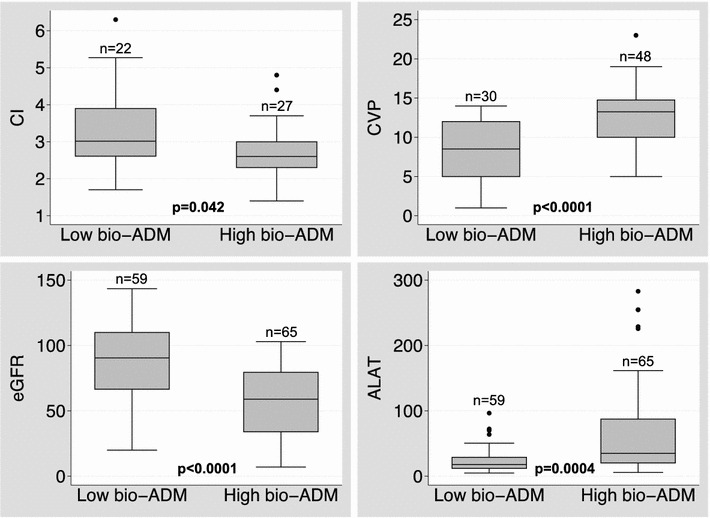
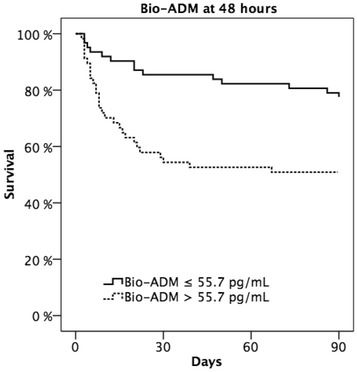
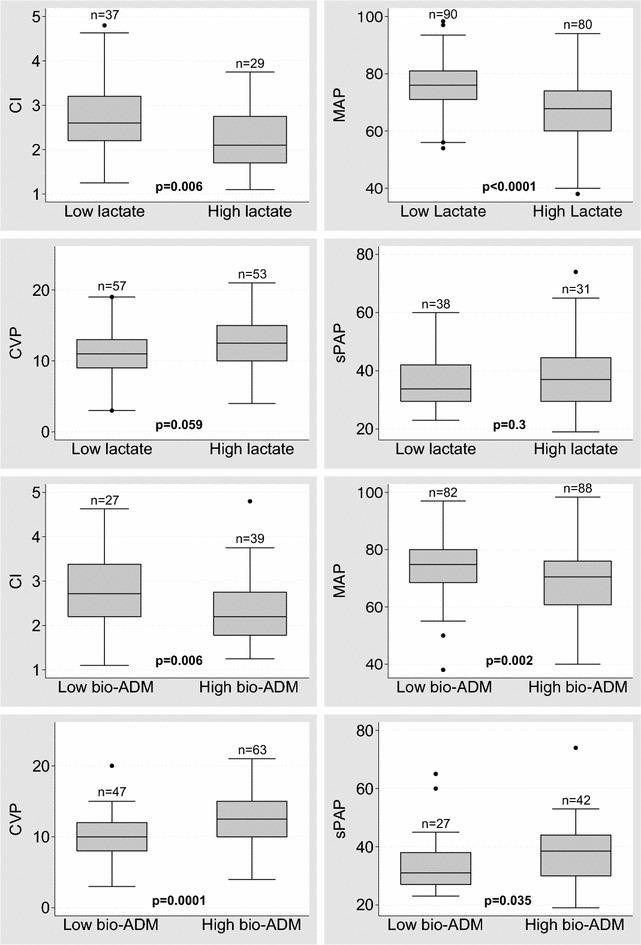
Both bio-ADM and lactate were higher in 90-day non-survivors compared to survivors at all time points (P < 0.05 for all). Lactate showed good prognostic value during the initial 24 h (AUC 0.78 at admission and 0.76 at 24 h). Subsequently, lactate returned normal (≤2 mmol/L) in most patients regardless of later outcome with lower prognostic value. By contrast, bio-ADM showed increasing prognostic value from 48 h and beyond (AUC 0.71 at 48 h and 0.80 at 5-10 days). Serial measurements of either bio-ADM or lactate were independent of and provided added value to CardShock risk score (P < 0.001 for both). Ninety-day mortality was more than double higher in patients with high levels of bio-ADM (>55.7 pg/mL) at 48 h compared to those with low bio-ADM levels (49.1 vs. 22.6%, P = 0.001). High levels of bio-ADM were associated with impaired cardiac index, mean arterial pressure, central venous pressure, and systolic pulmonary artery pressure during the study period. Furthermore, high levels of bio-ADM at 48 to 96 h were related to persistently impaired cardiac and end-organ function.
Bio-ADM is a valuable prognosticator and marker of impaired hemodynamics in CS patients. High levels of bio-ADM may show shock refractoriness and developing end-organ dysfunction and thus help to guide therapeutic approach in patients with CS. Study identifier of CardShock study NCT01374867 at clinicaltrials.gov.
临床CardShock风险评分,包括基线乳酸水平,最近被证明有助于心源性休克(CS)患者的风险分层。然而,基于基线参数,它可能无法反映初始治疗后死亡风险的变化。肾上腺髓质素是几种心血管疾病的预后生物标志物,最近被证明与感染性休克患者的血流动力学不稳定有关。我们研究的目的是评估生物活性肾上腺髓质素(bio-ADM)在CS患者中的预后价值及其与血流动力学参数的关系。
CardShock是一项关于CS的前瞻性、观察性、欧洲多中心队列研究。在这项亚分析中,在检测到CS后的前10天内,从178例患者中收集了系列血浆bio-ADM和动脉血乳酸测量值。
在所有时间点,90天非存活者的bio-ADM和乳酸水平均高于存活者(所有P<0.05)。乳酸在最初24小时内显示出良好的预后价值(入院时AUC为0.78,24小时时为0.76)。随后,大多数患者的乳酸恢复正常(≤2 mmol/L),无论后期结局如何,其预后价值降低。相比之下,bio-ADM从48小时及以后显示出越来越高的预后价值(48小时时AUC为0.71,5 - 10天时为0.80)。bio-ADM或乳酸的系列测量独立于CardShock风险评分并为其提供了附加价值(两者P<0.001)。与低bio-ADM水平的患者相比,48小时时bio-ADM水平高(>55.7 pg/mL)的患者90天死亡率高出两倍多(49.1%对22.6%,P = 0.001)。在研究期间,高bio-ADM水平与心脏指数、平均动脉压、中心静脉压和收缩期肺动脉压受损有关。此外,48至96小时时高bio-ADM水平与心脏和终末器官功能持续受损有关。
Bio-ADM是CS患者有价值的预后指标和血流动力学受损的标志物。高bio-ADM水平可能显示休克难治性和终末器官功能障碍的发展,从而有助于指导CS患者的治疗方法。CardShock研究在clinicaltrials.gov上的研究标识符为NCT01374867。