David Fabrice P A, Rougemont Jacques, Deplancke Bart
Bioinformatics and Biostatistics Core Facility, School of Life Sciences, Ecole Polytechnique Fédérale de Lausanne (EPFL), CH-1015 Lausanne, Switzerland.
Swiss Institute of Bioinformatics, CH-1015 Lausanne, Switzerland.
Nucleic Acids Res. 2017 Jan 4;45(D1):D56-D60. doi: 10.1093/nar/gkw913. Epub 2016 Oct 7.
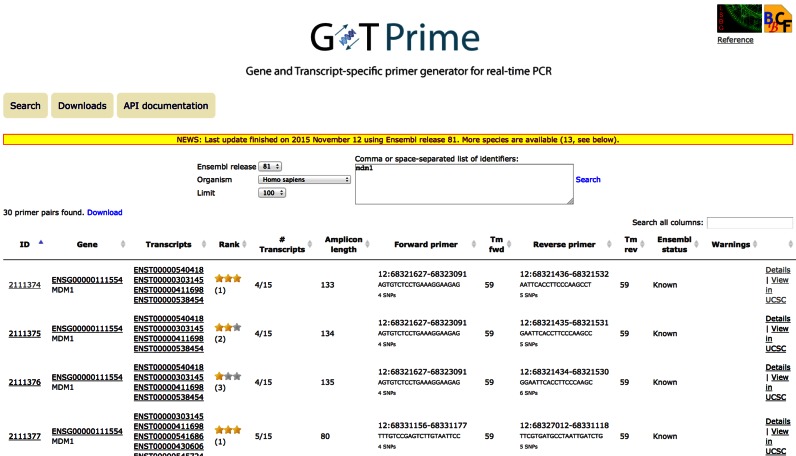
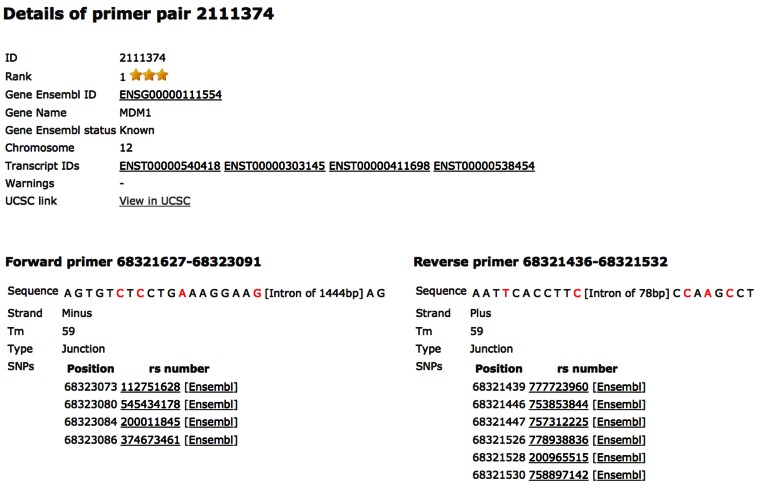
GETPrime (http://bbcftools.epfl.ch/getprime) is a database with a web frontend providing gene- and transcript-specific, pre-computed qPCR primer pairs. The primers have been optimized for genome-wide specificity and for allowing the selective amplification of one or several splice variants of most known genes. To ease selection, primers have also been ranked according to defined criteria such as genome-wide specificity (with BLAST), amplicon size, and isoform coverage. Here, we report a major upgrade (2.0) of the database: eight new species (yeast, chicken, macaque, chimpanzee, rat, platypus, pufferfish, and Anolis carolinensis) now complement the five already included in the previous version (human, mouse, zebrafish, fly, and worm). Furthermore, the genomic reference has been updated to Ensembl v81 (while keeping earlier versions for backward compatibility) as a result of re-designing the back-end database and automating the import of relevant sections of the Ensembl database in species-independent fashion. This also allowed us to map known polymorphisms to the primers (on average three per primer for human), with the aim of reducing experimental error when targeting specific strains or individuals. Another consequence is that the inclusion of future Ensembl releases and other species has now become a relatively straightforward task.
GETPrime(http://bbcftools.epfl.ch/getprime)是一个带有网络前端的数据库,它提供基因和转录本特异性的、预先计算好的qPCR引物对。这些引物已针对全基因组特异性进行了优化,以允许对大多数已知基因的一个或多个剪接变体进行选择性扩增。为便于选择,引物还根据定义的标准进行了排序,如全基因组特异性(通过BLAST)、扩增子大小和异构体覆盖范围。在此,我们报告该数据库的一次重大升级(2.0版):八个新物种(酵母、鸡、猕猴、黑猩猩、大鼠、鸭嘴兽、河豚和绿安乐蜥)现在补充了先前版本中已包含的五个物种(人类、小鼠、斑马鱼、果蝇和线虫)。此外,由于重新设计了后端数据库并以物种独立的方式自动导入Ensembl数据库的相关部分,基因组参考已更新为Ensembl v81(同时保留早期版本以实现向后兼容)。这也使我们能够将已知的多态性映射到引物上(人类引物平均每个有三个),目的是在针对特定菌株或个体时减少实验误差。另一个结果是,纳入未来的Ensembl版本和其他物种现在已成为一项相对简单的任务。