Feng Fei, Wang Bin, Sun Xiuxuan, Zhu Yumeng, Tang Hao, Nan Gang, Wang Lijuan, Wu Bo, Huhe Muren, Liu Shuangshuang, Diao Tengyue, Hou Rong, Zhang Yang, Zhang Zheng
a National Translational Science Center for Molecular Medicine , Department of Cell Biology , Fourth Military Medical University , Xi'an , P.R. China.
b Pacific Meinuoke Biopharmaceutical Company , Changzhou , P.R. China.
Cancer Biol Ther. 2017 Jan 2;18(1):51-62. doi: 10.1080/15384047.2016.1276126.
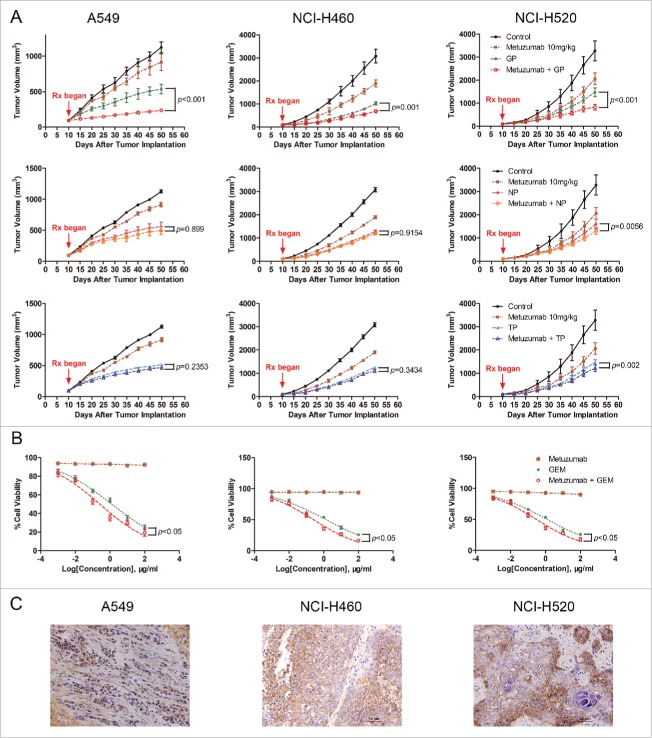
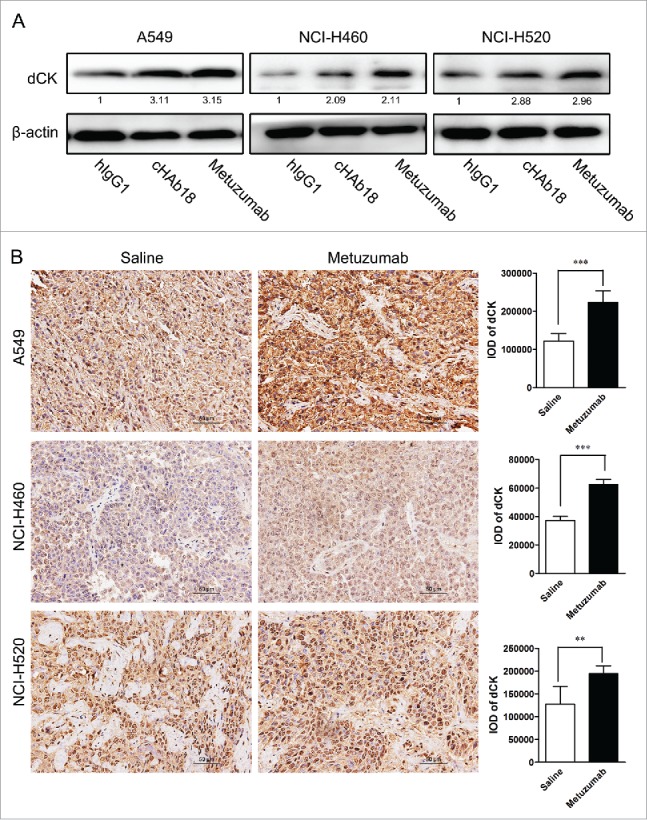
Targeted therapeutics is used as an alternative treatment of non-small cell lung cancer (NSCLC); however, treatment effect is far from being satisfactory, and therefore identification of new targets is needed. We have previously shown that metuzumab inhibit tumor growth in vivo. The present study was performed to investigate the anti-tumor efficacy of metuzumab combined with gemcitabine and cisplatin (GP), paclitaxel and cisplatin (TP) or navelbine and cisplatin (NP) regimens in multiple NSCLC cell lines. Our results demonstrate that, in comparison to single agent metuzumab or GP treated cells, metuzumab combined with GP display inhibitory effects on tumor growth. Furthermore, we found that metuzumab elevated the sensitivity of cell lines to gemcitabine, which was identified by MTT assay. Flow cytometric analysis showed that metuzumab combined with gemcitabine (GEM) treatment led to an obvious G1 arrest and an elevated apoptosis in A549, NCI-H460 and NCI-H520 cells. Western blot analysis also demonstrated a significantly reduced level of cyclin D1, Bcl-2, and an obviously increase level of Bax and full-length caspase-3 in A549, NCI-H460 and NCI-H520 cells treated with metuzumab/gemcitabine combination in comparison with single agent treated cells. In addition, metuzumab/gemcitabine treated A549, NCI-H460 and NCI-H520 cells also demonstrated a significantly increase in deoxycytidine kinase (dCK) protein level compared with single agent metuzumab or gemcitabine treated cells. Xenograft models also demonstrated that this metuzumab/gemcitabine combination led to upregulation of dCK. Taken together, the mechanisms of metuzumab combined with GP repress tumor growth were that the combined treatment significantly inhibited the tumor cell proliferation, apoptosis and cell cycle in vitro and in vivo and at least partially by induction of dCK expression. Our results suggested that metuzumab could significantly enhance chemosensitivity of human NSCLC cells to gemcitabine. Metuzumab/gemcitabine combination treatment may be a potentially useful therapeutic regimen for NSCLC patients.
靶向治疗被用作非小细胞肺癌(NSCLC)的一种替代治疗方法;然而,治疗效果远不能令人满意,因此需要确定新的靶点。我们之前已经表明美妥珠单抗在体内可抑制肿瘤生长。本研究旨在探讨美妥珠单抗联合吉西他滨和顺铂(GP)、紫杉醇和顺铂(TP)或长春瑞滨和顺铂(NP)方案对多种NSCLC细胞系的抗肿瘤疗效。我们的结果表明,与单药美妥珠单抗或GP处理的细胞相比,美妥珠单抗联合GP对肿瘤生长具有抑制作用。此外,我们发现美妥珠单抗提高了细胞系对吉西他滨的敏感性,这通过MTT法得以确定。流式细胞术分析表明,美妥珠单抗联合吉西他滨(GEM)处理导致A549、NCI-H460和NCI-H520细胞出现明显的G1期阻滞和凋亡增加。蛋白质印迹分析还表明,与单药处理的细胞相比,美妥珠单抗/吉西他滨联合处理的A549、NCI-H460和NCI-H520细胞中细胞周期蛋白D1、Bcl-2的水平显著降低,而Bax和全长caspase-3的水平明显升高。此外,与单药美妥珠单抗或吉西他滨处理的细胞相比,美妥珠单抗/吉西他滨处理的A549、NCI-H460和NCI-H520细胞中脱氧胞苷激酶(dCK)蛋白水平也显著升高。异种移植模型也表明这种美妥珠单抗/吉西他滨联合导致dCK上调。综上所述,美妥珠单抗联合GP抑制肿瘤生长的机制是联合治疗在体外和体内显著抑制肿瘤细胞增殖、凋亡和细胞周期,且至少部分是通过诱导dCK表达实现的。我们的结果表明美妥珠单抗可显著增强人NSCLC细胞对吉西他滨的化疗敏感性。美妥珠单抗/吉西他滨联合治疗可能是NSCLC患者一种潜在有用的治疗方案。