Wu Guo-Sheng, Cruz Ruy J, Cai Jun-Chao
Guo-Sheng Wu, Division of Gastrointestinal Surgery, Xijing Hospital of Digestive Diseases, the Fourth Military Medical University, Xi'an 710032, Shaanxi Province, China.
World J Transplant. 2016 Dec 24;6(4):719-728. doi: 10.5500/wjt.v6.i4.719.
To investigate the incidence, risk factors and clinical outcomes of acute antibody-mediated rejection (ABMR) after intestinal transplantation (ITx).
A retrospective single-center analysis was performed to identify cases of acute ABMR after ITx, based on the presence of donor-specific antibody (DSA), acute tissue damage, C4d deposition, and allograft dysfunction.
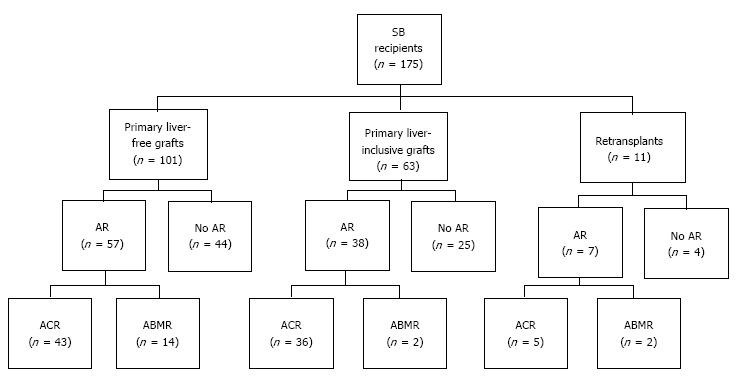
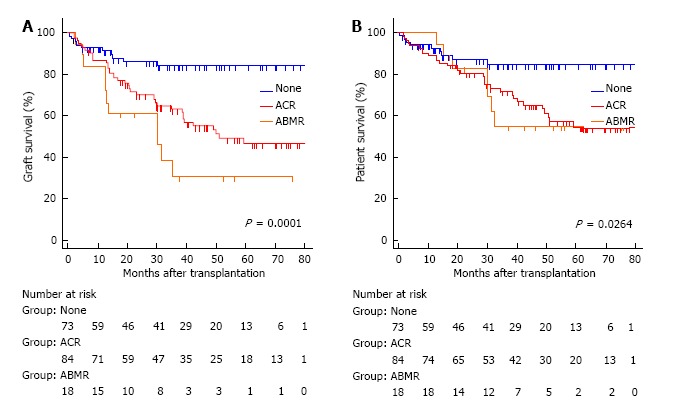
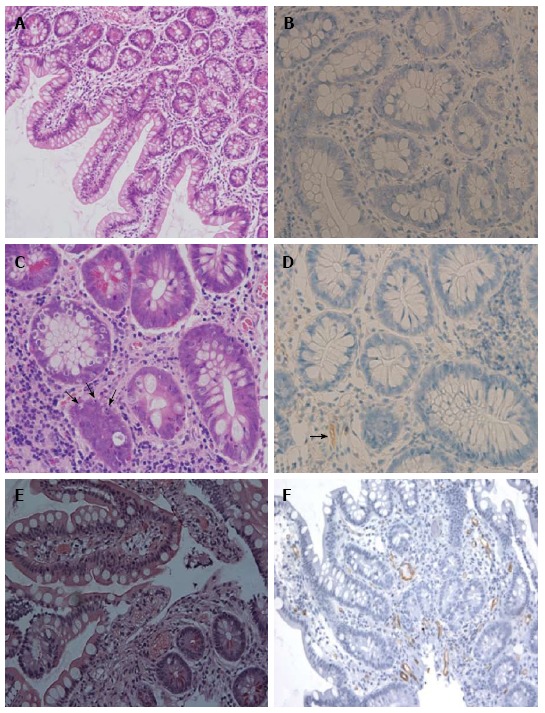
Acute ABMR was identified in 18 (10.3%) out of 175 intestinal allografts with an average occurrence of 10 d (range, 4-162) after ITx. All acute ABMR cases were presensitized to donor human leukocyte antigens class I and/or II antigens with a detectable DSA. A positive cross-match was seen in 14 (77.8%) cases and twelve of 18 patients (66.7%) produced newly-formed DSA following ITx. Histological characteristics of acute ABMR include endothelial C4d deposits, interstitial hemorrhage, and severe congestion with focal fibrin thrombin in the lamina propria capillaries. Multivariate analysis identified a liver-free graft and high level of panel reactive antibody as a significant independent risk factor. Despite initial improvement after therapy, eleven recipients (61.1%) lost transplant secondary to rejection. Of those, 9 (50%) underwent graft removal and 4 (22.2%) received second transplantation following acute ABMR. At an average follow-up of 32.3 mo (range, 13.3-76.4), 8 (44.4%) recipients died.
Our results indicate that acute ABMR is an important cause of intestine graft dysfunction, particularly in a liver-exclusive graft and survivors are at an increased risk of developing refractory acute rejection and chronic rejection. More effective strategies to prevent and manage acute ABMR are needed to improve outcomes.
探讨肠移植(ITx)后急性抗体介导性排斥反应(ABMR)的发生率、危险因素及临床结局。
基于供者特异性抗体(DSA)、急性组织损伤、C4d沉积及移植物功能障碍,进行回顾性单中心分析以确定ITx后急性ABMR病例。
175例肠移植受者中有18例(10.3%)发生急性ABMR,平均发生于ITx后10天(范围4 - 162天)。所有急性ABMR病例均对供者人类白细胞抗原I类和/或II类抗原致敏且可检测到DSA。14例(77.8%)病例交叉配型阳性,18例患者中有12例(66.7%)在ITx后产生新形成的DSA。急性ABMR的组织学特征包括内皮C4d沉积、间质出血以及固有层毛细血管严重充血伴局灶性纤维蛋白血栓形成。多因素分析确定无肝移植物和高群体反应性抗体水平是显著的独立危险因素。尽管治疗后最初有改善,但11例受者(61.1%)因排斥反应失去移植物。其中,9例(50%)接受了移植物切除,4例(22.2%)在急性ABMR后接受了二次移植。平均随访32.3个月(范围13.3 - 76.4个月),8例(44.4%)受者死亡。
我们的结果表明,急性ABMR是肠移植物功能障碍的重要原因,尤其是在仅行肝外移植时,幸存者发生难治性急性排斥反应和慢性排斥反应的风险增加。需要更有效的策略来预防和管理急性ABMR以改善结局。