Mieusset Roger, Walschaerts Marie, Isus François, Almont Thierry, Daudin Myriam, Hamdi Safouane M
Université Toulouse III-Paul Sabatier, Groupe de Recherche en Fertilité Humaine (Human Fertility Research Group), Toulouse, France.
Andrologie-Médecine de la Reproduction, Hôpital Paule de Viguier, CHU de Toulouse, Toulouse, France.
PLoS One. 2017 Jan 6;12(1):e0168742. doi: 10.1371/journal.pone.0168742. eCollection 2017.
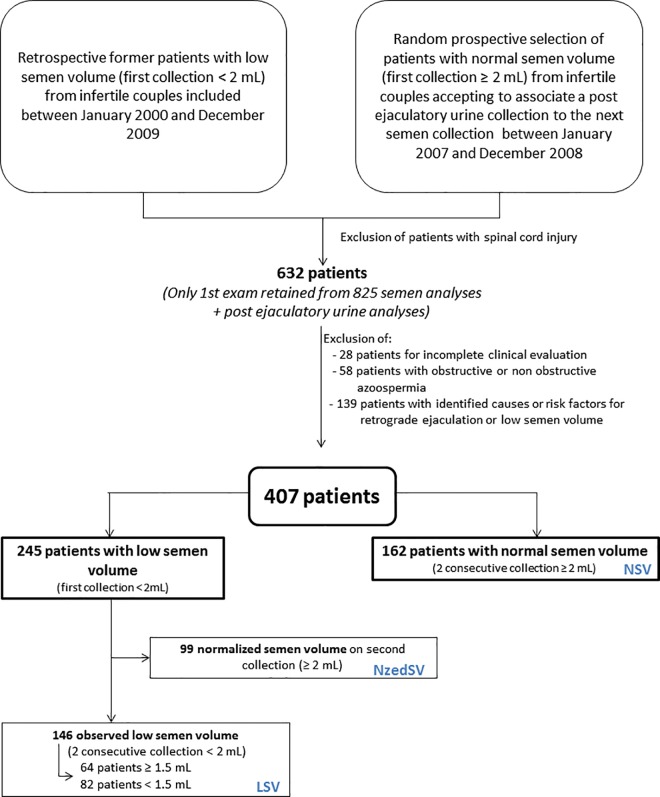
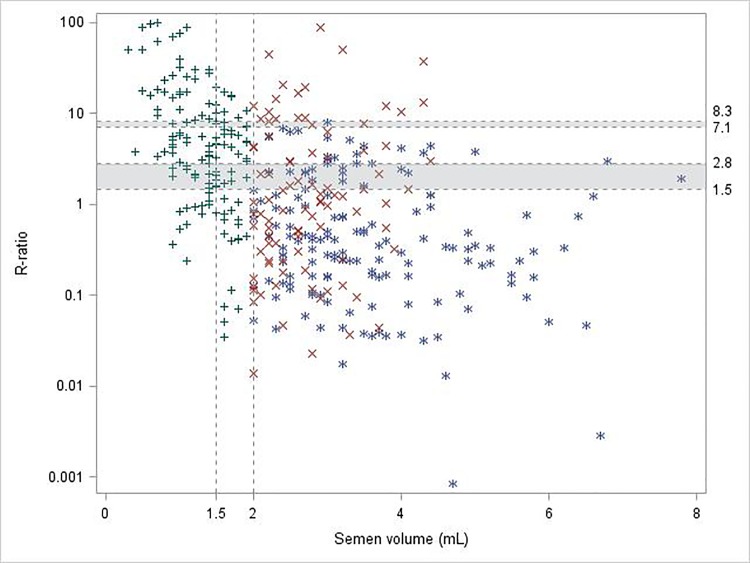
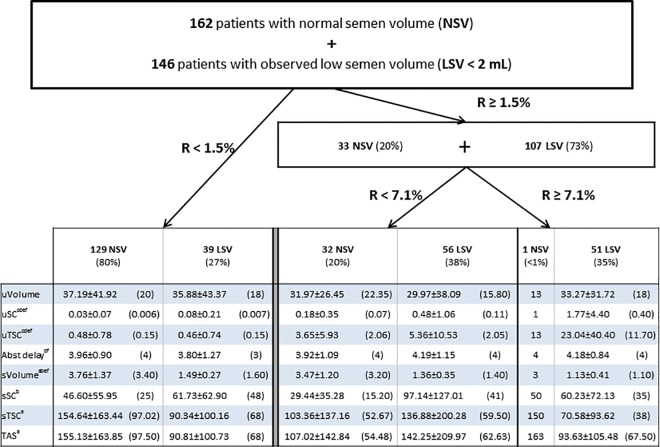
In non-azoospermic patients with low semen volume (LSV), looking for partial retrograde ejaculation (PRE) by searching sperm in the postejaculatory urine (PEU) is required. The use of a retro-ejaculatory index (R-ratio) was suggested to define PRE, but none of the studies indicated a specific threshold above which PRE must be considered. Our objective was to propose a threshold value for the R-ratio as indicative of PRE in patients with LSV selected to be devoid of any known causes or risk factors for retrograde ejaculation or LSV. Among our data base (2000-2009) including 632 patients with PEU, 245 male patients from infertile couples who had had a first semen analysis with LSV (< 2mL) and a second semen analysis associated with PEU, were selected on the previous criteria. A prospective control group was randomly constituted (2007-2008) of 162 first consulting male patients from infertile couples, with a normal semen volume (≥ 2mL) on a first semen analysis and who accepted to collect PEU with their usual second semen analysis, selected on the previous criteria. To define an R-ratio threshold indicative of PRE, we used a ROC curve analysis and a regression tree based on a classification and regression tree (CART) algorithm. Of the 245 LSV patients, 146 still presented low semen volume (< 2 mL) on the second semen analysis. From the use of the CART algorithm, two low (1.5% and 2.8%) and two high R-values (7.1% and 8.3%) were defined, according to the lower reference limit for semen volume of 2.0 mL (WHO 1999) or 1.5 mL (WHO 2010) respectively. As only one or no patient with normal semen volume was observed above the two high R-values, we suggest an R-value higher than the range of [7.1-8.3]% as indicative of PRE until confirmation by a prospective multicenter study.
对于精液量少(LSV)的非无精子症患者,需要通过检测射精后尿液(PEU)中的精子来排查部分逆行射精(PRE)。有人建议使用逆行射精指数(R比率)来定义PRE,但尚无研究指出一个特定的阈值,超过该阈值就必须考虑存在PRE。我们的目标是为R比率提出一个阈值,作为筛选出无任何已知逆行射精或LSV病因及风险因素的LSV患者中PRE的指标。在我们2000年至2009年包含632例PEU患者的数据库中,根据上述标准,选取了245例来自不育夫妇的男性患者,他们首次精液分析显示精液量少(<2mL),第二次精液分析与PEU相关。前瞻性对照组于2007年至2008年随机选取了162例首次就诊的不育夫妇男性患者,他们首次精液分析精液量正常(≥2mL),并同意在第二次常规精液分析时收集PEU,同样根据上述标准选取。为了确定指示PRE的R比率阈值,我们使用了基于分类与回归树(CART)算法的ROC曲线分析和回归树。在245例LSV患者中,146例在第二次精液分析时仍表现为精液量少(<2mL)。根据CART算法,分别依据世界卫生组织1999年精液量下限参考值2.0mL或2010年的1.5mL,定义了两个低(1.5%和2.8%)和两个高R值(7.1%和8.3%)。由于在两个高R值以上仅观察到1例或未观察到精液量正常的患者,我们建议将高于[7.1 - 8.3]%范围的R值作为PRE的指标,直至前瞻性多中心研究予以证实。