Lin Yi, Zhai Ertao, Liao Bing, Xu Lixia, Zhang Xinhua, Peng Sui, He Yulong, Cai Shirong, Zeng Zhirong, Chen Minhu
Department of Gastroenterology and Hepatology, The First Affiliated Hospital of Sun Yat-sen University, Guangzhou, Guangdong, P.R.China.
Department of Gastrointestinal Surgery, The First Affiliated Hospital of Sun Yat-sen University, Guangzhou, Guangdong, P.R.China.
Oncotarget. 2017 Feb 14;8(7):11990-12002. doi: 10.18632/oncotarget.14467.
Tumor cells produce vascular endothelial growth factor (VEGF) which interact with the membrane or cytoplasmic VEGF receptors (VEGFRs) to promote cell growth in an angiogenesis-independent fashion. Apatinib, a highly selective VEGFR2 inhibitor, is the only effective drug for patients with terminal gastric cancer (GC) who have no other chemotherapeutic options. However, its treatment efficacy is still controversy and the mechanism behind remains undetermined. In this study, we aimed to investigate the role of autocrine VEGF signaling in the growth of gastric cancer cells and the efficacy of Apatinib treatment.
The expression of phosphor VEGFR2 in gastric cancer cell lines was determined by real-time PCR, immunofluorescence, and Western blot. The gastric cancer cells were administrated with or without recombination human VEGF (rhVEGF), VEGFR2 neutralizing antibody, U73122, SU1498, and Apatinib. The nude mice were used for xenograft tumor model.
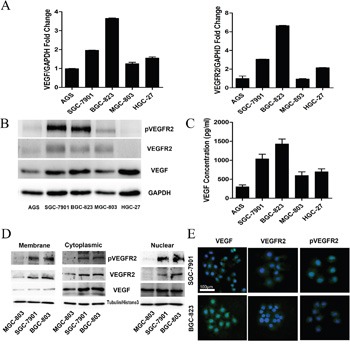
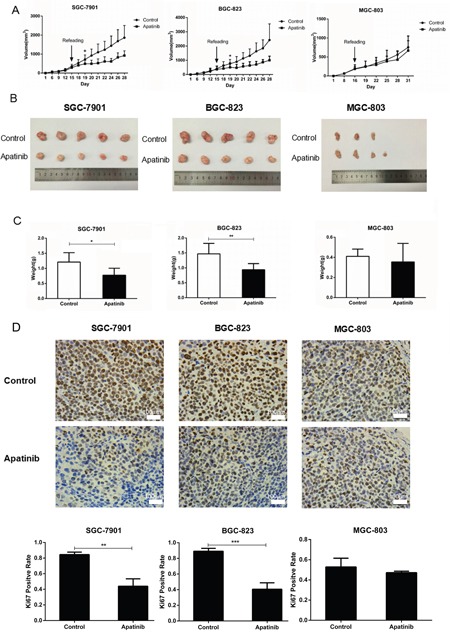
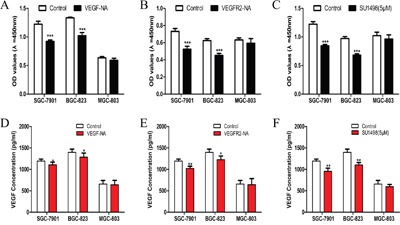
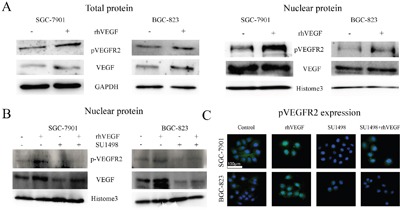
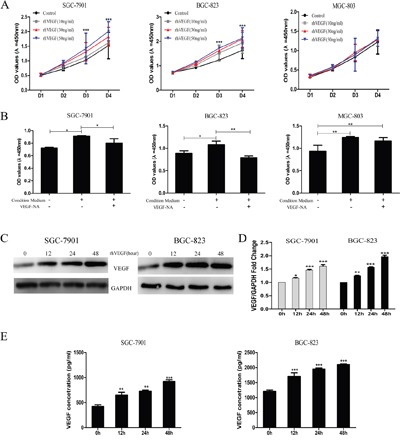
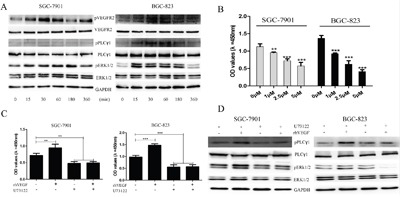
we found that autocrine VEGF induced high VEGFR2-expression, promoted phosphorylation of VEGFR2, and further enhanced internalization of pVEGFR2 in gastric cancer cells. The autocrine VEGF was self-sustained through increasing VEGF mRNA and protein expression. It exerted pro-proliferative effect through a PLC-ERK1/2 dependent pathway. Furthermore, we demonstrated that in VEGFR2 overexpressing gastric cancer cells, Apatinib inhibited cell proliferation in vitro and delayed xenograft tumor growth in vivo. However, these effects were not observed in VEGFR2 low expressing gastric cancer cells.
These results suggested that autocrine VEGF signaling promotes gastric cancer cell proliferation and enhances Apatinib treatment outcome in VEGFR2 overexpression gastric cancer cells both in vitro and in vivo. This study would enable better stratification of gastric cancer patients for clinical treatment decision.
肿瘤细胞产生血管内皮生长因子(VEGF),其与膜或细胞质VEGF受体(VEGFRs)相互作用,以非血管生成依赖的方式促进细胞生长。阿帕替尼是一种高度选择性的VEGFR2抑制剂,是晚期胃癌(GC)患者无其他化疗选择时唯一有效的药物。然而,其治疗效果仍存在争议,背后的机制尚不清楚。在本研究中,我们旨在探讨自分泌VEGF信号在胃癌细胞生长及阿帕替尼治疗效果中的作用。
通过实时PCR、免疫荧光和蛋白质印迹法测定胃癌细胞系中磷酸化VEGFR2的表达。对胃癌细胞给予或不给予重组人VEGF(rhVEGF)、VEGFR2中和抗体、U73122、SU1498和阿帕替尼。使用裸鼠建立异种移植肿瘤模型。
我们发现自分泌VEGF诱导胃癌细胞中VEGFR2高表达,促进VEGFR2磷酸化,并进一步增强pVEGFR2的内化。自分泌VEGF通过增加VEGF mRNA和蛋白质表达实现自我维持。它通过PLC-ERK1/2依赖途径发挥促增殖作用。此外,我们证明在VEGFR2过表达的胃癌细胞中,阿帕替尼在体外抑制细胞增殖,在体内延缓异种移植肿瘤生长。然而,在VEGFR2低表达的胃癌细胞中未观察到这些作用。
这些结果表明自分泌VEGF信号促进胃癌细胞增殖,并增强阿帕替尼在体外和体内对VEGFR2过表达胃癌细胞的治疗效果。本研究将有助于更好地对胃癌患者进行分层以做出临床治疗决策。