Marsh Elizabeth K, Delury Craig P, Davies Nicholas J, Weston Christopher J, Miah Mohammed A L, Banks Lawrence, Parish Joanna L, Higgs Martin R, Roberts Sally
Institute of Cancer and Genomic Sciences, University of Birmingham, Birmingham, United Kingdom.
Present address: Faculty of Medicine, Dentistry and Health, University of Sheffield, Sheffield, United Kingdom.
Oncotarget. 2017 Mar 21;8(12):19491-19506. doi: 10.18632/oncotarget.14469.
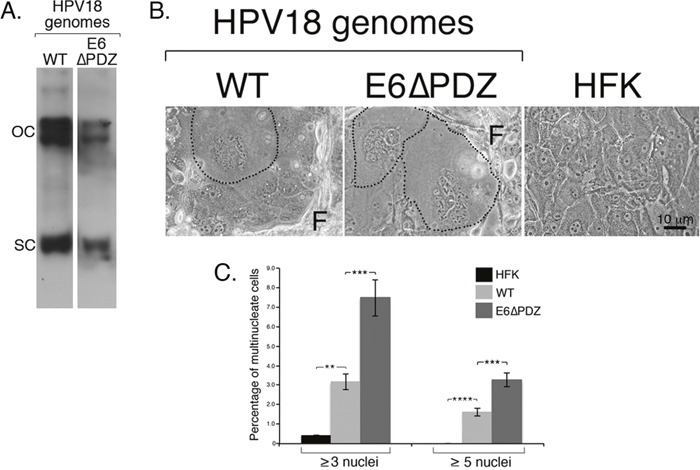
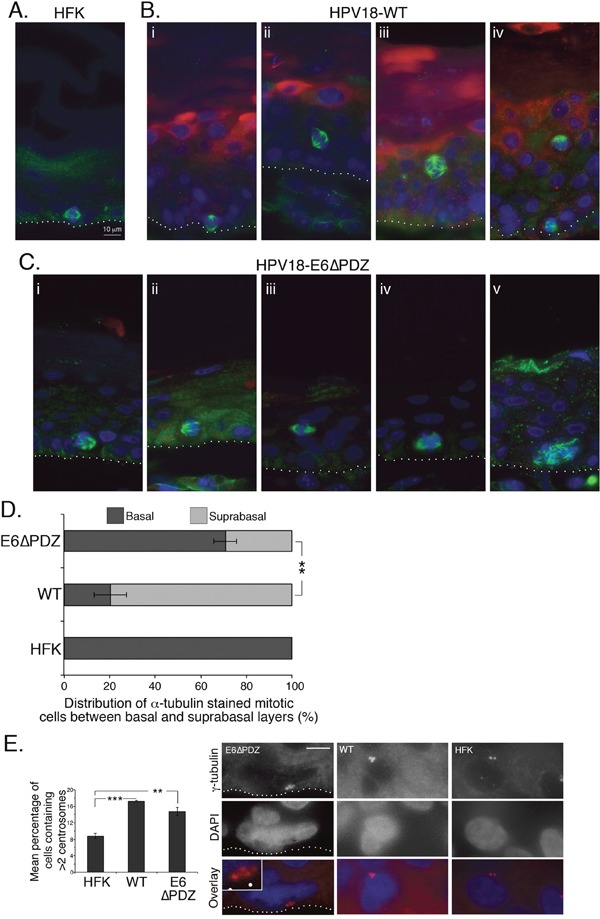
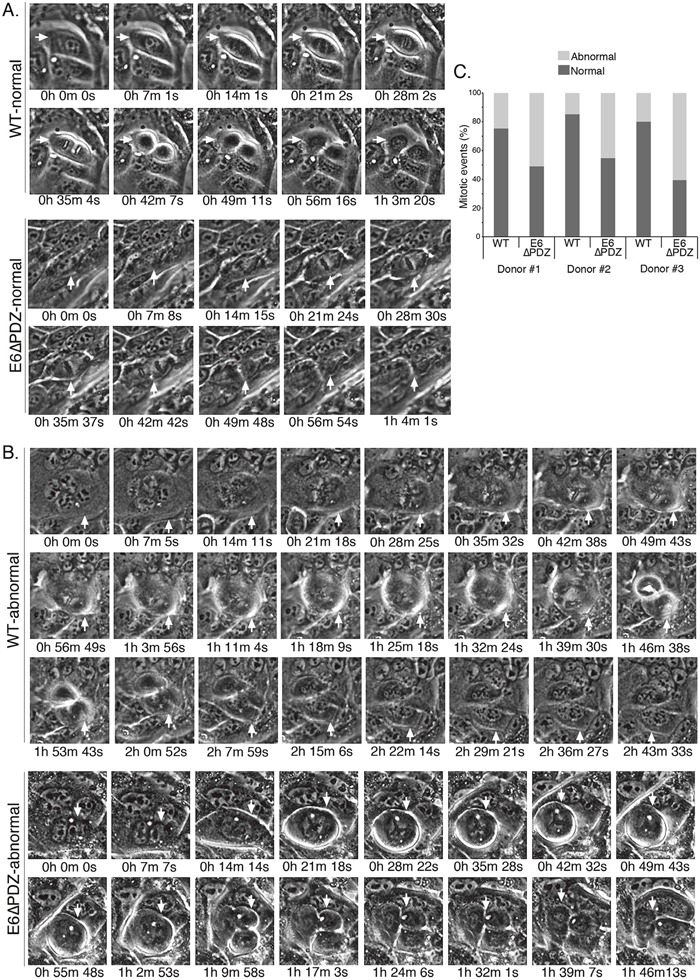
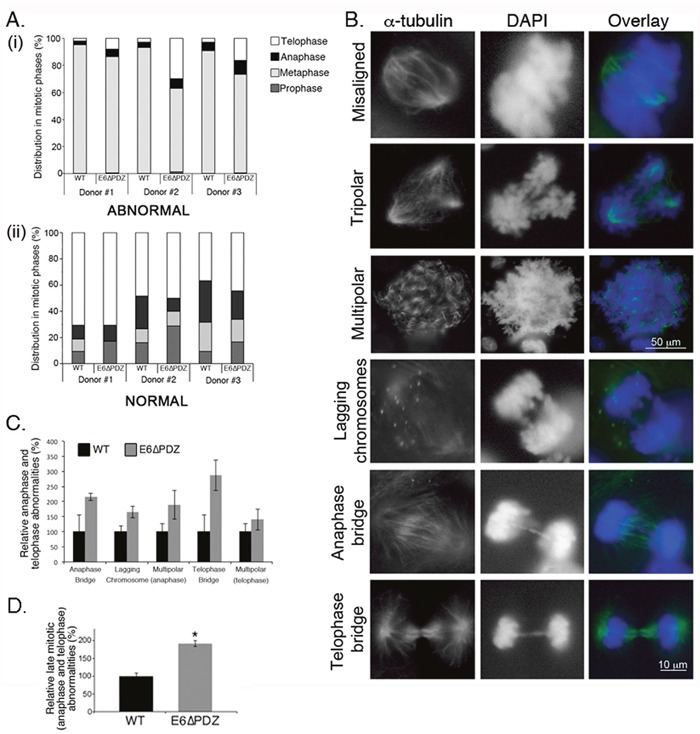
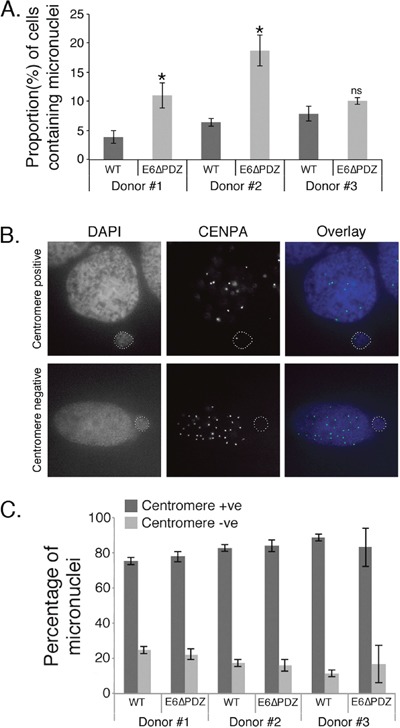
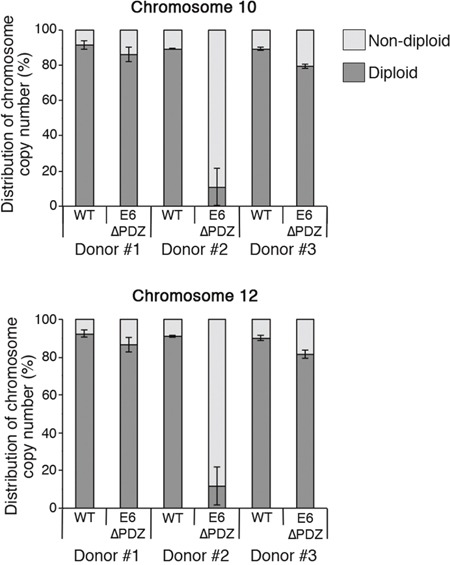
The function of a conserved PDS95/DLG1/ZO1 (PDZ) binding motif (E6 PBM) at the C-termini of E6 oncoproteins of high-risk human papillomavirus (HPV) types contributes to the development of HPV-associated malignancies. Here, using a primary human keratinocyte-based model of the high-risk HPV18 life cycle, we identify a novel link between the E6 PBM and mitotic stability. In cultures containing a mutant genome in which the E6 PBM was deleted there was an increase in the frequency of abnormal mitoses, including multinucleation, compared to cells harboring the wild type HPV18 genome. The loss of the E6 PBM was associated with a significant increase in the frequency of mitotic spindle defects associated with anaphase and telophase. Furthermore, cells carrying this mutant genome had increased chromosome segregation defects and they also exhibited greater levels of genomic instability, as shown by an elevated level of centromere-positive micronuclei. In wild type HPV18 genome-containing organotypic cultures, the majority of mitotic cells reside in the suprabasal layers, in keeping with the hyperplastic morphology of the structures. However, in mutant genome-containing structures a greater proportion of mitotic cells were retained in the basal layer, which were often of undefined polarity, thus correlating with their reduced thickness. We conclude that the ability of E6 to target cellular PDZ proteins plays a critical role in maintaining mitotic stability of HPV infected cells, ensuring stable episome persistence and vegetative amplification.
高危型人乳头瘤病毒(HPV)E6癌蛋白C末端保守的PDS95/DLG1/ZO1(PDZ)结合基序(E6 PBM)的功能,在HPV相关恶性肿瘤的发生发展中发挥作用。在此,我们利用基于原代人角质形成细胞的高危型HPV18生命周期模型,确定了E6 PBM与有丝分裂稳定性之间的新联系。在含有缺失E6 PBM的突变基因组的培养物中,与携带野生型HPV18基因组的细胞相比,包括多核化在内的异常有丝分裂频率增加。E6 PBM的缺失与后期和末期相关的有丝分裂纺锤体缺陷频率显著增加有关。此外,携带这种突变基因组的细胞染色体分离缺陷增加,并且如着丝粒阳性微核水平升高所示,它们还表现出更高水平的基因组不稳定。在含有野生型HPV18基因组的器官样培养物中,大多数有丝分裂细胞位于基底上层,这与结构的增生形态一致。然而,在含有突变基因组的结构中,更大比例的有丝分裂细胞保留在基底层,这些细胞的极性通常不明确,因此与其厚度减小相关。我们得出结论,E6靶向细胞PDZ蛋白的能力在维持HPV感染细胞的有丝分裂稳定性、确保游离体的稳定持续存在和营养扩增方面起着关键作用。