Jones Kelly K, Zenk Shannon N, Tarlov Elizabeth, Powell Lisa M, Matthews Stephen A, Horoi Irina
Department of Health Systems Science, College of Nursing, University of Illinois at Chicago, 845 S. Damen Ave, Chicago, IL, 60612, USA.
Center of Innovation for Complex Chronic Healthcare, Edward Hines, Jr. VA Hospital, Hines, IL, 60141, USA.
BMC Res Notes. 2017 Jan 7;10(1):35. doi: 10.1186/s13104-016-2355-1.
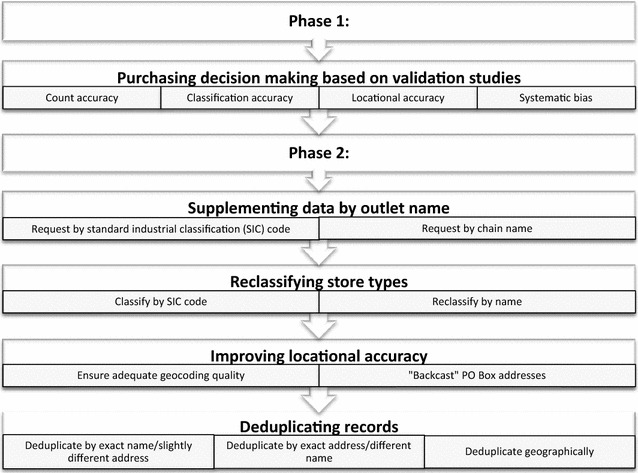
Food environment characterization in health studies often requires data on the location of food stores and restaurants. While commercial business lists are commonly used as data sources for such studies, current literature provides little guidance on how to use validation study results to make decisions on which commercial business list to use and how to maximize the accuracy of those lists. Using data from a retrospective cohort study [Weight And Veterans' Environments Study (WAVES)], we (a) explain how validity and bias information from existing validation studies (count accuracy, classification accuracy, locational accuracy, as well as potential bias by neighborhood racial/ethnic composition, economic characteristics, and urbanicity) were used to determine which commercial business listing to purchase for retail food outlet data and (b) describe the methods used to maximize the quality of the data and results of this approach.
We developed data improvement methods based on existing validation studies. These methods included purchasing records from commercial business lists (InfoUSA and Dun and Bradstreet) based on store/restaurant names as well as standard industrial classification (SIC) codes, reclassifying records by store type, improving geographic accuracy of records, and deduplicating records. We examined the impact of these procedures on food outlet counts in US census tracts.
After cleaning and deduplicating, our strategy resulted in a 17.5% reduction in the count of food stores that were valid from those purchased from InfoUSA and 5.6% reduction in valid counts of restaurants purchased from Dun and Bradstreet. Locational accuracy was improved for 7.5% of records by applying street addresses of subsequent years to records with post-office (PO) box addresses. In total, up to 83% of US census tracts annually experienced a change (either positive or negative) in the count of retail food outlets between the initial purchase and the final dataset.
Our study provides a step-by-step approach to purchase and process business list data obtained from commercial vendors. The approach can be followed by studies of any size, including those with datasets too large to process each record by hand and will promote consistency in characterization of the retail food environment across studies.
健康研究中的食物环境特征描述通常需要食品商店和餐馆的位置数据。虽然商业企业名录通常被用作此类研究的数据来源,但目前的文献几乎没有提供关于如何利用验证研究结果来决定使用哪份商业企业名录以及如何最大限度提高这些名录准确性的指导。利用一项回顾性队列研究[体重与退伍军人环境研究(WAVES)]的数据,我们(a)解释了如何利用现有验证研究中的有效性和偏差信息(计数准确性、分类准确性、位置准确性,以及按邻里种族/族裔构成、经济特征和城市化程度划分的潜在偏差)来确定购买哪份商业企业名录以获取零售食品店数据,以及(b)描述了用于最大限度提高数据质量和此方法结果的方法。
我们基于现有验证研究开发了数据改进方法。这些方法包括根据商店/餐馆名称以及标准产业分类(SIC)代码从商业企业名录(InfoUSA和邓白氏公司)购买记录,按商店类型重新分类记录,提高记录的地理准确性,以及去除重复记录。我们研究了这些程序对美国人口普查区食品店计数的影响。
经过清理和去重后,我们的策略使从InfoUSA购买的有效食品店计数减少了17.5%,从邓白氏公司购买的有效餐馆计数减少了5.6%。通过将后续年份的街道地址应用于有邮政信箱地址的记录,7.5%的记录的位置准确性得到了提高。总体而言,每年多达83%的美国人口普查区在最初购买和最终数据集之间零售食品店的计数出现了变化(无论是增加还是减少)。
我们的研究提供了一种逐步的方法来购买和处理从商业供应商获得的企业名录数据。任何规模的研究都可以遵循这种方法,包括那些数据集太大无法手工处理每条记录的研究,并且将促进不同研究中零售食品环境特征描述的一致性。