Shu Danhua, Xu Feifei, Su Zhen, Zhang Ji, Chen Chaosheng, Zhang Jianna, Ding Xiaokai, Lv Yinqiu, Lin Haixia, Huang Peipei
Department of Nephrology, the First Affiliated Hospital of Wenzhou Medical University, Wenzhou, China.
BMC Nephrol. 2017 Jan 7;18(1):11. doi: 10.1186/s12882-016-0429-x.
There were few related studies aiming to severe IgA nephropathy (IgAN) which could progress rapidly to end stage renal disease (ESRD) within ten years. To find valuable clinical or pathological factors and promising precautions is essential.
A single center case-control study was performed. Fifty ESRD patients with the primary cause of IgAN and a short renal survival time of less than ten years after diagnose were enrolled in the case group. One hundred IgAN patients with a renal survival time of more than ten years were enrolled in the control group. IgA Oxford classification scores, clinical data at baseline and during the follow-up were collected. Multivariate logistic regression was used to investigate factors associated with the development of ESRD.
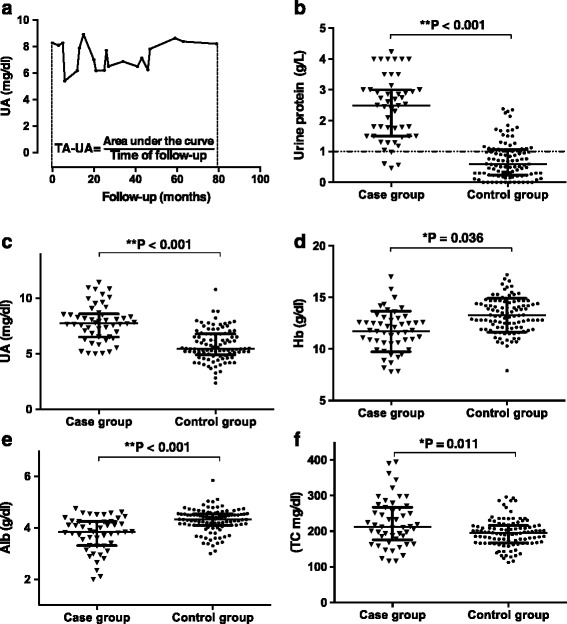
There were significant differences in baseline clinical data between these two groups, as well as the constituent ratio of Oxford MEST-score. Distinct differences were observed in time-average uric acid(TA-UA), time-average hemoglobin(TA-Hb), time-average albumin(TA-Alb), time-average total cholesterol(TA-TC) and time-average urinary protein(TA-P) during the follow-up. In multivariate logistic models, IgA Oxford score M1(OR = 5.10, P = 0.018) and eGFR(OR = 0.97, P = 0.039) at biopsy, TA-UA (OR = 2.06, P = 0.026) and TA-Hb (OR = 0.53, P = 0.022) during the follow-up were identified independent factors for developing ESRD.
IgAN patients with pathological assessment of M1, low baseline eGFR, TA-Hb and high TA-UA were more likely to progress to ESRD, and should be paid more attention. Appropriate regulations of UA, Hb and urine protein after diagnose may be a promising treatment.
针对严重IgA肾病(IgAN)的相关研究较少,这类疾病可在十年内迅速进展至终末期肾病(ESRD)。寻找有价值的临床或病理因素以及有前景的预防措施至关重要。
进行了一项单中心病例对照研究。病例组纳入了50例原发性IgAN导致的ESRD患者,其诊断后肾脏存活时间短于10年。对照组纳入了100例肾脏存活时间超过10年的IgAN患者。收集IgA牛津分类评分、基线及随访期间的临床数据。采用多因素logistic回归分析与ESRD发生相关的因素。
两组间基线临床数据以及牛津MEST评分的构成比存在显著差异。随访期间,时间平均尿酸(TA-UA)、时间平均血红蛋白(TA-Hb)、时间平均白蛋白(TA-Alb)、时间平均总胆固醇(TA-TC)和时间平均尿蛋白(TA-P)存在明显差异。在多因素logistic模型中,活检时的IgA牛津评分M1(OR = 5.10,P = 0.018)和估算肾小球滤过率(eGFR,OR = 0.97,P = 0.039),随访期间的TA-UA(OR = 2.06,P = 0.026)和TA-Hb(OR = 0.53,P = 0.022)被确定为ESRD发生的独立因素。
病理评估为M1、基线eGFR低、TA-Hb低以及TA-UA高的IgAN患者更易进展为ESRD,应予以更多关注。诊断后适当调节尿酸、血红蛋白和尿蛋白可能是一种有前景的治疗方法。