Klingner Carsten M, Brodoehl Stefan, Huonker Ralph, Witte Otto W
Hans Berger Department of Neurology, Jena University Hospital-Friedrich Schiller University JenaJena, Germany; Biomagnetic Center, Jena University Hospital-Friedrich Schiller University JenaJena, Germany.
Hans Berger Department of Neurology, Jena University Hospital-Friedrich Schiller University Jena Jena, Germany.
Front Syst Neurosci. 2016 Dec 20;10:103. doi: 10.3389/fnsys.2016.00103. eCollection 2016.
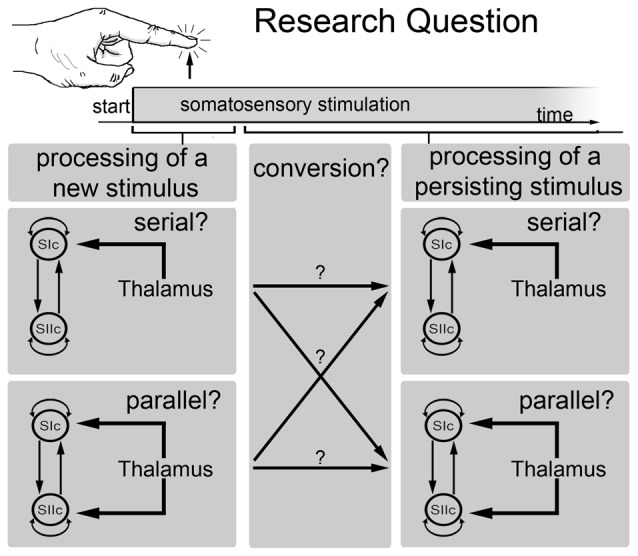
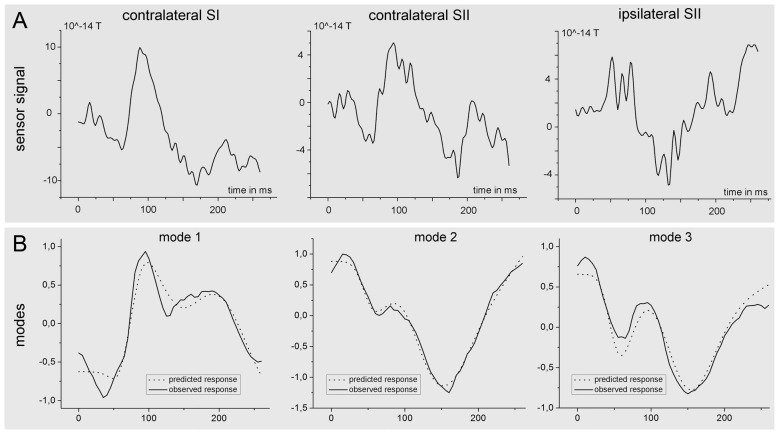
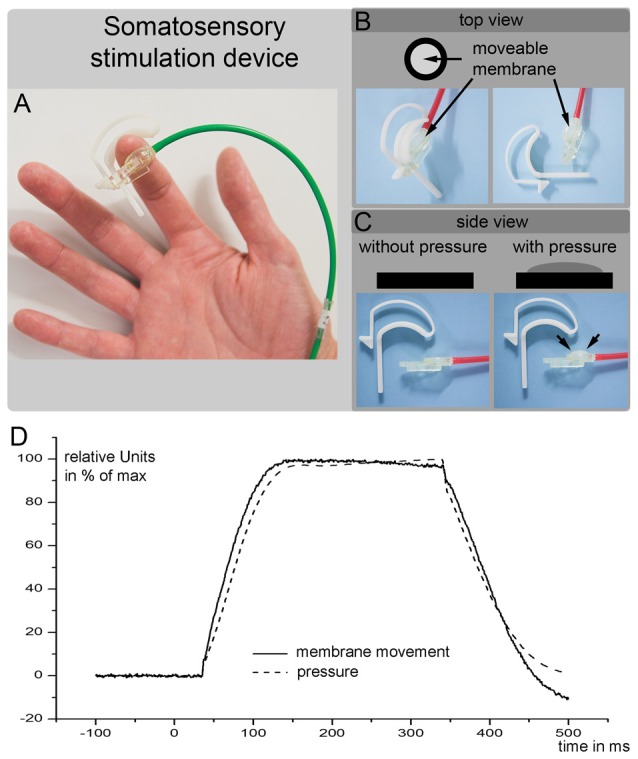
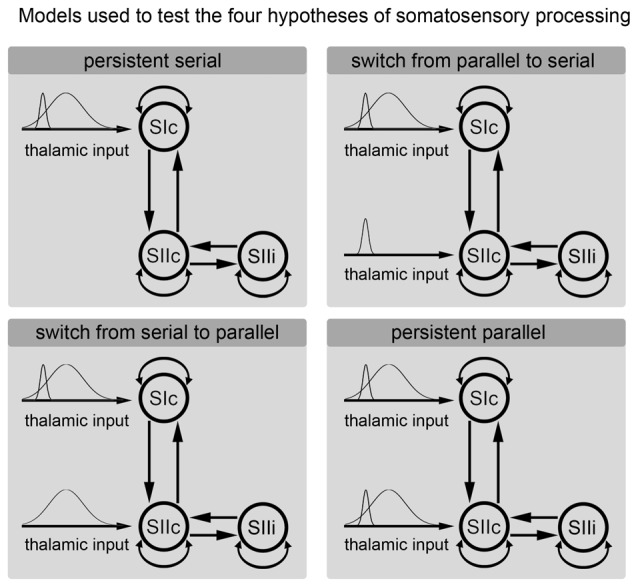
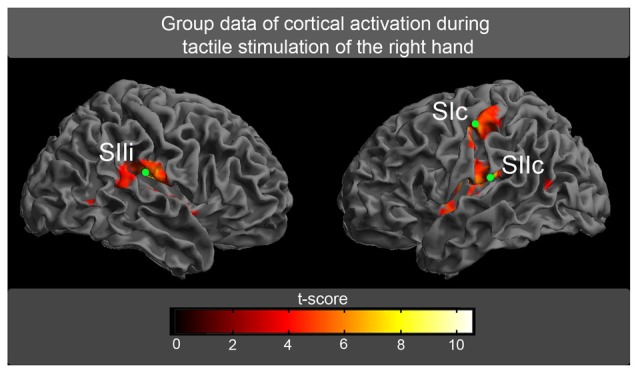
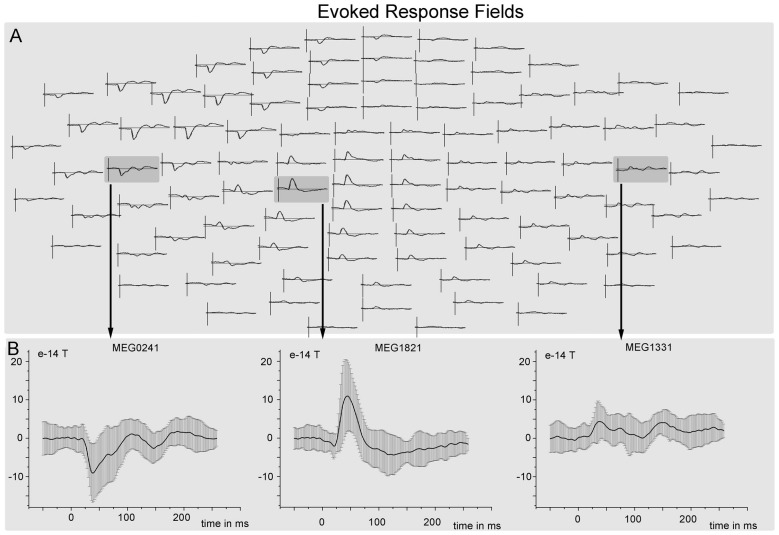
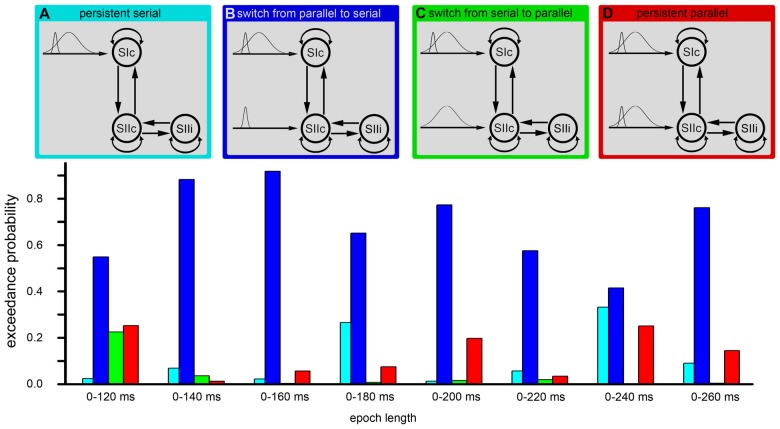
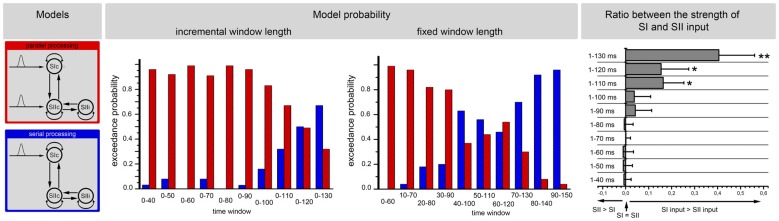
The question regarding whether somatosensory inputs are processed in parallel or in series has not been clearly answered. Several studies that have applied dynamic causal modeling (DCM) to fMRI data have arrived at seemingly divergent conclusions. However, these divergent results could be explained by the hypothesis that the processing route of somatosensory information changes with time. Specifically, we suggest that somatosensory stimuli are processed in parallel only during the early stage, whereas the processing is later dominated by serial processing. This hypothesis was revisited in the present study based on fMRI analyses of tactile stimuli and the application of DCM to magnetoencephalographic (MEG) data collected during sustained (260 ms) tactile stimulation. Bayesian model comparisons were used to infer the processing stream. We demonstrated that the favored processing stream changes over time. We found that the neural activity elicited in the first 100 ms following somatosensory stimuli is best explained by models that support a parallel processing route, whereas a serial processing route is subsequently favored. These results suggest that the secondary somatosensory area (SII) receives information regarding a new stimulus in parallel with the primary somatosensory area (SI), whereas later processing in the SII is dominated by the preprocessed input from the SI.
关于体感输入是并行处理还是串行处理的问题尚未得到明确解答。几项将动态因果模型(DCM)应用于功能磁共振成像(fMRI)数据的研究得出了看似不同的结论。然而,这些不同的结果可以用体感信息处理路径随时间变化的假说来解释。具体而言,我们认为体感刺激仅在早期阶段进行并行处理,而后期处理则以串行处理为主导。本研究基于对触觉刺激的功能磁共振成像分析以及将动态因果模型应用于在持续(260毫秒)触觉刺激期间收集的脑磁图(MEG)数据,对这一假说进行了重新审视。采用贝叶斯模型比较来推断处理流。我们证明了偏好的处理流会随时间变化。我们发现,体感刺激后最初100毫秒内引发的神经活动,用支持并行处理路径的模型来解释最为合适,而随后则更倾向于串行处理路径。这些结果表明,次级体感区(SII)与初级体感区(SI)并行接收有关新刺激的信息,而SII中的后期处理则由来自SI的预处理输入主导。