Mathew Rajamma, Huang Jing, Wu Joseph M, Fallon John T, Gewitz Michael H
Rajamma Mathew, Department of Physiology, New York Medical College, Valhalla, NY 10595, United States.
World J Cardiol. 2016 Dec 26;8(12):703-718. doi: 10.4330/wjc.v8.i12.703.
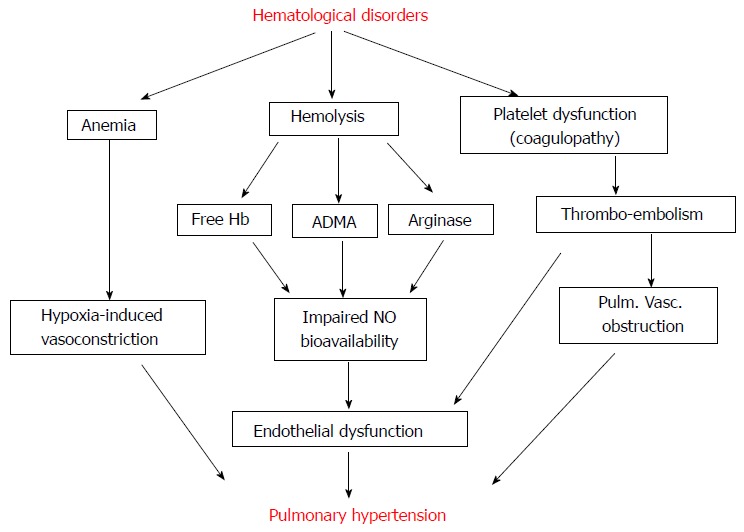
Pulmonary hypertension (PH), a serious disorder with a high morbidity and mortality rate, is known to occur in a number of unrelated systemic diseases. Several hematological disorders such as sickle cell disease, thalassemia and myeloproliferative diseases develop PH which worsens the prognosis. Associated oxidant injury and vascular inflammation cause endothelial damage and dysfunction. Pulmonary vascular endothelial damage/dysfunction is an early event in PH resulting in the loss of vascular reactivity, activation of proliferative and antiapoptotic pathways leading to vascular remodeling, elevated pulmonary artery pressure, right ventricular hypertrophy and premature death. Hemolysis observed in hematological disorders leads to free hemoglobin which rapidly scavenges nitric oxide (NO), limiting its bioavailability, and leading to endothelial dysfunction. In addition, hemolysis releases arginase into the circulation which converts L-arginine to ornithine, thus bypassing NO production. Furthermore, treatments for hematological disorders such as immunosuppressive therapy, splenectomy, bone marrow transplantation, and radiation have been shown to contribute to the development of PH. Recent studies have shown deregulated iron homeostasis in patients with cardiopulmonary diseases including pulmonary arterial hypertension (PAH). Several studies have reported low iron levels in patients with idiopathic PAH, and iron deficiency is an important risk factor. This article reviews PH associated with hematological disorders and its mechanism; and iron homeostasis and its relevance to PH.
肺动脉高压(PH)是一种发病率和死亡率都很高的严重疾病,已知它会在多种不相关的全身性疾病中出现。一些血液系统疾病,如镰状细胞病、地中海贫血和骨髓增殖性疾病,会引发肺动脉高压,从而使预后恶化。相关的氧化损伤和血管炎症会导致内皮损伤和功能障碍。肺血管内皮损伤/功能障碍是肺动脉高压的早期事件,会导致血管反应性丧失,激活增殖和抗凋亡途径,进而导致血管重塑、肺动脉压力升高、右心室肥厚和过早死亡。血液系统疾病中观察到的溶血会产生游离血红蛋白,它会迅速清除一氧化氮(NO),限制其生物利用度,从而导致内皮功能障碍。此外,溶血会将精氨酸酶释放到循环中,将L-精氨酸转化为鸟氨酸,从而绕过NO的产生。此外,血液系统疾病的治疗方法,如免疫抑制治疗、脾切除术、骨髓移植和放疗,已被证明会促进肺动脉高压的发展。最近的研究表明,包括肺动脉高压(PAH)在内的心肺疾病患者存在铁稳态失调。几项研究报告称,特发性PAH患者的铁水平较低,缺铁是一个重要的危险因素。本文综述了与血液系统疾病相关的肺动脉高压及其机制;以及铁稳态及其与肺动脉高压的相关性。