Deckers Anne, Muris Peter, Roelofs Jeffrey
Virenze RIAGG Maastricht and Department of Clinical Psychological Science, Maastricht University, Post box 616, 6200, Maastricht, MD, The Netherlands.
Child Psychiatry Hum Dev. 2017 Oct;48(5):828-839. doi: 10.1007/s10578-016-0707-7.
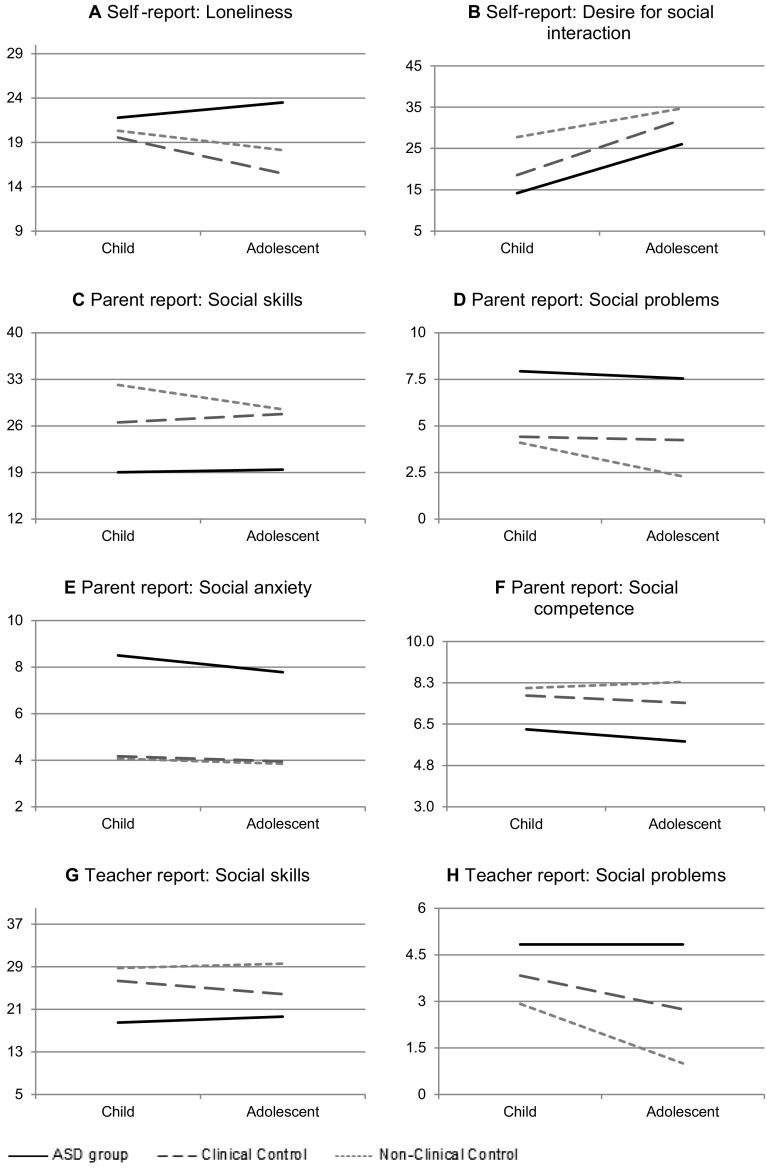
A cross-sectional study was conducted to examine loneliness and its correlates in children (7 to 11 years) and adolescents (12 to 18 years) with autism spectrum disorders (ASD, n = 73) and control groups of clinically referred (ADHD, n = 76) and non-clinical (n = 106) youths. Youths completed questionnaires on loneliness and desire for social interaction, while parents and teachers filled out scales on other aspects of children's social functioning. Results indicated that only at an adolescent age, the ASD group reported higher levels of loneliness than the control groups. Further, the ASD group generally expressed relatively low levels of desire for social interaction, although these youths displayed a similar increase in the wish to belong during adolescence as participants in the control groups. Finally, the ASD group exhibited lower levels of social competence and social skills and higher levels of social problems and social anxiety than the control groups, and in all groups these social variables correlated in a theoretically meaningful with loneliness.
一项横断面研究对患有自闭症谱系障碍(ASD,n = 73)的儿童(7至11岁)和青少年(12至18岁)以及临床转诊的对照组(注意力缺陷多动障碍,ADHD,n = 76)和非临床对照组(n = 106)的青少年进行了调查,以研究孤独感及其相关因素。青少年完成了关于孤独感和社交互动愿望的问卷调查,而家长和教师则填写了关于儿童社会功能其他方面的量表。结果表明,只有在青少年时期,ASD组报告的孤独感水平高于对照组。此外,ASD组总体上表现出相对较低的社交互动愿望水平,尽管这些青少年在青春期表现出与对照组参与者类似的归属感增加。最后,与对照组相比,ASD组的社会能力和社交技能水平较低,社会问题和社交焦虑水平较高,并且在所有组中,这些社会变量与孤独感在理论上具有有意义的相关性。