Boxall Naomi, Bennett Dimitri, Hunger Matthias, Dolin Paul, Thompson Paula L
Real World Strategy and Analytics , Mapi , London , UK.
Takeda Pharmaceutical Company Limited, Global Risk Management and Pharmacoepidemiology , Cambridge, Massachusetts , USA.
BMJ Open Diabetes Res Care. 2016 Dec 12;4(1):e000303. doi: 10.1136/bmjdrc-2016-000303. eCollection 2016.
Investigate potential association between pioglitazone exposure and risk of prostate cancer.
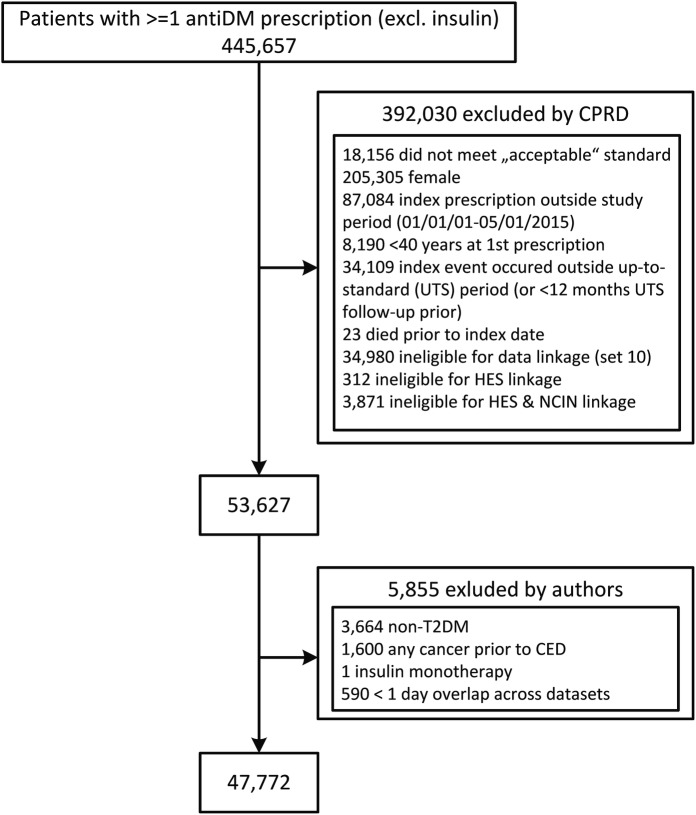
Nested, matched case-control study. UK primary care data (Clinical Practice Research Datalink (CPRD) GOLD) linked to inpatient (Hospital Episode Statistics (HES)) and cancer registry (National Cancer Information Network (NCIN)) data. English men aged ≥40 years diagnosed with type 2 diabetes mellitus, January 1, 2001 to January 5, 2015. Cases, with prostate cancer diagnosis, matched with up to 4 controls by age, cohort entry date and region. ORs for association of exposure to pioglitazone to incident prostate cancer, adjusted for potential confounders.
From a cohort of 47 772 men with 243 923 person-years follow-up, 756 definite cases of prostate cancer were identified. Incidence was 309.9/100 000 person-years (95% CI 288.6 to 332.8). Pioglitazone use was not associated with prostate cancer risk; adjusted OR 0.759, 95% CI 0.502 to 1.148. Analyses showed no difference when possible cases, prostate cancer in CPRD GOLD only, included (adjusted OR 0.726, 95% CI 0.510 to 1.034). No association when adjusted for channeling bias (OR 0.778, 95% CI 0.511 to 1.184) or limited to an index date prior to July 1, 2011 (adjusted OR 0.508, 95% CI 0.294 to 0.879), despite prostate-specific antigen screening occurring more frequently among cases than controls (81.6% of 756 definite cases cf. 24.2% of 2942 controls (p<0.01)). No association with duration of pioglitazone use, increasing pioglitazone dose or increasing time since initiation.
In this real-world, nested matched case-control study, exposure to pioglitazone was not associated with increased risk of prostate cancer.
研究吡格列酮暴露与前列腺癌风险之间的潜在关联。
巢式匹配病例对照研究。将英国初级医疗数据(临床实践研究数据链(CPRD)黄金数据集)与住院患者数据(医院事件统计(HES))及癌症登记数据(国家癌症信息网络(NCIN))相链接。研究对象为2001年1月1日至2015年1月5日期间确诊为2型糖尿病的40岁及以上英国男性。病例为确诊前列腺癌患者,按年龄、队列入组日期和地区与最多4名对照进行匹配。对吡格列酮暴露与前列腺癌发病的关联进行比值比(OR)分析,并对潜在混杂因素进行校正。
在47772名男性队列中进行了243923人年的随访,共识别出756例确诊前列腺癌病例。发病率为309.9/100000人年(95%置信区间288.6至332.8)。使用吡格列酮与前列腺癌风险无关;校正后的OR为0.759,95%置信区间为0.502至1.148。分析显示,纳入可能病例(仅CPRD黄金数据集中的前列腺癌病例)时无差异(校正后的OR为0.726,95%置信区间为0.510至1.034)。校正渠道偏倚后无关联(OR为0.778,95%置信区间为0.511至1.184),或仅限于2011年7月1日之前的索引日期时也无关联(校正后的OR为0.508,95%置信区间为0.294至0.879),尽管病例组中前列腺特异性抗原筛查的频率高于对照组(756例确诊病例中的81.6%对比2942例对照中的24.2%,p<0.01)。与吡格列酮使用时长、剂量增加或开始用药后的时间增加均无关联。
在这项真实世界的巢式匹配病例对照研究中,吡格列酮暴露与前列腺癌风险增加无关。