Kapoor Poonam Malhotra, Magoon Rohan, Rawat Rajinder Singh, Mehta Yatin, Taneja Sameer, Ravi R, Hote Milind P
Department of Cardiac Anaesthesia, Cardio Thoracic Centre, AIIMS, New Delhi, India.
Department of Cardiac Anaesthesiology, Salalah Heart Center, Salalah, Sultanate of Oman.
Ann Card Anaesth. 2017 Jan-Mar;20(1):83-89. doi: 10.4103/0971-9784.197842.
There has been a constant emphasis on developing management strategies to improve the outcome of high-risk cardiac patients undergoing surgical revascularization. The performance of coronary artery bypass surgery on an off-pump coronary artery bypass (OPCAB) avoids the risks associated with extra-corporeal circulation. The preliminary results of goal-directed therapy (GDT) for hemodynamic management of high-risk cardiac surgical patients are encouraging. The present study was conducted to study the outcome benefits with the combined use of GDT with OPCAB as compared to the conventional hemodynamic management.
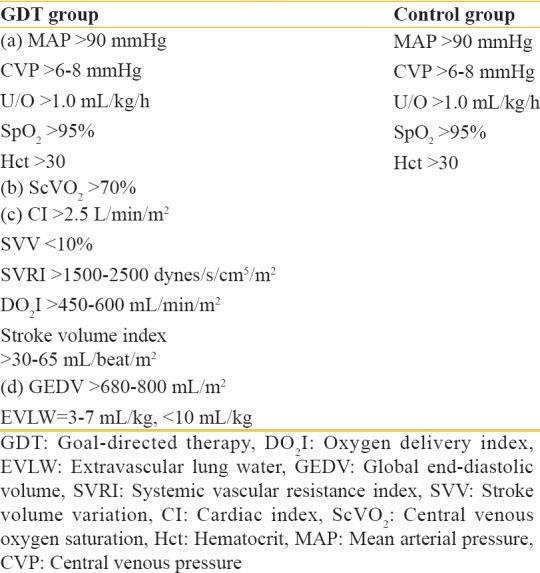
Patients with the European System for Cardiac Operative Risk Evaluation ≥3 scheduled for OPCAB were randomly divided into two groups; the control and GDT groups. The GDT group included the monitoring and optimization of advanced parameters, including cardiac index (CI), systemic vascular resistance index, oxygen delivery index, stroke volume variation; continuous central venous oxygen saturation (ScVO 2 ), global end-diastolic volume, and extravascular lung water (EVLW), using FloTrac™ , PreSep™ , and EV-1000 ® monitoring panels, in addition to the conventional hemodynamic management in the control group. The hemodynamic parameters were continuously monitored for 48 h in Intensive Care Unit (ICU) and corrected according to GDT protocol. A total of 163 patients consented for the study.
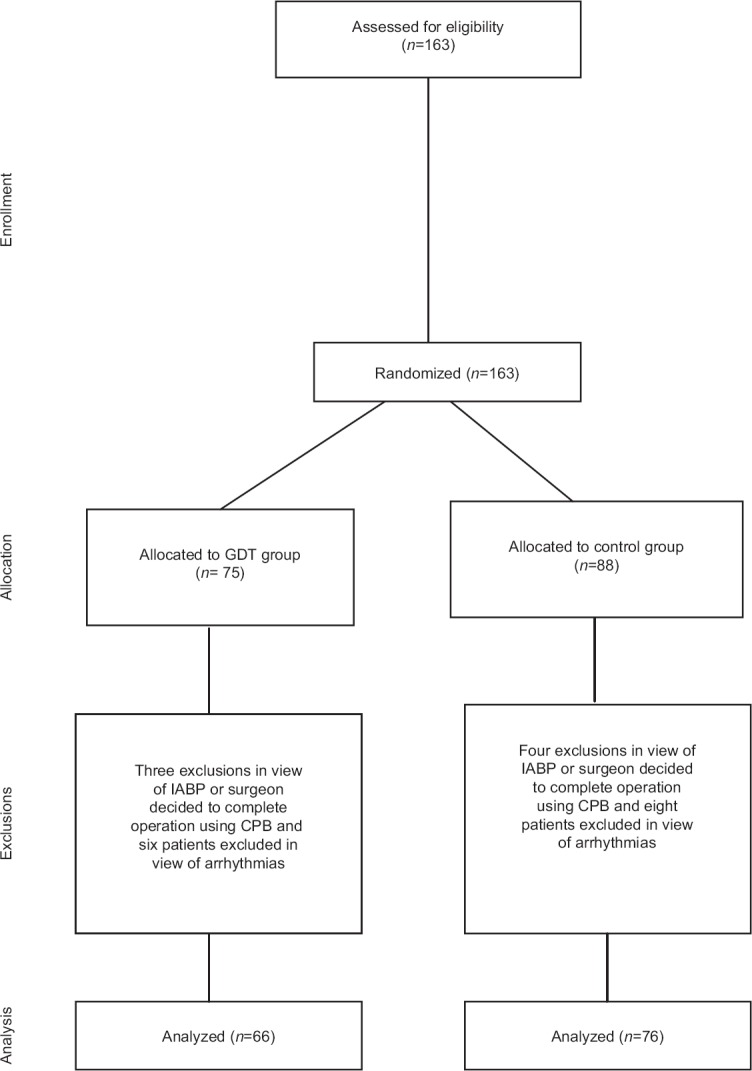
Seventy-five patients were assigned to the GDT group and 88 patients were in the control group. In view of 9 exclusions from the GDT group and 12 exclusions from control group, 66 patients in the GDT group and 76 patients in control group completed the study.
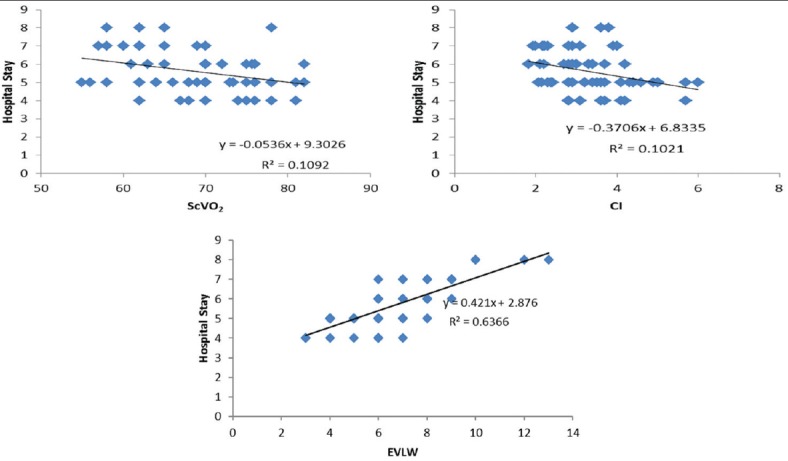
The length of stay in hospital (LOS-H) (7.42 ± 1.48 vs. 5.61 ± 1.11 days, P < 0.001) and ICU stay (4.2 ± 0.82 vs. 2.53 ± 0.56 days, P < 0.001) were significantly lower in the GDT group as compared to control group. The duration of inotropes (3.24 ± 0.73 vs. 2.89 ± 0.68 h, P = 0.005) was also significantly lower in the GDT group. The two groups did not differ in duration of ventilated hours, mortality, and other complications. The parameters such as ScVO 2 , CI, and EVLW had a strong negative and positive correlation with the LOS-H with r values of - 0.331, -0.319, and 0.798, respectively. The study elucidates the role of a goal-directed hemodynamic optimization for improved outcome in high-risk cardiac patients undergoing OPCAB.
一直以来都在不断强调制定管理策略以改善接受外科血运重建的高危心脏病患者的治疗效果。非体外循环冠状动脉搭桥术(OPCAB)进行冠状动脉搭桥手术可避免与体外循环相关的风险。目标导向治疗(GDT)用于高危心脏手术患者血流动力学管理的初步结果令人鼓舞。本研究旨在探讨与传统血流动力学管理相比,GDT联合OPCAB的治疗效果优势。
欧洲心脏手术风险评估系统≥3分且计划行OPCAB的患者被随机分为两组,即对照组和GDT组。GDT组除了采用对照组的传统血流动力学管理外,还使用FloTrac™、PreSep™和EV - 1000®监测面板监测和优化包括心脏指数(CI)、全身血管阻力指数、氧输送指数、每搏量变异等高级参数;持续监测中心静脉血氧饱和度(ScVO₂)、全心舒张末期容积和血管外肺水(EVLW)。在重症监护病房(ICU)对血流动力学参数持续监测48小时,并根据GDT方案进行校正。共有163例患者同意参与本研究。
75例患者被分配至GDT组,88例患者被分配至对照组。鉴于GDT组有9例被排除,对照组有12例被排除,GDT组66例患者和对照组76例患者完成了研究。
与对照组相比,GDT组的住院时间(LOS - H)(7.42±1.48天 vs. 5.61±1.11天,P<0.001)和ICU住院时间(4.2±0.82天 vs. 2.53±0.56天,P<0.001)显著缩短。GDT组的血管活性药物使用时间(3.24±0.73小时 vs. 2.89±0.68小时,P = 0.005)也显著缩短。两组在机械通气时间、死亡率和其他并发症方面无差异。ScVO₂、CI和EVLW等参数与LOS - H呈强负相关和正相关,r值分别为 - 0.331、 - 0.319和0.798。本研究阐明了目标导向的血流动力学优化在改善接受OPCAB的高危心脏病患者治疗效果中的作用。