Yoon Dok Hyun, Sohn Byeong Seok, Oh Sung Yong, Lee Won-Sik, Lee Sang Min, Yang Deok-Hwan, Huh Jooryung, Suh Cheolwon
Department of Oncology, Asan Medical Center, University of Ulsan College of Medicine, Seoul, Korea.
Department of Internal Medicine, Sanggye Paik Hospital, Inje University College of Medicine, Seoul, Korea.
Oncotarget. 2017 Feb 21;8(8):13367-13374. doi: 10.18632/oncotarget.14531.
The appropriate number of chemotherapy cycles for limited stage diffuse large B-cell lymphoma (DLBCL) patients without gross residual lesions after complete resection, has not been specifically questioned. We performed a multicenter, single-arm, phase 2 study to investigate the feasibility of 3 cycles of abbreviated R-CHOP chemotherapy in low-risk patients with completely resected localized CD20+ DLBCL.
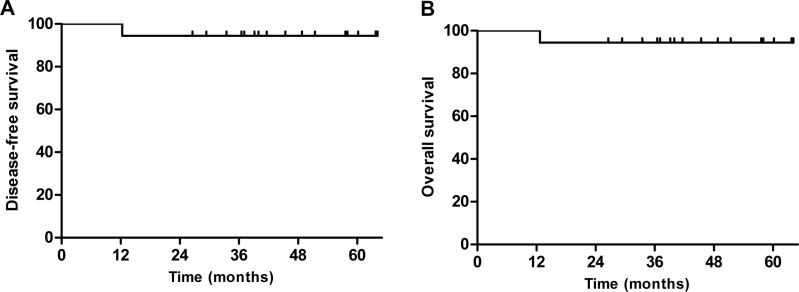
Between December 2010 and May 2013, we recruited 23 patients. One was excluded due to ineligibility, and hence, 22 were included in the final analysis. The primary sites comprised the intestine (n = 15), cervical lymph nodes (n = 4), stomach (n = 1), tonsil (n = 1), and spleen (n = 1). All patients successfully completed the 3 cycles of planned R-CHOP chemotherapy. Over a median follow-up of 39.5 months (95% confidence interval, 29.9-47.1 months), both the estimated 2-year disease-free survival and overall survival rates was 95% confidence interval, 85.9-104.1%. Only one patient with an international prognostic index of 2 experienced relapse and died. The most common grade 3 or 4 toxicity condition included neutropenia (n = 8, 36.4%). Three patients experienced grade 3 febrile neutropenia, but no grade 3 or 4 non-hematologic toxicity was observed.
DLBCL patients without residual lesions after resection were enrolled and R-CHOP chemotherapy was repeated at 3-week-intervals over 3 cycles. The primary endpoint was 2-year disease-free survival.
Three cycles of abbreviated R-CHOP immunochemotherapy is feasible for completely resected low risk localized DLBCL.
对于完全切除后无明显残留病灶的局限期弥漫性大B细胞淋巴瘤(DLBCL)患者,合适的化疗周期数尚未受到特别质疑。我们开展了一项多中心、单臂、2期研究,以探讨在完全切除的局限性CD20+ DLBCL低风险患者中进行3周期简化R-CHOP化疗的可行性。
2010年12月至2013年5月期间,我们招募了23例患者。1例因不符合入选标准被排除,因此,最终分析纳入了22例患者。主要发病部位包括肠道(n = 15)、颈部淋巴结(n = 4)、胃(n = 1)、扁桃体(n = 1)和脾脏(n = 1)。所有患者均成功完成了3周期计划的R-CHOP化疗。在中位随访39.5个月(95%置信区间,29.9 - 47.1个月)期间,估计的2年无病生存率和总生存率的95%置信区间为85.9 - 104.1%。仅1例国际预后指数为2的患者出现复发并死亡。最常见的3级或4级毒性情况为中性粒细胞减少(n = 8,36.4%)。3例患者出现3级发热性中性粒细胞减少,但未观察到3级或4级非血液学毒性。
纳入切除后无残留病灶的DLBCL患者,每3周重复进行1次R-CHOP化疗,共3个周期。主要终点为2年无病生存率。
对于完全切除的低风险局限性DLBCL,3周期简化R-CHOP免疫化疗是可行的。