Bitton Pierre-Paul, Janisse Kevyn, Doucet Stéphanie M
Department of Biological Sciences, University of Windsor, Windsor, Ontario, Canada.
PLoS One. 2017 Jan 11;12(1):e0169810. doi: 10.1371/journal.pone.0169810. eCollection 2017.
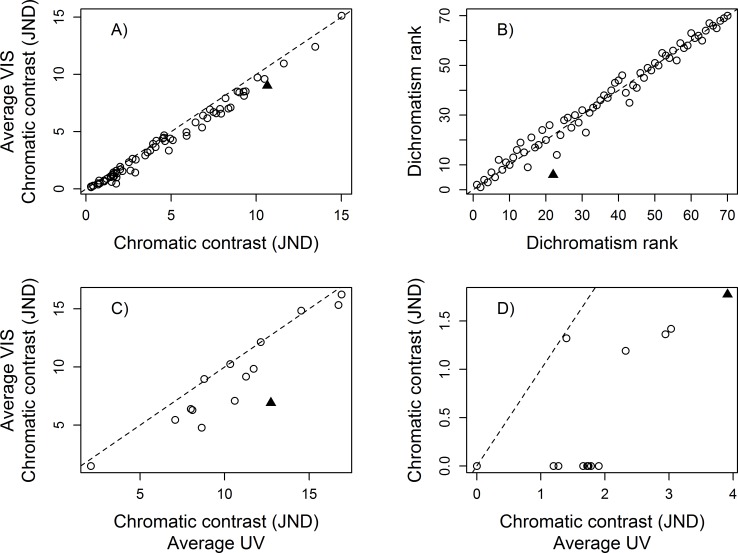
Perceptual models of animal vision have greatly contributed to our understanding of animal-animal and plant-animal communication. The receptor-noise model of color contrasts has been central to this research as it quantifies the difference between two colors for any visual system of interest. However, if the properties of the visual system are unknown, assumptions regarding parameter values must be made, generally with unknown consequences. In this study, we conduct a sensitivity analysis of the receptor-noise model using avian visual system parameters to systematically investigate the influence of variation in light environment, photoreceptor sensitivities, photoreceptor densities, and light transmission properties of the ocular media and the oil droplets. We calculated the chromatic contrast of 15 plumage patches to quantify a dichromatism score for 70 species of Galliformes, a group of birds that display a wide range of sexual dimorphism. We found that the photoreceptor densities and the wavelength of maximum sensitivity of the short-wavelength-sensitive photoreceptor 1 (SWS1) can change dichromatism scores by 50% to 100%. In contrast, the light environment, transmission properties of the oil droplets, transmission properties of the ocular media, and the peak sensitivities of the cone photoreceptors had a smaller impact on the scores. By investigating the effect of varying two or more parameters simultaneously, we further demonstrate that improper parameterization could lead to differences between calculated and actual contrasts of more than 650%. Our findings demonstrate that improper parameterization of tetrachromatic visual models can have very large effects on measures of dichromatism scores, potentially leading to erroneous inferences. We urge more complete characterization of avian retinal properties and recommend that researchers either determine whether their species of interest possess an ultraviolet or near-ultraviolet sensitive SWS1 photoreceptor, or present models for both.
动物视觉的感知模型极大地促进了我们对动物与动物以及植物与动物之间交流的理解。颜色对比度的受体噪声模型一直是这项研究的核心,因为它量化了任何感兴趣的视觉系统中两种颜色之间的差异。然而,如果视觉系统的特性未知,就必须对参数值做出假设,而这些假设的后果通常是未知的。在本研究中,我们使用鸟类视觉系统参数对受体噪声模型进行了敏感性分析,以系统地研究光环境、光感受器敏感性、光感受器密度以及眼介质和油滴的光传输特性变化的影响。我们计算了15个羽毛斑块的色度对比度,以量化70种鸡形目鸟类的二色性得分,鸡形目鸟类表现出广泛的性别二态性。我们发现,光感受器密度和短波长敏感光感受器1(SWS1)的最大敏感波长可使二色性得分变化50%至100%。相比之下,光环境、油滴的传输特性、眼介质的传输特性以及视锥光感受器的峰值敏感性对得分的影响较小。通过同时研究两个或更多参数变化的影响,我们进一步证明,参数设置不当可能导致计算对比度与实际对比度之间的差异超过650%。我们的研究结果表明,四色视觉模型的参数设置不当会对二色性得分的测量产生非常大的影响,可能导致错误的推断。我们敦促更全面地描述鸟类视网膜特性,并建议研究人员要么确定他们感兴趣的物种是否拥有对紫外线或近紫外线敏感的SWS1光感受器,要么同时给出两种模型。