Kemp Jurene E, Ellis Allan G
Botany and Zoology Department, Stellenbosch University, Matieland, South Africa.
PLoS One. 2017 Jan 11;12(1):e0168033. doi: 10.1371/journal.pone.0168033. eCollection 2017.
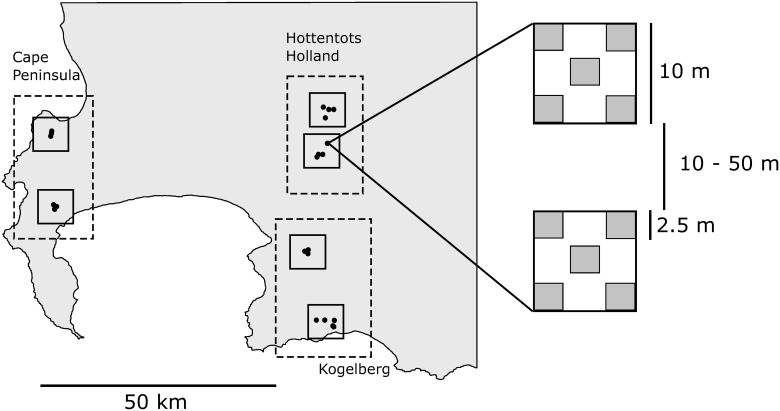
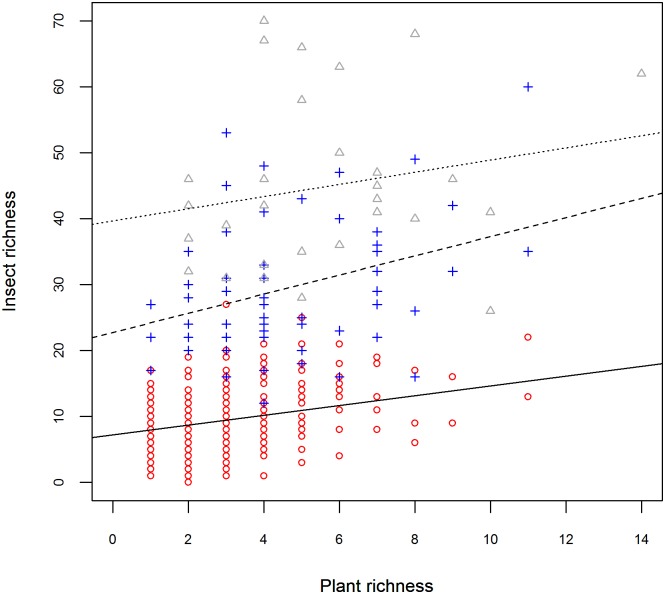
Globally plant species richness is a significant predictor of insect richness. Whether this is the result of insect diversity responding directly to plant diversity, or both groups responding in similar ways to extrinsic factors, has been much debated. Here we assess this relationship in the Cape Floristic Region (CFR), a biodiversity hotspot. The CFR has higher plant diversity than expected from latitude (i.e., abiotic conditions), but very little is known about the diversity of insects residing in this region. We first quantify diversity relationships at multiple spatial scales for one of the dominant plant families in the CFR, the Restionaceae, and its associated insect herbivore community. Plant and insect diversity are significantly positively correlated at the local scales (10-50 m; 0.1-3 km), but not at the regional scales (15-20 km; 50-70 km). The local scale relationship remains significantly positively correlated even when accounting for the influence of extrinsic variables and other vegetation attributes. This suggests that the diversity of local insect assemblages may be more strongly influenced by plant species richness than by abiotic variables. Further, vegetation age and plant structural complexity also influenced insect richness. The ratio of insect species per plant species in the CFR is comparable to other temperate regions around the world, suggesting that the insect diversity of the CFR is high relative to other areas of the globe with similar abiotic conditions, primarily as a result of the unusually high plant diversity in the region.
在全球范围内,植物物种丰富度是昆虫丰富度的一个重要预测指标。这是昆虫多样性直接响应植物多样性的结果,还是这两个群体以相似方式响应外部因素的结果,一直存在很多争议。在这里,我们评估了生物多样性热点地区开普植物区(CFR)的这种关系。CFR的植物多样性高于根据纬度(即非生物条件)预期的水平,但对于该地区昆虫的多样性却知之甚少。我们首先对CFR的一个优势植物科——帚灯草科及其相关的昆虫食草动物群落,在多个空间尺度上的多样性关系进行了量化。植物和昆虫多样性在局部尺度(10 - 50米;0.1 - 3千米)上显著正相关,但在区域尺度(15 - 20千米;50 - 70千米)上并非如此。即使考虑到外部变量和其他植被属性的影响,局部尺度的关系仍然显著正相关。这表明,当地昆虫群落的多样性可能受植物物种丰富度的影响比受非生物变量的影响更大。此外,植被年龄和植物结构复杂性也影响昆虫丰富度。CFR中每植物物种的昆虫物种比率与世界其他温带地区相当,这表明相对于全球其他具有相似非生物条件的地区,CFR的昆虫多样性较高,这主要是由于该地区异常高的植物多样性。