Rocha Daniela Mayumi, Bressan Josefina, Hermsdorff Helen Hermana
RD, MSc. Department of Nutrition and Health, Universidade Federal de Viçosa (UFV), Viçosa (MG), Brazil.
RD, MSc, PhD. Titular Professor, Department of Nutrition and Health, Universidade Federal de Viçosa (UFV), Viçosa (MG), Brazil.
Sao Paulo Med J. 2017 Mar-Apr;135(2):157-168. doi: 10.1590/1516-3180.2016.008607072016. Epub 2017 Jan 5.
: Diet is an important modifiable factor involved in obesity-induced inflammation. We reviewed clinical trials that assessed the effect of consumption of different fatty acids on the expression of inflammation-related genes, such as cytokines, adipokines, chemokines and transcription factors.
: Narrative review study conducted at a research center.
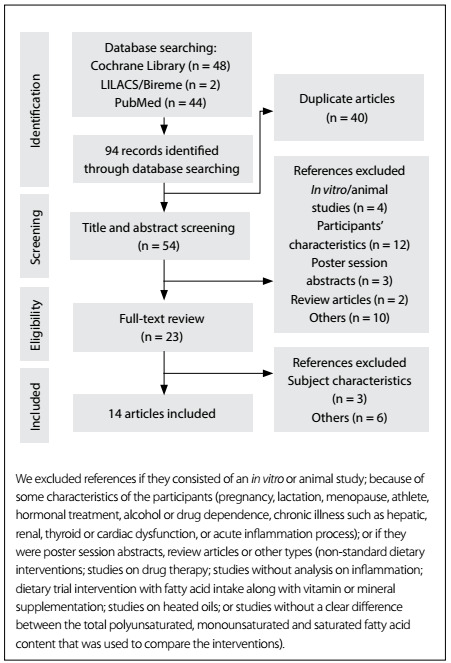
: This was a review on the effect of fat intake on inflammatory gene expression in humans.
: Consumption of saturated fatty acids (SFAs) was related to postprandial upregulation of genes associated with pro-inflammatory pathways in peripheral blood mononuclear cells (PBMCs), in comparison with monounsaturated fatty acid (MUFA) or polyunsaturated fatty acid (PUFA) intake. In addition, acute intake of a high-SFA meal also induced a postprandial pro-inflammatory response for several inflammatory genes in subcutaneous adipose tissue. Both high-MUFA and high-PUFA diets showed anti-inflammatory profiles, or at least a less pronounced pro-inflammatory response than did SFA consumption. However, the results concerning the best substitute for SFAs were divergent because of the large variability in doses of MUFA (20% to 72% of energy intake) and n3 PUFA (0.4 g to 23.7% of energy intake) used in interventions.
: The lipid profile of the diet can modulate the genes relating to postprandial and long-term inflammation in PBMCs and adipose tissue. Identifying the optimal fat profile for inflammatory control may be a promising approach for treating chronic diseases such as obesity.
饮食是肥胖诱导炎症中一个重要的可调节因素。我们回顾了评估不同脂肪酸摄入对炎症相关基因(如细胞因子、脂肪因子、趋化因子和转录因子)表达影响的临床试验。
在一个研究中心进行的叙述性综述研究。
这是一项关于脂肪摄入对人类炎症基因表达影响的综述。
与单不饱和脂肪酸(MUFA)或多不饱和脂肪酸(PUFA)摄入相比,饱和脂肪酸(SFA)的摄入与外周血单核细胞(PBMC)中促炎途径相关基因的餐后上调有关。此外,急性摄入高饱和脂肪酸餐也会在皮下脂肪组织中诱导几种炎症基因的餐后促炎反应。高单不饱和脂肪酸和高多不饱和脂肪酸饮食均显示出抗炎特征,或者至少比饱和脂肪酸摄入引起的促炎反应不那么明显。然而,由于干预中使用的单不饱和脂肪酸(占能量摄入的20%至72%)和n-3多不饱和脂肪酸(占能量摄入的0.4克至23.7%)剂量差异很大,关于饱和脂肪酸最佳替代物的结果存在分歧。
饮食中的脂质谱可调节外周血单核细胞和脂肪组织中与餐后及长期炎症相关的基因。确定用于炎症控制的最佳脂肪谱可能是治疗肥胖等慢性疾病的一种有前景的方法。