Franklin Patricia D, Miozzari Hermes, Christofilopoulos Panayiotis, Hoffmeyer Pierre, Ayers David C, Lübbeke Anne
Department of Orthopedics and Physical Rehabilitation, University of Massachusetts Medical School, 55 Lake Avenue North, Worcester, MA, 01655, USA.
Division of Orthopaedics and Trauma Surgery, Geneva University Hospitals and Geneva University, Geneva, Switzerland.
BMC Musculoskelet Disord. 2017 Jan 11;18(1):14. doi: 10.1186/s12891-016-1372-5.
Outcomes after total knee (TKA) and hip (THA) arthroplasty are often generalized internationally. Patient-dependent factors and preoperative symptom levels may differ across countries. We compared preoperative patient and clinical characteristics from two large cohorts, one in Switzerland, the other in the US.
Patient characteristics were collected prospectively on all elective primary TKAs and THAs performed at a large Swiss hospital and in a US national sample. Data included age, sex, education level, BMI, diagnosis, medical co-morbidities, PROMs (WOMAC pain/function), global health (SF-12).
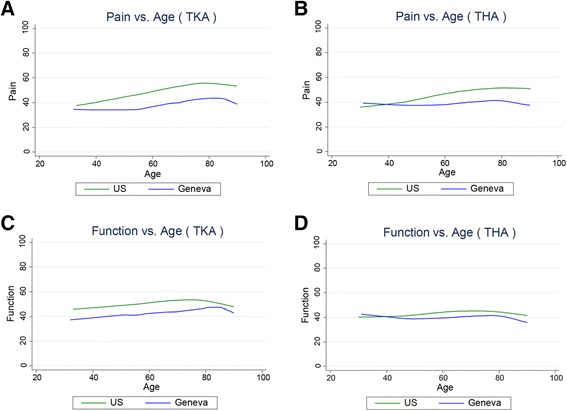
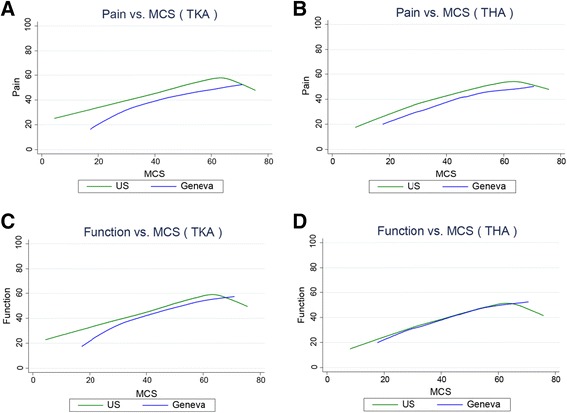
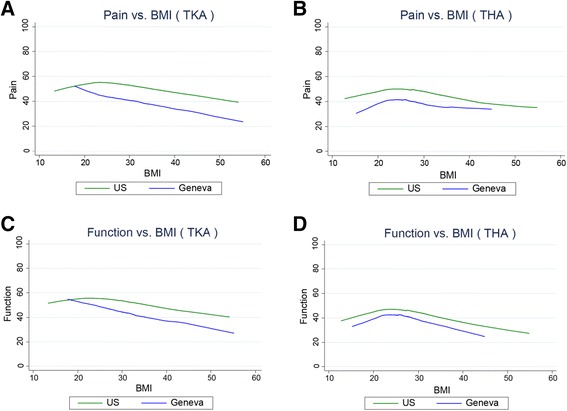
Six thousand six hundred eighty primary TKAs (US) and 823 TKAs (Swiss) were evaluated. US vs. Switzerland TKA patients were younger (mean age 67 vs. 72 years.), more obese (BMI ≥30 55% vs. 43%), had higher levels of education, more cardiac disease. Swiss patients had lower preoperative WOMAC pain scores (41 vs. 52) but pre-operative physical disability were comparable. 4,647 primary THAs (US) and 1,023 THAs (Swiss) were evaluated. US vs. Switzerland patients were younger (65 vs. 68 years.), more obese (BMI ≥30: 38% vs. 24%), had higher levels of education, more diabetes. Swiss patients had lower preoperative WOMAC pain scores (40 vs. 48 points). Physical disability was reported comparable, but Swiss patients indicated lower mental health scores.
We found substantial differences between US and Swiss cohorts in pre-operative patient characteristics and pain levels, which has potentially important implications for cross-cultural comparison of TKA/THA outcomes. Reports from national registries lack detailed patient information while these data suggest the need for adequate risk adjustment of patient factors.
全膝关节置换术(TKA)和全髋关节置换术(THA)的术后结果通常在国际上进行归纳总结。不同国家的患者相关因素和术前症状水平可能存在差异。我们比较了来自两个大型队列的术前患者和临床特征,一个队列来自瑞士,另一个来自美国。
前瞻性收集了一家大型瑞士医院和美国全国样本中所有择期初次TKA和THA患者的特征。数据包括年龄、性别、教育水平、体重指数(BMI)、诊断、合并症、患者报告结局量表(PROMs,如WOMAC疼痛/功能量表)、整体健康状况(SF - 12量表)。
评估了6680例美国初次TKA患者和823例瑞士初次TKA患者。与瑞士TKA患者相比,美国患者更年轻(平均年龄67岁对72岁),更肥胖(BMI≥30:55%对43%),教育水平更高,心脏病患者更多。瑞士患者术前WOMAC疼痛评分更低(41对52),但术前身体残疾情况相当。评估了4647例美国初次THA患者和1023例瑞士初次THA患者。与瑞士患者相比,美国患者更年轻(65岁对68岁),更肥胖(BMI≥30:38%对24%),教育水平更高,糖尿病患者更多。瑞士患者术前WOMAC疼痛评分更低(40对48分)。报告的身体残疾情况相当,但瑞士患者心理健康评分更低。
我们发现美国和瑞士队列在术前患者特征和疼痛水平方面存在显著差异,这对TKA/THA结果的跨文化比较可能具有重要意义。国家登记处的报告缺乏详细的患者信息,而这些数据表明需要对患者因素进行充分的风险调整。