Burr Paul C, Robinson Aaron C, Larsen Randy T, Newman Robert A, Ellis-Felege Susan N
Department of Biology, University of North Dakota, Grand Forks, ND, United States of America.
North Dakota Game and Fish Department, Dickinson, North Dakota, United States of America.
PLoS One. 2017 Jan 12;12(1):e0170177. doi: 10.1371/journal.pone.0170177. eCollection 2017.
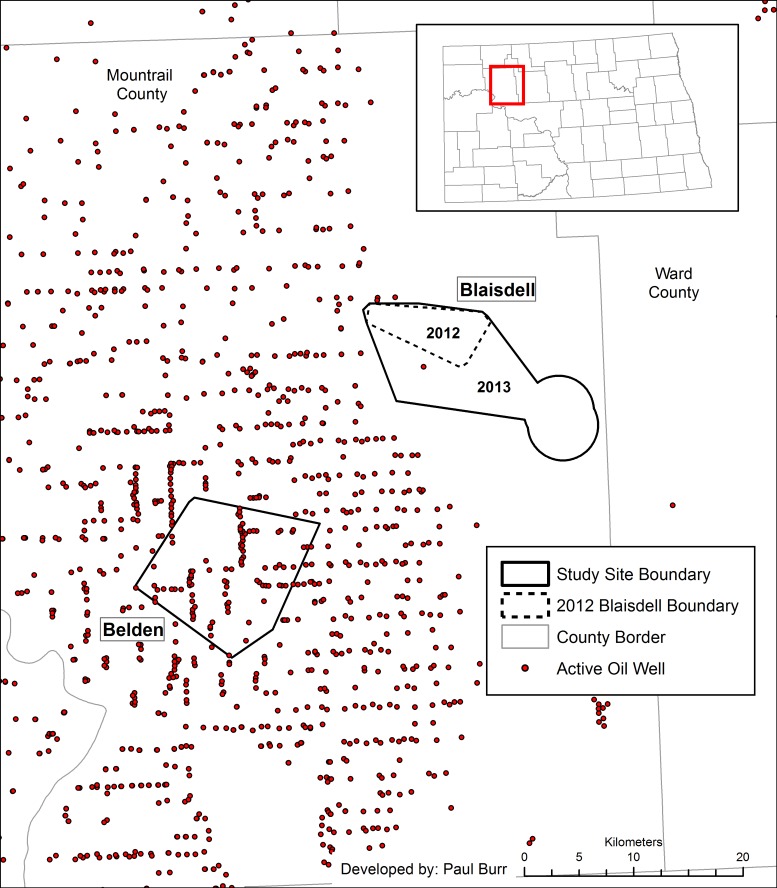
Recent advancements in extraction technologies have resulted in rapid increases of gas and oil development across the United States and specifically in western North Dakota. This expansion of energy development has unknown influences on local wildlife populations and the ecological interactions within and among species. Our objectives for this study were to evaluate nest success and nest predator dynamics of sharp-tailed grouse (Tympanuchus phasianellus) in two study sites that represented areas of high and low energy development intensities in North Dakota. During the summers of 2012 and 2013, we monitored 163 grouse nests using radio telemetry. Of these, 90 nests also were monitored using miniature cameras to accurately determine nest fates and identify nest predators. We simultaneously conducted predator surveys using camera scent stations and occupancy modeling to estimate nest predator occurrence at each site. American badgers (Taxidea taxus) and striped skunks (Mephitis mephitis) were the primary nest predators, accounting for 56.7% of all video recorded nest depredations. Nests in our high intensity gas and oil area were 1.95 times more likely to succeed compared to our minimal intensity area. Camera monitored nests were 2.03 times more likely to succeed than non-camera monitored nests. Occupancy of mammalian nest predators was 6.9 times more likely in our study area of minimal gas and oil intensity compared to the high intensity area. Although only a correlative study, our results suggest energy development may alter the predator community, thereby increasing nest success for sharp-tailed grouse in areas of intense development, while adjacent areas may have increased predator occurrence and reduced nest success. Our study illustrates the potential influences of energy development on the nest predator-prey dynamics of sharp-tailed grouse in western North Dakota and the complexity of evaluating such impacts on wildlife.
近期,提取技术的进步使得美国,尤其是北达科他州西部的天然气和石油开发迅速增加。这种能源开发的扩张对当地野生动物种群以及物种内部和物种之间的生态相互作用产生了未知影响。我们这项研究的目的是评估北达科他州两个代表高能量开发强度和低能量开发强度区域的研究地点的尖尾榛鸡(Tympanuchus phasianellus)的巢成功率和巢捕食者动态。在2012年和2013年的夏季,我们使用无线电遥测技术监测了163个榛鸡巢。其中,90个巢还使用微型相机进行了监测,以准确确定巢的命运并识别巢捕食者。我们同时使用相机气味站进行捕食者调查,并通过占用模型来估计每个地点的巢捕食者出现情况。美洲獾(Taxidea taxus)和条纹臭鼬(Mephitis mephitis)是主要的巢捕食者,占所有视频记录的巢掠夺事件的56.7%。与我们的低强度区域相比,我们高强度天然气和石油区域的巢成功的可能性高1.95倍。相机监测的巢成功的可能性是非相机监测巢的2.03倍。与高强度区域相比,在我们天然气和石油强度最低的研究区域,哺乳动物巢捕食者的占用可能性高6.9倍。尽管这只是一项相关性研究,但我们的结果表明,能源开发可能会改变捕食者群落,从而提高高强度开发区域尖尾榛鸡的巢成功率,而相邻区域可能会增加捕食者的出现并降低巢成功率。我们的研究说明了能源开发对北达科他州西部尖尾榛鸡的巢捕食者 - 猎物动态的潜在影响以及评估此类对野生动物影响的复杂性。