Yoo Sun Hong, Jang Jeong Won, Kwon Jung Hyun, Jung Seung Min, Jang Bohyun, Choi Jong Young
Department of Internal Medicine, Bundang Jesaeng Hospital, Seongnam, Korea.
Department of Internal Medicine, College of Medicine, The Catholic University of Korea, Seoul, Korea.
Clin Mol Hepatol. 2016 Dec;22(4):458-465. doi: 10.3350/cmh.2016.0054. Epub 2016 Dec 25.
BACKGROUND/AIMS: Hepatic damage during transarterial chemoembolization (TACE) is a critical complication in patients with hepatitis B virus (HBV)-related hepatocellular carcinoma (HCC). Apart from its role in preventing HBV reactivation, there is some evidence for the benefits of preemptive antiviral therapy in TACE. This study evaluated the effect of preemptive antiviral therapy on acute hepatic deterioration following TACE.
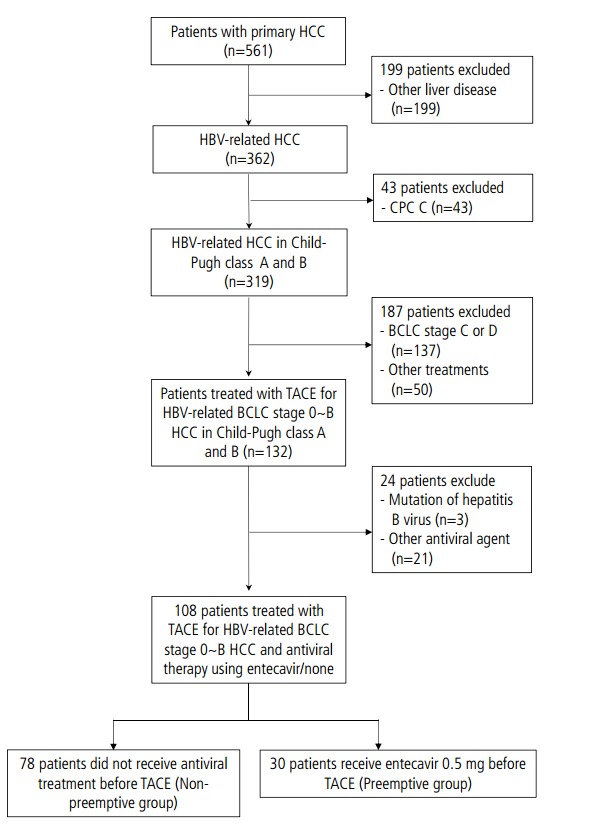
This retrospective observational study included a prospectively collected cohort of 108 patients with HBV-related HCC who underwent TACE between January 2007 and January 2013. Acute hepatic deterioration following TACE was evaluated. Treatment-related hepatic decompensation was defined as newly developed encephalopathy, ascites, variceal bleeding, elevation of the bilirubin level, prolongation of prothrombin time, or elevation of the Child-Pugh score by ≥2 within 2 weeks following TACE. Univariate and multivariate analyses were conducted to identify factors influencing treatment-related decompensation. Preemptive antiviral therapy involves directing prophylaxis only toward high-risk chronic hepatitis B patients in an attempt to prevent the progression of liver disease. We regarded at least 6 months as a significant duration of preemptive antiviral treatment before diagnosis of HCC.
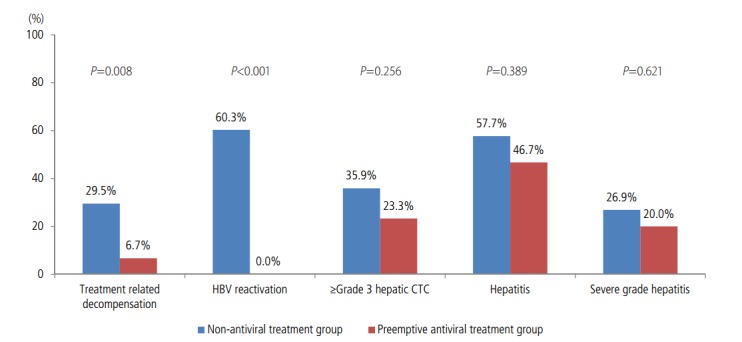
Of the 108 patients, 30 (27.8%) patients received preemptive antiviral therapy. Treatment-related decompensation was observed in 25 (23.1%) patients during the follow-up period. Treatment-related decompensation following TACE was observed more frequently in the nonpreemptive group than in the preemptive group (29.5% vs. 6.7%, =0.008). In the multivariate analysis, higher serum total bilirubin (Hazard ratio [HR] =3.425, =0.013), hypoalbuminemia (HR=3.990, =0.015), and absence of antiviral therapy (HR=7.597, =0.006) were significantly associated with treatment-related hepatic decompensation.
Our findings suggest that preemptive antiviral therapy significantly reduces the risk of acute hepatic deterioration. Preventing hepatic deterioration during TACE by applying such a preemptive approach may facilitate the continuation of anticancer therapy and thus improve long-term outcomes.
背景/目的:经动脉化疗栓塞术(TACE)期间的肝损伤是乙型肝炎病毒(HBV)相关肝细胞癌(HCC)患者的一种关键并发症。除了其在预防HBV再激活中的作用外,有一些证据表明预防性抗病毒治疗在TACE中有益。本研究评估了预防性抗病毒治疗对TACE后急性肝恶化的影响。
这项回顾性观察性研究纳入了一个前瞻性收集的队列,该队列由108例2007年1月至2013年1月期间接受TACE的HBV相关HCC患者组成。评估了TACE后的急性肝恶化情况。治疗相关的肝失代偿定义为TACE后2周内新出现的肝性脑病、腹水、静脉曲张出血、胆红素水平升高、凝血酶原时间延长或Child-Pugh评分升高≥2分。进行单因素和多因素分析以确定影响治疗相关失代偿的因素。预防性抗病毒治疗仅针对高危慢性乙型肝炎患者进行预防,以试图防止肝病进展。我们将诊断为HCC前至少6个月视为预防性抗病毒治疗的显著持续时间。
108例患者中,30例(27.8%)接受了预防性抗病毒治疗。随访期间,25例(23.1%)患者出现治疗相关失代偿。非预防性组TACE后治疗相关失代偿的发生率高于预防性组(29.5%对6.7%,P = 0.008)。多因素分析中,较高的血清总胆红素(风险比[HR]=3.425,P = 0.013)、低白蛋白血症(HR = 3.990,P = 0.015)和未进行抗病毒治疗(HR = 7.597,P = 0.006)与治疗相关的肝失代偿显著相关。
我们的研究结果表明,预防性抗病毒治疗可显著降低急性肝恶化的风险。通过采用这种预防性方法预防TACE期间的肝恶化可能有助于抗癌治疗的持续进行,从而改善长期预后。